 ***Updated, February 26th***
A rare guitar piece from Congo, produced ca. 1950 or so. That’s today’s post, although I must admit it was something of a rescue effort. I’ve had this on my hard drive for many months, and have tried numerous transfers to get it right. I finally decided to let it loose – a hitherto unreleased and potentially unknown piece on an independent African label by a Congolese guitarist (and company), and that’s at least three reasons to get excited, in my opinion. Acoustic guitar music from Africa is worth all of the hype.
So, why was it a “rescue effort”? Well – conditions in Africa for independent labels weren’t exactly the easiest. No one is really to blame – sales in such an emerging market probably weren’t large enough to warrant money to be spent recording multiple takes, or re-pressing problem tracks. That said, I’ve found absolutely amazing records on a number of labels marred by tape speed issues, low-frequency hum, poor microphone placement, and bad pressings – sometimes all at once. This record comes close. The recording quality is poor, the pressing is mediocre to poor, there seems to be some warbly tape issues (though the speed is constant), the record is warped, and the center hole is slightly off. Although I have other guitar records from Africa in my collection, it was precisely because of these issues that I thought it needed to be worked on and heard by an audience – plus, it’s a beautiful song.
After I first posted this track, late February 15th, I received an illuminating e-mail from Tony Klein in Sweden, who had a hunch that the song was not recorded and pressed at the correct speed. He had taken my mix and raised it two semitones. (Speed issues are common with 78s, and I’ve often adjusted the speed in the past.) After that, we heard from Vincent Kenis of Crammed Discs, who informed us about the speed issues on early Opika records (see the comments) and confirmed that the proper speed was indeed a minor third higher than the released record – THREE semitones. So, we have since adjusted the recording to its proper speed. With his permission, I’ve reproduced Tony’s comments below, as I think they are a great example of this site being a conduit for people interested in historical recordings, as well as an example of the many pitfalls and perils one encounters when transferring 78s.
What I reacted to on your disc was that, even before the voice came in, it felt like the music was running through thick syrup, that no one could play that way even if they wanted to, and then the vowel sounds sounded like slowed down tape. The thing with speed accuracy in music is that there are two particular acoustic absolutes:
1) Transients (i.e. the kick-in sounds, perhaps especially in plucked and struck instruments, and in plosive consonants and of course in extraneous plosive “noises”) and
2) Vowel and timbre formants – which are more or less independent of the pitch of the note sung or played. In the case of instruments, this will depend on the particular acoustic qualities of the musical instrument in question.
Any speed inaccuracy will create (more or less subtle) artefactual effects of the Donald Duck or Darth Vader type. Of course, in the ideal situation one would be familiar with the language, but I’ll take the risk in this case to assert my point.
Thanks to Tony and Vincent, we now have a more accurate version of this rare track. Meanwhile…
Opika was a tremendous label, which I’ve written about in the past. Starting in the late 1940s, the owners of Opika, the Greek brothers Benetar, began recording all manner of artists in east Léopoldville (Kinshasa). They were the first to sign Congolese legends Joseph Kabasele, Jhimmy, and Dr. Nico – and according to Gary Stewart’s Rumba on the River, Opika dominated music sales in the region until they ceased production ca. 1957 or so. They simply had a terrific roster of musicians. (Popular music is not all they recorded, however. In fact, Opika and their competitor label Ngoma recorded a substantial amount of raw, more “ethnographic” recordings as well – and virtually none of those recordings have made it to any present-day compilation, or perhaps have even been acknowledged.) I could find nothing on Felix Sunzu, unfortunately. The label states he was “Wahemba” which appears to be an out-of-date cultural name, and does not appear in the present day Ethnologue. Thanks to a reader (thanks Vincent!) we know that the Wahemba are located in North Katanga, close to Lake Tanganyika. Enjoy the music.
Felix Sunzu – Vejika
Technical Notes
Label: Opika
Issue Number: 423
Matrix Number: 1092
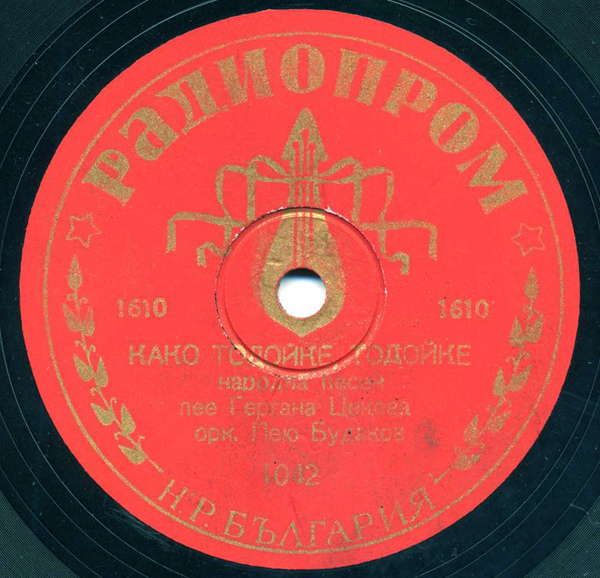 While recording in Bulgaria did begin as early as the first decade of the 20th century, it wasn’t until the 1930s when independent Bulgarian labels began to crop up that recording began in full-swing. To compete with Odeon, Pathé, and HMV, local labels like Orfei, Arfa, Balkan, and London Record were recording at a rapid clip. That said, it wouldn’t surprise me if these records received little distribution beyond cities in Bulgaria – finding folkloric Bulgarian records in anything above hopelessly worn condition is difficult.

 Excavated Shellac