Excavated Shellac Fifth Year Anniversary

Well…hell, it’s been about five years. I’ll have a little more to say on that subject further down the page, but for now, the music – and why not make it special?

I wouldn’t be surprised if a significant number of readers of Excavated Shellac were familiar with the incredible Kenyan recording of “Chemirocha,” which was captured by the South African ethnographer and recordist Hugh Tracey on his 1950 expedition across East Africa. If ever there was an early recording from Africa that could be described as infamous, “Chemirocha” is it. Decades ago, that recording was issued by Tracey on his long out-of-print Music of Africa LP collection (#2: Kenya), then later by John Storm Roberts on his groundbreaking and long out-of-print Nairobi Sound LP, and later, sounding clear as a bell, on the recent SWP Records CD Kenyan Songs and Strings.

“Chemirocha” is deservedly infamous because of it’s backstory. Tracey arrived in Kapkatet, Kenya, inland from the eastern shore of Lake Victoria, to record the music of the Kipsigis. The Kipsigis were then known (and it seems still are) as a pastoral people whose livelihood, on the whole, depended on cattle, tea, and millet. Their language, interestingly, is not a Bantu language, and is part of the Nilotic language group, centered around southern Sudan, Kenya, and Uganda (Luo is also a Nilotic language). Anyway, Tracey discovered on his apparently rainy visit that the Kipsigis had heard numerous recordings by American country music star Jimmie Rodgers – likely purchased and/or brought to Kenya by the British, as Jimmie Rodgers discs were reissued in Britain on the Zonophone label. The Kipsigis, after hearing Rodgers’ music, were, according to Tracey, fascinated by his voice, which they deemed magical, and created a legend around him, calling him Chemirocha: Chemi (Jimmie) Rocha (Rodgers). According to the Kipsigis, Chemirocha, because of his prowess as a singer and player, had to have been half-man, half-antelope. The younger Kipsigis invented songs about him. This well known and beautiful version of “Chemirocha” can be heard, introduced by Hugh Tracey himself, here.

However, that was not the only song about Chemirocha that Tracey recorded. In fact, he recorded THREE Chemirocha songs – and the famous one described above technically was known in Tracey’s archive as “Chemirocha III.” They are all slightly different. This version, far less known and sung by young men, is “Chemirocha II,” and is slower, and more methodical. Tracey wrote in his notes that the other two versions of Chemirocha tunes were in fact songs usually performed by women, but the young men clearly knew them well enough to perform them, despite the embarrassment of their sisters, who were reticent to perform themselves. They are accompanied, as usual, by the 6-string bowl lyre of the Kipsigis known as the chepkongo (also chepkong, chemonge, or sometimes bukandit). In fact, the lyrics to this track are about the chepkongo, and how Chemirocha’s guitar playing sounds so similar to their own instrument. The instrument is used for both entertainment and ceremonial purposes. According to one source, in 1952 chepkongo songs by the Kipsigis were banned by the colonial-era Nandi African District Council.

These songs have continued to marvel, probably due to the fact that the two main elements, the Kipsigis and the American country star, seem incongruous to most. Their music in theory appears incompatible. Yet, despite distance and difference of culture, and with help from the rampant dispersal of the gramophone record, one influenced the other. Of course, it’s far more complicated than that. Quite possibly, the devastating effects of colonialism played a part in bringing those Jimmie Rodgers records to Kenya. As Barry Mazor points out in his book “Meeting Jimmie Rodgers,” some patronizing hyperbole abounds in the writing on these recordings – one source I came across stated that the Kipsigis developed a “Jimmie Rodgers cult.” This appears to be, at best, an extreme exaggeration. Mazor, referencing Tracey’s notes, states that the name “Chemirocha,” from the Kipsigis standpoint, stood for anything new and different that came from outside of their country. Further, according to Tracey’s notes, the singers of “Chemirocha I” ask why their country has been taken over by white men. That, in itself, is a tip-off that we’re not talking about a Jimmie Rodgers personality cult. The Kipsigis were fascinated by the quality of Rodgers’ voice and playing – not his personality, his career as a country music star, or his lyrics, which they could not understand. At any rate, Hugh Tracey loved the region and was impressed by the Kipsigis, and for that we can be thankful.

I have noticed since returning home that whenever members of my party refer to our recording sessions with the Nandi or Kipsigis they do so with a smile of pleasure…I can think of no single area where greater pleasure for any research man is inherent in the countryside. In human talent it has a special contribution to make to African music.  – Hugh Tracey, 1951*

It should be mentioned that many of Tracey’s recordings can be accessed, via cooperation from Tracey’s ILAM (International Library of African Music), on the South African Music Archive Project website. The samples are low-resolution, stereo, and often poorly transferred, with sometimes incomplete or incorrect metadata – but still, it’s a phenomenal wealth of important content for researchers that deserves far more than lip service on a blog.

Charondet Arap Ng’asura – Chemirocha II
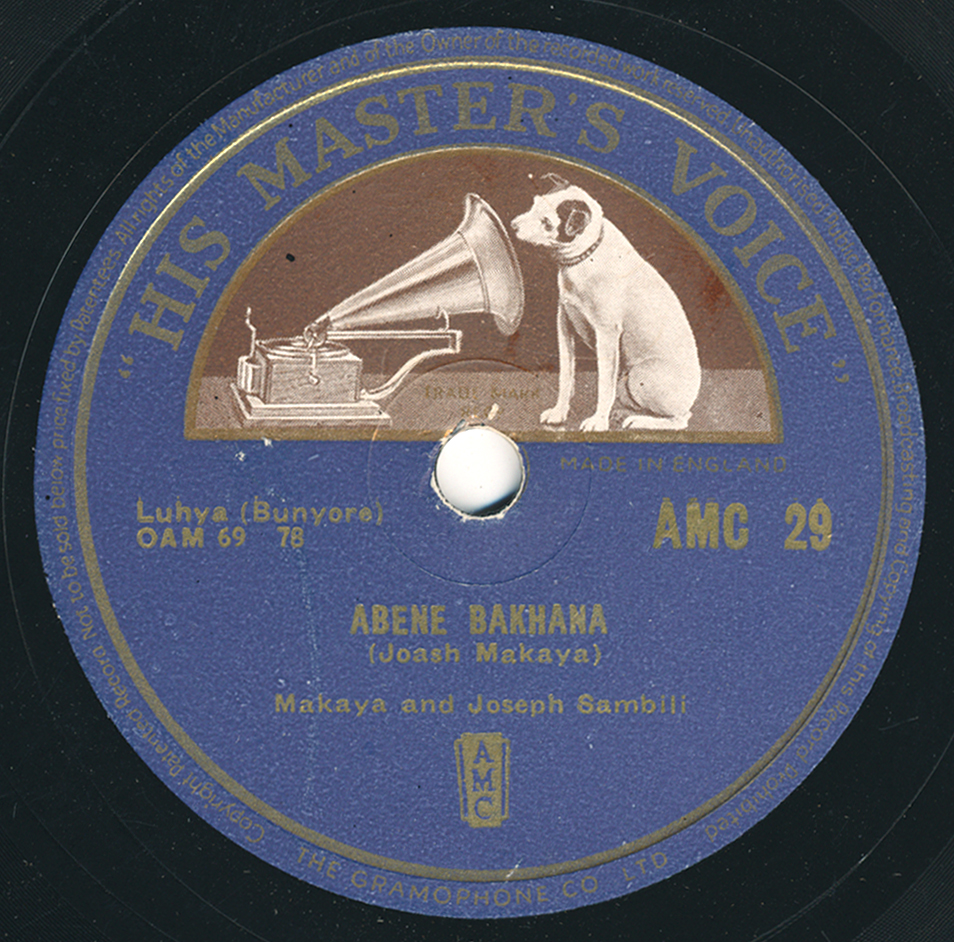
Why not another example of music from Kenya – this time a piece that is otherwise wholly unavailable….and one of my favorite types of music: Kenyan “dry guitar.”

I could find nothing about the duo of Joash Makaya and Joseph Sambili, members of the Luhya people of Western Kenya. Which one of them is providing the guitar, soda bottle, and vocals, is unknown – conceivably it could be just one of them. But Makaya was the writer of this piece, which was likely recorded in Nairobi in the summer of 1956. I discuss this a little in the notes to Opika Pende, but this entire series was funded by the African Mercantile Company (the “AMC” on the label), and organized by a British ex-patriot named Peter Colmore, a gregarious entrepreneur based in Nairobi. Every disc I’ve heard on this rare series has been terrific. Makaya and Sambili take a little while to get into a groove (indicating yet again that there was no time for second takes with most 78 recording), but then glide smoothly into beautiful singing and playing.

Joash Makaya & Joseph Sambili – Abene Bakhana

So…five years of Excavated Shellac. Admittedly, the last few have been erratic in terms of posting, I realize. And who celebrates the anniversary of a website, anyway? I had an entire screed written, filled with complaints, anecdotes, opinions on blogging, opinions on collecting, the meaning of why on Earth I continue to do this…but I erased it. Ultimately, the meaning of why I do this is tied to the experience of listening and meeting people for whom this music (as opposed to merely the records) generates a response. It is entirely personal. Through it, I’ve met some generous people, incredibly knowledgeable contributors, and have had the lucky chance to release work publicly. I’ll keep updating Excavated Shellac so long as it continues to modestly make attempts to bridge a gap between ad-free interactive scholarship and entertainment. While the transfers have, and the writing has, I believe, improved over the years, I’ve kept to the same format and design. It’s a less-is-more approach…although with Opika Pende and Strings the amount of music released under the Excavated Shellac rubric has approached the 11-CD boxed set range, so the “more” part of “less-is-more” might be winning that battle. While it’s pretty easy to figure out who I am, at least on this website I will only be ‘JW,’ your (vaguely) anonymous moderator. And my one plug will be that if you have enjoyed these 150+ tracks on this website and have appreciated the commentary, please support my analog releases. You will not be disappointed.

Technical Notes
Label: Gallotone
Issue Number: GB.1472
Matrix Number: XYZ.5530

Label: HMV
Issue Number: AMC.29
Matrix Number: 0AM 69

*Tracey, Hugh. (1951). Recording Tour, May to November 1950 East Africa. Newsletter. African Music Society, 1(4), 38-51.

Oh…a few posts that I had taken down over the years have been brought back to life. Have at them, if you hadn’t downloaded them already…
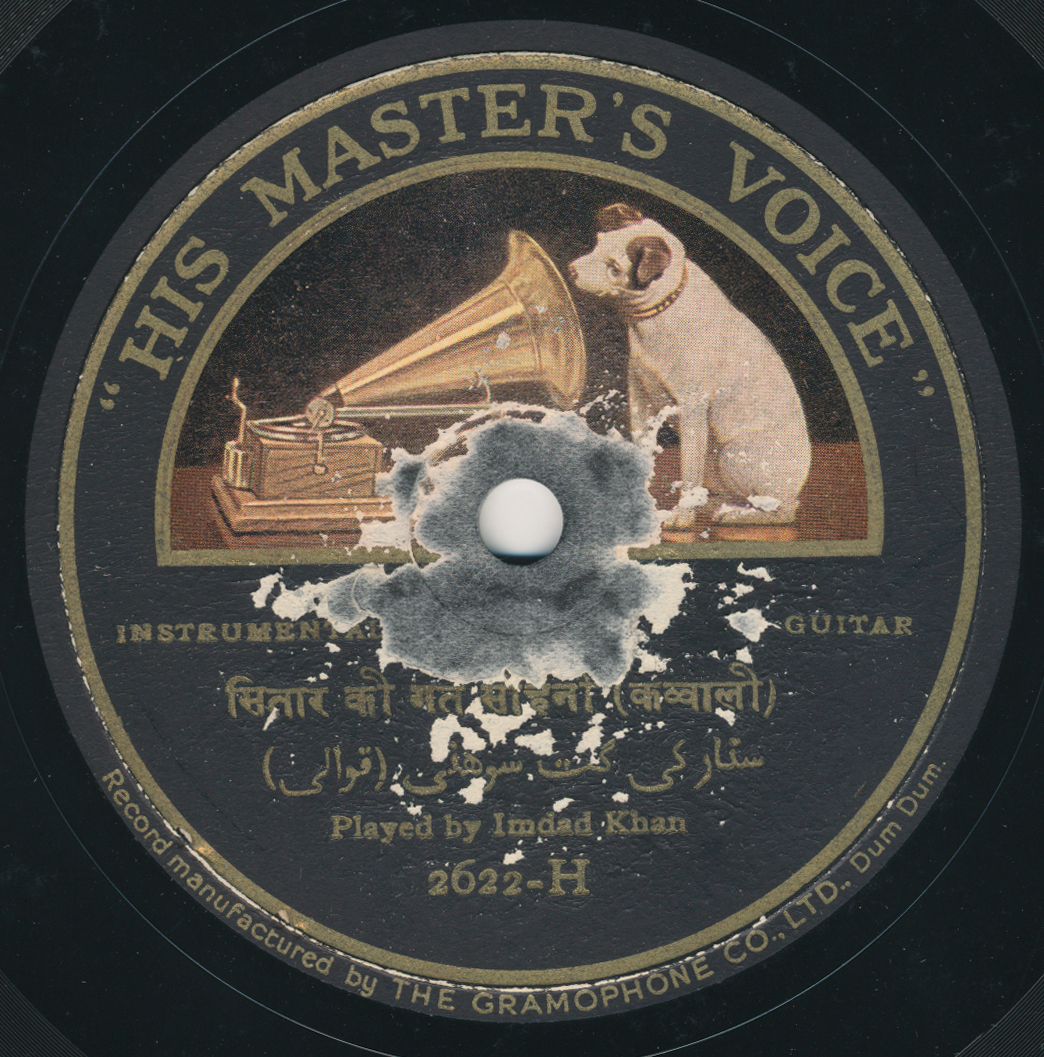
Three Generations of the Khan Family

It’s not uncommon to have multiple generations of a family of musicians captured on disc – though the case of the Khan family is extraordinary in a number of ways, not the least of which is the fact that a full three generations of Khans were recorded on 78 rpm records, dating to the very earliest recording sessions in India. The family tradition still continues, with numerous members active as professional musicians.

Imdad Khan (1848-1920) was the very first solo sitar instrumentalist to be recorded on disc. Born in Agra and raised in the nearby town of Etawah in Uttar Pradesh, Imdad Khan studied with his father, Sahabdad Khan, who familiarized Imdad with sitar, sarangi, and khyal, the North Indian classical singing style (Sahabdad’s brother Haddu was a famed khyal singer). He also studied with veena master Bande Ali Khan (1830-1890). Gradually, Imdad transformed Indian sitar playing, creating his own, incredibly popular style. In fact, he became something of a celebrity. His patrons were wealthy landowners and members of the Calcutta elite (such as Sourindo Mohun Tagore of the Bengali Tagore family), and he even played for the Queen. Yet his most impressive legacy is the entire school of music that stemmed from his performances and teachings – the Imdadkhani gharana – which, as sitar playing goes, is at least partly based on khyal vocal performance. It’s still very much in vogue to this day.

This short sitar solo, “Sohini Qawwali,” was recorded in Calcutta on December of 1904 by the Gramophone Company. The engineer was William Sinkler Darby. This was only the second time recording engineers from England had visited India, yet the market was exploding. According to scholar and researcher Michael Kinnear, the Gramophone Company had learned its lessons from the first tour of Asia (1902-1903), and was ready to record better artists and improve the company’s standing in the marketplace. Plus, smaller independent labels had already begun to set up shop and snap up popular artists. On this particular recording tour, Darby and his assistant Max Hampe started in Calcutta (recording, among other things, 6 tracks by Imdad Khan), after which they moved on to Delhi, Mumbai, Chennai (Madras), Colombo in Sri Lanka, Yangon (Rangoon), and eventually back to Calcutta where they recorded a Tibetan music troupe. Darby and Hampe recorded some very important performers on this trip along with Imdad Khan, including Abdul Karim Khan, female singing legend Gauhar Jan, shehnai master Talim Hossein, Sikh musicians and singers, and even two performers from Peshawar, Pakistan.

Instrumental solos weren’t as commonly recorded during the first decade of the 20th century. And the subtleties of the sound of the sitar, in particular, seem to have been difficult to capture during the acoustic recording era. Yet, at about 108 years later, we can still experience the master at work.

Imdad Khan – Sohini Qawwali

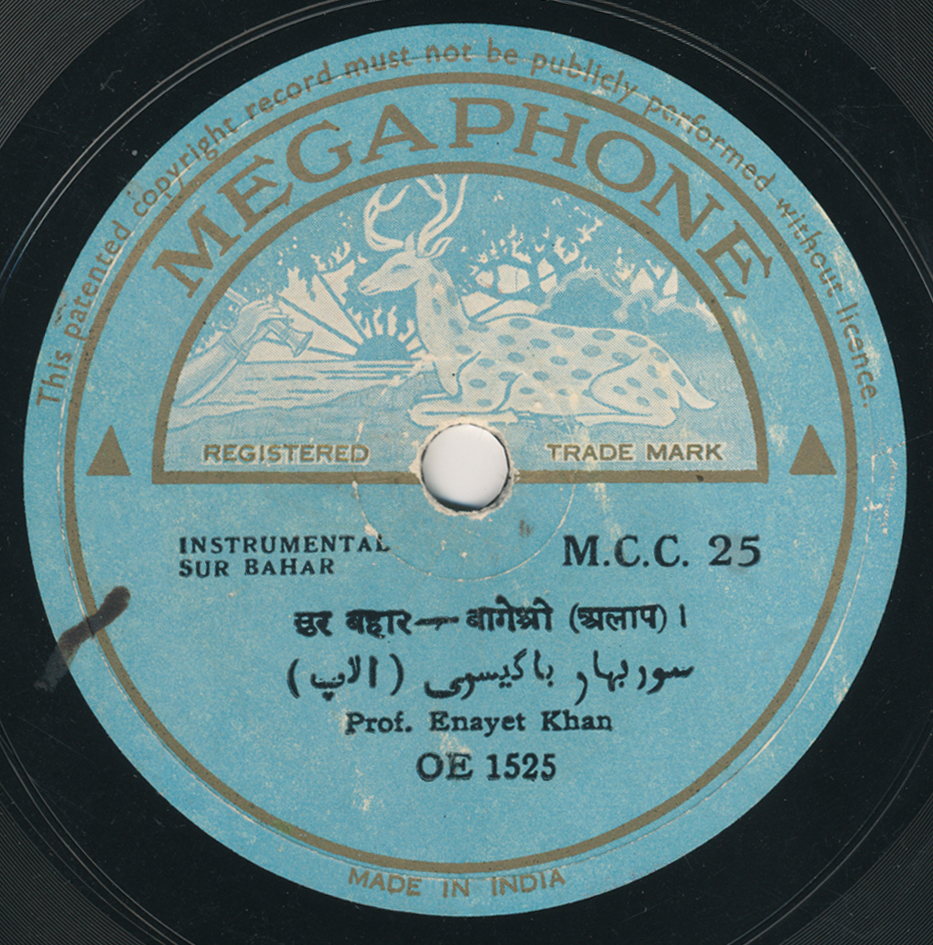
Imdad’s son, Enayat Khan (also spelled Inayat, Enayet, etc.) was born in 1894 and studied under his father, who taught him both the sitar and the surbahar, also known as the bass sitar. The surbahar’s origins trace back to ca. 1825-1830 in Lucknow. It has fixed frets and a wider neck than the traditional sitar. It generally has 6-8 strings (4 for melody and 2-4 for drones) and 13-17 sympathetic strings. Enayat was more commonly a sitar player, yet I chose here an example of his surbahar playing – an alap (an introduction) to the Bageshri raga. He died young, in 1938.

Interestingly, Enayat Khan recorded this piece in early 1933 thanks to the newly established Megaphone label. Megaphone, launched by an entrepreneur named J. N. Ghosh, had its origins ca. 1910 as a gramophone machine and harmonium manufacturer. However, by the late 1920s, Ghosh wanted to compete with the Gramophone Company, issuing 78s of artists he felt were ignored by the massive label, including Enayat Khan. By July of 1932, Ghosh began recording and releasing his own Megaphone discs, though they were pressed (rather poorly, I’m afraid – at least my examples are!) by the Gramophone Company at their plant in Dum Dum. Over the next 25 years, Megaphone released thousands of discs. Ghosh died in 1958, and his nephews took over the company – in the 1980s, they were making Megaphone cassettes.

Enayat Khan – Bageshri (Alap)

Born in 1928 in Gouripur in what is now Bangladesh, Enayat Khan’s son, Vilayat Khan, became one of the most important and well-known sitar players of the 20th century, carrying on and expanding upon the musical traditions of his father and grandfather. I recently read a section of an ethnomusicologist’s article stating that there was no proof that Vilayat Khan studied with his father before his death. In fact, Vilayat Khan recorded his first 78 for the Megaphone label at age 8! His father died one year later and Vilayat continued to study with his uncle Wahid Khan, a renowned surbahar player, as well as his mother and mother’s father. Vilayat’s career was long, was well-documented and often peppered with hyperbole. The word “unique” is frequently used when encapsulating his life, as well as “legendary” and “revolutionary.” He toured the world over, won numerous honors (some of which he famously refused, claiming that the judges were unfit to judge his or anyone else’s talent), and was prolifically recorded. He’s also well-known for providing the soundtrack for the 1958 Satyajit Ray film The Music Room (Jalsaghar). He passed away in 2004 from lung cancer. This piece, the Mishra Khamaj raga, was recorded in 1952, and Vilayat Khan is accompanied by tabla master Alla Rakha (1919-2000).

Vilayat Khan – Raag Mishra Khamaj

Many members of the Khan family are still performing today, including Imrat Khan (also the son of Enayat), Shujaat Khan and Hiayat Khan (both sons of Vilayat), Irshad Khan and Wajahat Khan (both sons of Imrat), and Shahid Parvez Khan (the son of Enayat’s brother Walid).

Technical Notes

Imdad Khan
Label: HMV
Issue Number: P 61
Matrix Number: 2622h

Enayat Khan
Label: Megaphone
Issue Number: M.C.C. 25
Matrix Number: 0E 1525

Vilayat Khan
Label: HMV
Issue Number: N.92565
Matrix Number: 0JW 2899

Thank you to Ajith Raman, Bill Dean-Myatt, and the works of Michael Kinnear.

Angus C. MacLeod – Puirt-A-Beul

According to the Garland Encyclopedia of World Music, after the Battle of Culloden in 1746 where the Jacobite Rising, consisting largely of Scotsmen from the Highlands, was brutally crushed by forces loyal the British government, a ban on musical instruments was placed on the people of the Highlands. According to Garland and other sources, this is the predominant reason for the existence of one of the most enduring folk traditions of Scotland: port-à-beul (or puirt-à-beul), also known as “mouth music.” When no instruments were available, bards from the Highlands would sing for dancing, often imitating the rhythms and music of the bagpipes, using humorous and sometimes bawdy lyrics in a dancable rhythm. However, according to several present-day scholars, this story is utterly apocryphal and nothing more than unsubstantiated legend. Port-à-beul could be much older than 1746, and why not? Humans haven’t always had instruments at their disposal, and what would have kept them from inventing their own music? And there are similar styles in other European regions – lilting in Ireland, for example, and in Norway with a fiddle imitation known as tralling. Regardless, this legend is a nice lead-in to discuss a recording of real mouth music.

Recordings of traditional music from England, Scotland, and Wales, are by far the exception than the norm. While the Gramophone Company of London was cavorting around the world recording all manner of peoples and cultures and exploiting new markets in the first half of the 20th century, the regional and folk music in their back yard went largely unnoticed. There are a number of important exceptions, of course. The Beltona label of Scotland recorded many folk bands and unaccompanied singers from the 1930s onward. People like Cecil Sharpe and Ralph Vaughn Williams helped to usher in a folk revival. Carrying the byline “Lon Dubh Na H-Albainn” or “The Blackbird of Scotland,” the Gaelfonn label was in operation in the late 1950s, and had an office at 102 Maxwell Street in Glasgow. The outfit was run by a well-known Gaelic singer, Murdo Ferguson (1923-2005), who recorded performers on tape in Glasgow and had the records pressed in London. He also pressed Gaelfonn recordings on 45s and LPs as well (which might certainly be worth searching for, as clean Gaelfonn 78s are uncommonly noisy in my experience – an instance where limiting oneself to the 78 medium might solely be fetishistic).

Angus MacLeod was born on the island of Scalpay in the Outer Hebrides (2001 population: 322) and died in 1970. Murdo Ferguson recorded several records by MacLeod ca. March of 1957. This piece is a medley of four different examples of mouth music. My Gaelic being virtually nonexistent, I cannot determine their order….yet I believe I hear the first piece, “Tha Fionnlagh Ag Innearadh” or “Finlay is Spreading Manure,” a little later in the recording than stated. Perhaps a Gaelic expert can chime in…in the meantime, enjoy.

Angus C. MacLeod – Puirt-A-Beul

Technical Notes
Label: Gaelfonn
Issue Number: GLA.1005
Matrix Number: 572 0-6703

Thanks to Bill Dean-Myatt, Cormac O’Donoghue, and Ray Templeton.

For another track by MacLeod, take a look at the new 2-CD collection by Fremeaux, 60 Years of Scottish Gaelic, put together by Scottish discographer Bill Dean-Myatt and Nigel Barrett (and from which I gathered some biographical information).

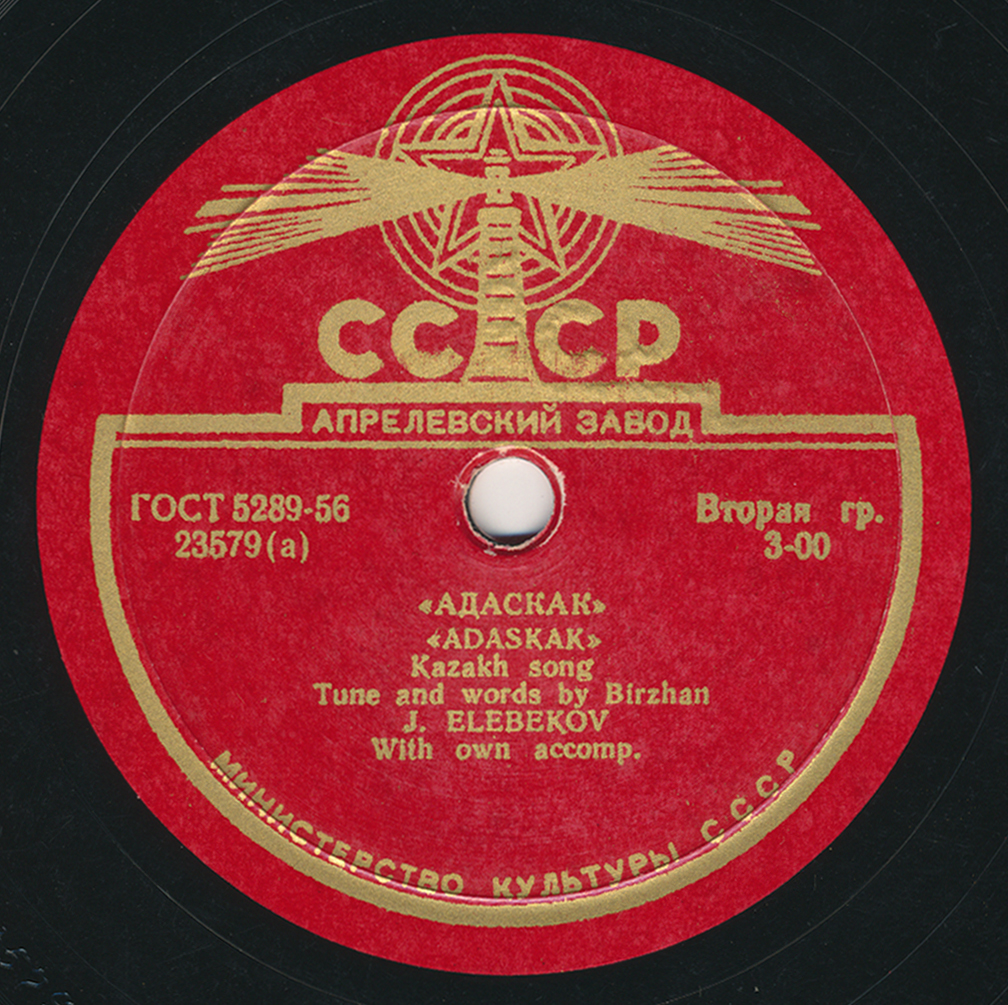
Zhusupbek Elebekov – Adaskak

Kazakh folk singer and dombra player Zhusupbek Elebekov was born in 1904 in the Karagandy region of central Kazakhstan. He first studied music with his uncle Zhakypbek, and later with the well-known musician Ämre Qashaubaiuly (1888-1934), who apparently bequeathed his personal dombra (the long-necked, two-string lute of Kazakhstan, of which where are several types) to Elebekov, as a gesture indicating Elebekov’s excellence as a performer. Elebekov was part of various touring Kazakh dramatic troupes and worked as a touring musician and actor throughout the 1920s and 1930s, eventually solidifying his reputation as part of the Kazakh Philharmonic Society in the mid-20th century, as well as his work with a concert association known as Kazakhconcert until his death in 1977.

Elebekov was a singer of the Kazakh lyric folk song, known as änshilik. Lyric folk singing is different than Kazakh epic folk singing or the improvisational poetry tradition, although like those other traditions, it is always played with the dombra. The lyric folk singer draws more on ornamentation when singing, and frequently uses non-lexical vocables, especially in refrains (which you can hear on this track). The änshilik tradition apparently was most robust during the final decades of the 19th century.

The label of this 78 – recorded ca. 1954 – indicates that the “tune and words” were written by “Birzhan.” Birzhan is in fact Birzhan Sal, or Birzhan-sal Qozhagululy (1831-1894), a famous lyric singer and also the subject of a recent biographical film. The translated title or subtitle of this piece is “Wanderer.” More information on Elebekov as well as an entire CD worth of downloadable recordings can be found on the Musical Heritage of Kazakhstan website. (A performance of “Adaskak” is available for download, but it appears to be a different, later performance of the song by Elebekov, and suffers from some heavy-handed noise reduction.)

Zhusupbek Elebekov – Adaskak

Technical Notes
Label: Aprelevski Zavod (SSSR)
Issue Number: 23579 (a)
Matrix Number: 23579 / 3-4

Trio Los Aguilillas – Samba Rumbera

Since I picked up this little gem, I’ve been playing it incessantly. It’s a beautiful example of regional Mexican music, and it’s positively anthemic – rollicking, upbeat, happy, and played with finesse.

The Trio Los Aguilillas performed local corridos, but they also issued discs of wonderful son huasteco from the various states in northeastern Mexico, son jarocho from Veracruz, and – today’s example – son michoacano. In terms of instrumentation, it’s fairly close to son jarocho, featuring guitar, a type of local jarana guitar (5 or 8 strings, depending on its origin), and the harp. Michoacán is one of the regions in Mexico where the harp – sometimes known as the arpa grande or even the arpa de tierra caliente – flourished. Traditionally, it is played while standing, and can be 3-5 feet tall, with a soundbox on it’s base acting as a resonator.

While Aguilillas literally means “little eagles,” in this case it’s also a reference to the town of Aguililla, in Michoacán, the birthplace of the Trio, which was comprised of three brothers, Antonio, Pedro, and Juan Rivera. The brothers were taught by their father, Don Pedro Rivera, a local harpist known throughout Michoacán as a great interpreter of the region’s music. Eventually the brothers moved from the family’s farm to Mexico City, to try and make their living as professional musicians. Apparently it took years before their local music was accepted without being watered down. Ethnomusicologist and anthropologist Joseph R. Hellmer aka Raúl Hellmer (1913-1971) recorded them ca. 1950 as “Trio Aguilillas” and issued their 10″ disc on Folkways titled “Sones of Mexico.” This Columbia disc dates from around the same time.

Trio Los Aguilillas – Samba Rumbera

Technical Notes
Label: Columbia
Issue Number: 6233-X
Matrix Number: MEX-99

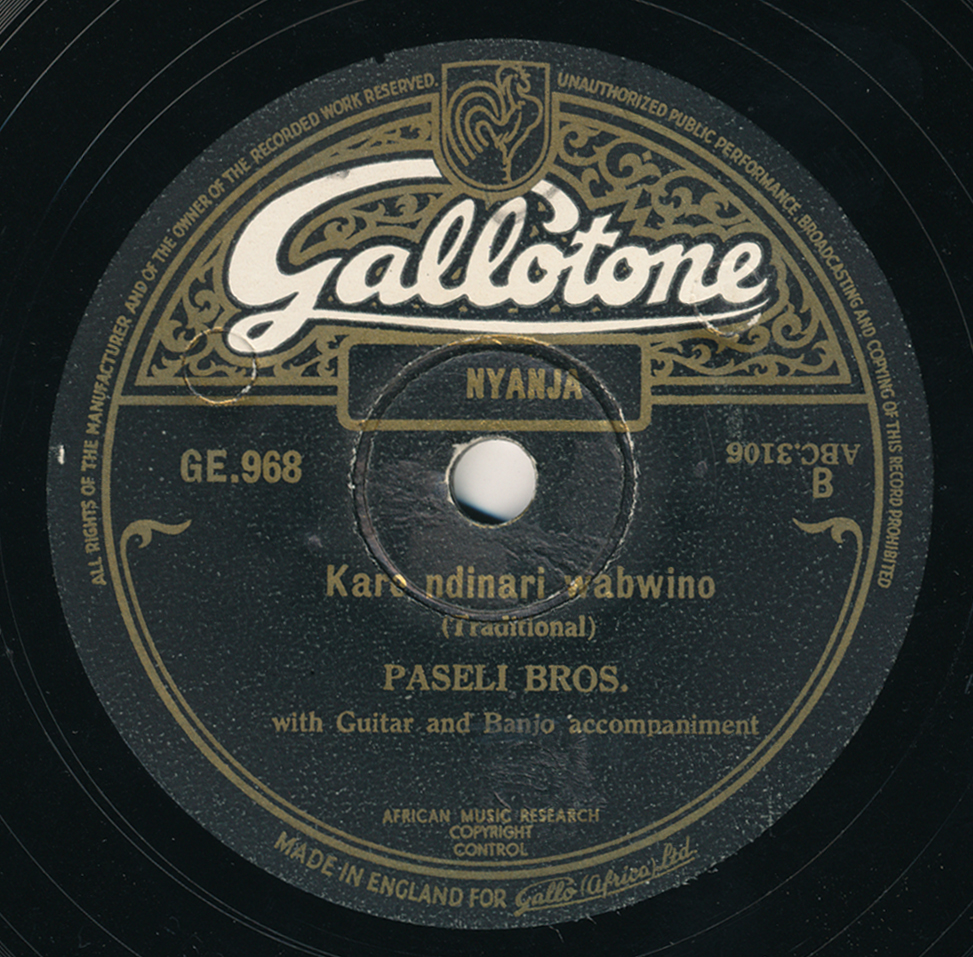
Paseli Brothers – Kare Ndinari Wabwino

There’s a stunning lack of early popular music from Malawi available on CD, which is a shame, as it’s wonderfully engaging and strewn with lively gems. It seems as if all the record labels active in southern Africa after World War II – from conglomerates like HMV to local, shop-based labels owned by Indian immigrants – were making records of the pop music from what was then the British protectorate known as Nyasaland.

Hugh Tracey, ethnographer extraordinaire, was right there as usual. In 1948, he recorded tracks by Black Paseli, his brother Barry (or Bari), and sometimes his brother Airini (or Irene) – the Paseli Brothers. These songs were recorded in Harare, Zimbabwe, where apparently the brothers had located themselves at that time, and they were popular enough to have them remembered today. Tracey felt that although the Paseli Brothers played in the “common Southern Guitar style,” they were particularly talented. According to several sources, the guitar and banjo were brought back to Malawi by Malawian soldiers who were serving alongside the British during World War II.

This was not exactly the case with Black Paseli, the leader of the Paseli Brothers. Black Paseli was born in 1921 in the city of Zomba, and during his teenage years was employed by a Mr. Mackay as a handyman and mechanic. During those years, in the mid-1930s, Black Paseli taught himself how to play Mackay’s guitar, eventually becoming adept enough to teach his older brother Barry the instrument. Until 1938, when Black Paseli was recruited to fight for the British, the duo played in then Rhodesia and Nyasaland as part-time entertainers at tea parties and bottle stores. After the war, they became full-time musicians.

The Paseli Brothers were, according to at least one source, the very first Malawian artists to record, and this would be one of their earliest efforts. Their first records were made in Zomba in 1947, recorded on equipment owned by an Indian shop-owner. They became extremely well-known in the region. When scholar and musician K. Mongani Katundu interviewed Black Paseli in 1986, he asked if his records made him famous, Paseli’s reply was: “Yes! So much so that other people’s wives ran away from their husbands to me.”

Tracey translated the title of this piece as “I Shall Never Drink Again” – which you can hear the Paselis repeat during the song. However, on a cassette of Malawian music produced by ethnomusicologist Mitchel Strumpf from the late 1980s, the true translated title was used: “I Once Was A Good Man.” There are also a couple of errors on the label. It states Nyanja as the language, but after I sent it to a speaker of that language (known more commonly as Chewa or Chichewa), he stated it was not, in fact, in that language. Listener John Iwanda wrote in and let us know that the title and first verse are in Nyanja/Chewa, the second verse is in Yao, third verse is in English, and the remainder in Nyanja. Also, despite the label, the piece is a guitar duet, and there is no banjo present.

One of the unfortunate, ubiquitous phrases one hears in the record collecting world is “No one’s ever heard of this stuff!” Well, that’s just simply not true in most, if not all cases. While Black Paseli is unknown in the West, there’s many people in an entire country that remember him, and the performances he made with his brothers.

Paseli Brothers – Kare Ndinari Wabwino

Technical Notes
Label: Gallotone
Issue Number: GE.968
Matrix Number: ABC.3101

Biographical information gleaned from:
Katundu, K. Wongani. (1993). Black Paseli: His Place in Early Popular Malawian Music. In Mitchel Strumpf and Kondwani Phwandaphwanda (Eds.), Readings in Malawian Music: A Collection of Previously Published Articles on Malawian Music (pp. 53-54), Zomba: Zomba Music Society.

Elmughani Maalim Shaban – Unguja, Pt. 1

October 2011, fast approaching, is the release month for my upcoming Dust-to-Digital box set, Opika Pende: Africa at 78rpm (October 25th, to be precise), therefore it’s high time for a stone rarity of an African record. For some readers, the artist and title of this track might ring a bell. Part 2 of this terrific, historically significant disc appeared on the Secret Museum of Mankind’s East Africa CD. I thought I’d offer Part 1 from my own copy, completing the listening experience.

This 78 represents one of the very first pieces of recorded music from the Zanzibar archipelago, produced during the very first recording sessions of Zanzibari musicians. In March 1928, the Gramophone Company in England shipped a handful of Zanzibari musicians to Bombay, India, including Maalim Shaban and the renowned Siti binti Saad. The engineer was Robert Edward Beckett, who had been recording around the world for GramCo since 1922. Over the next three years, these and other Zanzibari musicians recorded over 125 discs in Bombay, over several visits. The records themselves were pressed in Calcutta, and shipped to Swahili-speaking regions of coastal Africa. Details are scant with regard to precisely when this disc was recorded, but it appears to have been released in September of 1929. After these historic sessions, there seemed to be a mad rush to record East African musicians: Odeon began recording local music all down the East African coast, Pathé shipped East African musicians to Marseille to record, and Columbia began recording some of the very same musicians that GramCo had recorded, except onsite.

78rpm records and gramophone players, however, had been available in the region for decades, but by and large the music that was being sold to locals was not popular or traditional music in Swahili or other African dialects. It was either English or Indian music – sold to those populations. The Zanzibari music that was recorded in 1928 (and onward) by the Gramophone Company was taarab. Probably the most overt influence heard in early taarab ensembles is the classical Arabic influence. But as scholar Werner Graebner and others have pointed out, the influences were wide – from India and Southeast Asia, to the Persian Gulf’s khaleeji music. The instrumentation heard on this piece is oud, violin, and percussion (darabukka). The title of the piece, “Unguja,” refers to Zanzibar itself (it’s the name of the largest and most populated island of the Zanzibar archipelago). Maalim Shaban lived at least until the 1960s, when he participated in interviews for a book on early Swahili recording artists (Waimbaji wa juzi, by A. A. Jahadhmy, available only in Swahili).

Elmughani Maalim Shaban – Unguja, Pt. 1

Technical Notes
Label: His Master’s Voice
Issue Number: P. 13290
Coupling Number: 28-12239
Matrix Number: BD3063

For further listening, additional compositions by Maalim Shaban are on Janet Topp Fargion’s essential CD Poetry and Languid Charm, on Topic.

News

For those who don’t follow the Excavated Shellac Facebook page, I was recently on Jason Sigal’s WFMU radio program Talk’s Cheap. He graciously had me for 90 minutes to play music and chat. For those interested, here is a link to the archived show.

And as for Opika Pende – I’ll try to keep the self-promotion bearable, but I do hope that any fan of the site, especially those that understand and appreciate the time and effort it takes to find and make these types of recordings available, will purchase and enjoy the set. This was a labor of love – from me, to you.

Orkest Eddy Vervuurt – Lied

I’ll admit it – I had no idea that any 78s from the country of Suriname existed. It made sense that there were recordings made, and I had some documentation stating that there were recordings of music from British Guiana (now Guyana), but nothing from Suriname – until I came across this rarity. As soon as I started poking around, the label, the artist, and the story behind this fun little record came into focus.

Suriname, the smallest country in South America, had been a Dutch colony since the 17th century, when the British famously traded it to the Dutch for the island of Manhattan. Previously, the Arawak and Carib peoples lived in the region. The Dutch brought African slaves to their colonies in Suriname and many escaped, starting their own rural societies away from the Dutch-owned plantations. They became known as the Maroons. In the 19th century immigrants from India, the Dutch East Indies, the Middle East, and China arrived, further diversifying Suriname’s population into one of the most varied in the world. In 1954, Suriname was granted some self-rule, but it wasn’t completely independent until 1975.

Edward James “Eddy” Vervuurt was born in Suriname in 1928. By the time he was a teenager, he was studying piano and composition at the Amsterdam conservatory. While in the Netherlands, he formed a band called “Edwardo y su Orquestro Rhytmico.” He returned to Suriname soonafter and had a long career as a composer, bandleader and conductor of the Suriname Philharmonic, as well as the head of the local radio station Radio Apintie. From what I understand, Vervuurt frequently incorporated local, Surinamese folk music into his compositions, and encouraged Surinamese composers to do the same, and to musically embrace their culture. He died in 1988.

The name of this label – Parbo – has two meanings: it’s a shortened nickname of Paramaribo, the capital of Suriname, and it is the name of a famous Surinamese beer. This record, it turns out, is in fact a promotional record for Parbo Bier, then being brewed at the Amstel factory (and now brewed by Heineken). The song title – “Lied” – simply means “Song” in Dutch. The colors and font on the label are the same as those used for the beer. Eddy Vervuurt, it turns out, was the bandleader for a local group featuring the vocalist “Big Jones” (real name: Marius Liesdek) who was a fisherman and sausage seller by day. According to an article by Joop van Mil, this band cut several records with an Afro-Caribbean feel, in Surinamese styles known as kaseko and kawina. Part of this song appears to be sung in Dutch (the national language of Suriname), although it’s possible (?) that the chorus is in Sranan Tongo, the English-based Creole language which is spoken by a large amount of the country’s population. It’s a wonderful piece – beer-infused or not. The musicians play beautifully and loosely, with Eddy giving himself a piano break that wouldn’t sound out of place on a Les Baxter album!

Na di Sranan mek’ en biri
Ala tra biri kon tan tiri
Parbobiri, Srananbiri…

Orkest Eddy Vervuurt – Lied

Technical Notes
Label: Parbo
Issue Number: D 99088 H
Matrix Number: AA 99088 1H = 2//670

Live in Boston, September 7, 2011

I will be in Brookline at Café Fixe doing a live Excavated Shellac show on September 7th. I’ll be spinning rare music and focusing on local 78 rpm labels across the globe, and how they provided unique, regional music that the majors may have missed. I will also be showcasing some tracks from the upcoming Opika Pende box set. Please come!

For more information, you can visit here.

Thanks to Susanna Bolle!

Hamida Rokhshana – Washlidah

Excavated Shellac is back, again – continuing after four years, to keep up…well, at least a modicum of a schedule in posting international 78s. Again, I appreciate any and all comments, information, and collaboration – especially from some of the regulars who have consistently been following this website from the very beginning. Many marriages don’t last that long! So, I honor it, truly. Back in 2007-2008, I posted each week and wrote just a couple of paragraphs. Now, I post more or less monthly, and focus on records that for one reason or another would be interesting to both write about and listen to.

Today: Afghanistan.

Throughout much of the 20th century, music was recorded erratically in Afghanistan, to say the least. On top of that, according to various books on world music history, Afghan music has been, on the whole, largely undocumented. From my own collection, and from listening to the 78s of friends, the early art music of Afghanistan seems to situate itself as a bridge between the music of Iran and the music of India.

This piece was recorded quite late, ca. 1965. It was pressed and distributed in Afghanistan and elsewhere by the Russians on their state-owned label, although they did give the Afghan series their own lovely white label design. Most likely, it was produced by Radio Kabul, which was at the forefront of disseminating music of Afghanistan from the 1950s to the 1970s as well as, like many other countries at the time, developing a “national” music. Radio Kabul actually began in 1925, but the station was destroyed in 1929 when King Amanullah Khan, seen by many as too progressive, was deposed. Radio in Kabul was not reestablished until 1940 and after that, it became a center for Afghan music and its primary patron.

In this piece by Rakshanah (whom you can see pictured at the bottom of this web page), you’ll hear the traditional Afghan rubab, the bowed sarinda (a relative of the sarangi from India), and the tabla, also imported from India. These are all essential instruments in Afghan court and art music. While I was unable to find any concrete information on Rakshanah, it is likely she was professionally trained and possibly from a wealthy family. Female musicians were not often heard in public in Afghanistan, as traditional culture and religion relegated women’s music to the home. A female musician wasn’t heard on the radio until 1951. From a musical standpoint, the 1950s-1970s were considered the most progressive era in Afghanistan – there were many women performers heard on a regular basis, regardless of the austere viewpoints of the conservative population.

As far as I can tell, the very first recordings of Afghan music were the ones made in Lahore, Pakistan in 1926, by the Gramophone Company. Musicians from Kabul and Peshawar traveled to Lahore and recorded about 60 discs worth of material. The discs were distributed in urban centers of Afghanistan and throughout Afghan communities in India. (I have seen only one of these records in 10 years.) In 1928, a few more Afghan recordings were issued by GramCo.

Between 1928 and 1946, the only outfit recording Afghan music with any degree of regularity was a local, independent company called The Frontier Trading Company based in Peshawar. They issued Pashto discs on their Banga-Phone label in India, along with music from Kashmir, Punjab, and Persia. (Again, I’ve seen a grand total of one of these records in 10 years.) After World War II, some Afghan recordings were made by Columbia, and issued in their Persian music green-label “GP” series. Then, there is the Russian-pressed series from 1959-1960 shown here. I have no idea how many were issued in this series – the numbering is erratic, though it could have been as many as several hundred. They were recorded on tape, and somehow connected with a company called “Afghan Magnetic Film” (or “Tape”… the records are not film music, though musically it’s very possible that they were influenced by the film music of Pakistan and India).

Hamida Rokhshana – Washlidah

Technical Notes
Label: Melodiya
Issue Number: 43973
Matrix Number: 43973/1-1

Thanks to Alfred Madain, Garland Ency., Michael Kinnear.

Announcements:

As some have seen on the Excavated Shellac Facebook page, an official announcement has been made for my next project with Dust-to-Digital, which is a Pan-African, 4-CD box set. It will feature 100 tracks from my collection, from all across the continent. It comes with a 112-page book and a CD portfolio, all housed in a hardbound cloth slipcase. I’ll be talking about this more in the near future. We expect it to be released in the Fall – late October or early November or so. This has been in the works for 3 1/2 years. It’s my goal to give you a diverse representation of some truly remarkable music that’s not before been issued.

Also – guest contributor Ian Nagoski has a major box set just out on Tomkins Square, which will surely be of interest to readers. And David Seubert, another guest contributor, has been a major part of the National Jukebox project. There’s lots of great work being done – all of it, in most cases, a labor of love.

Update 8/9/11

After having unearthed my old copy of the Nonesuch LP Afghanistan: Music from the Crossroads of Asia recorded by Peeter Ten Hoopen, I think I’m ready to say that the artist here is actually Hamida Rokhshana, who sings one song on that LP.