Dores Granja e Henrique Lima – Cana Verde (Portugal); Rena Galibova – Ba Stakhanov (Tajikistan)

Listening to these two tracks recently got me thinking about the complex concept of “authenticity” with relation to commercial recordings in certain regions. I’ve broached the subject several times on Excavated Shellac, and still find it a worthy discussion to ruminate upon. I suppose the overarching rhetorical question is: how do we treat these recordings in the present-day?

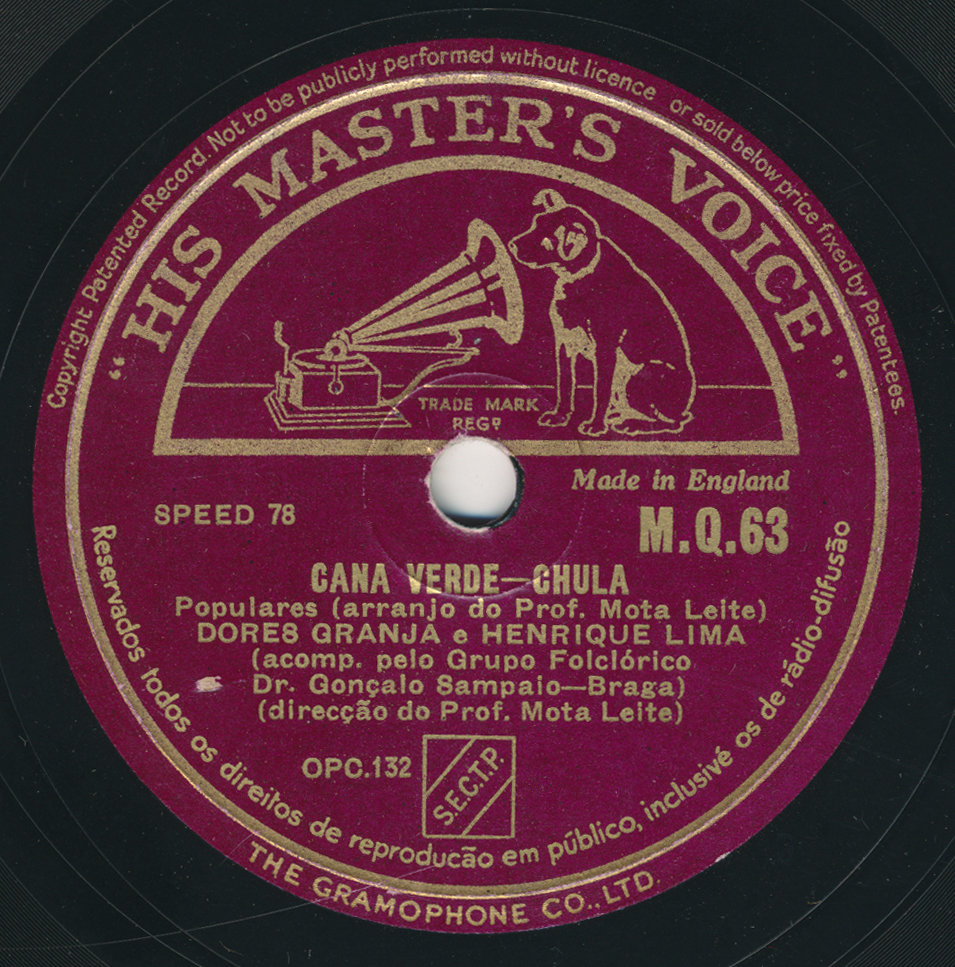
The first piece is a folk song from Portugal, recorded June 17, 1947, in Braga. For better or worse, the might and popularity of fado usually eclipses the other regional styles that have existed in Portugal for centuries. There’s unaccompanied polyphonic singing from the south, bagpipe music from the northeast, accordion bands, and all manner of rancho folclóricos performing regional music across the country. This piece is from northwest Portugal, specifically the area once known Minho province (now the Viana do Castelo and Braga provinces). It is a chula, a localized circle dance for couples. The singers Granja and Lima are accompanied by a chorus, drum, and multiple four-stringed cavaquinhos, the small guitar of Portugal which was apparently the original model for the ukulele, brought to Hawaii by Portuguese sailors.

But, it is probably safe to say that this piece was, in one form or another, mediated by the Salazar dictatorship in Portugal, which apparently exercised strict control over all cultural activities. During the dictatorship, folk music groups – the aforementioned rancho folclóricos – were part of the nationalist organization known as FNAT, or Fundação Nacional para a Alegria no Trabalho – meaning “The National Foundation for Joy at Work.” And FNAT is represented here on this recording with the presence of Professor J.C. Mota Leite (credited as the director of this performance) and the Grupo Folclórico do Doutor Gonçalo Sampaio (who accompany the lead singers). During this period, FNAT was involved in essentially fostering a revivalist spirit throughout the country with these groups. The Grupo Sampaio, formed in 1943, worked closely with FNAT and worked to create what scholar Kimberly DaCosta Holton calls “an authentic duplicate of regional tradition.” Mota Leite, a folk music scholar, was hired by FNAT to train the group for months, acting as a bridge between the members of the group, who were peasants, and the dictatorship nobility.

Now that we know this about the recording, will we feel differently about it after listening? Do we have the capability to take it at face value, or is it fraught with the politics of the day? Does the fact that this recording is in the renowned Constantin Brăiloiu archive of folk music change anything?

The second piece is from Tajikistan. Under Stalin, the nationlist influence on the manifestation of folk music traditions was in full effect.

“…traditional musics were transformed into national monuments in order to comply with Soviet internationalism. This entailed standardization to ensure compatibility with, and inclusion within, a monolithic Soviet culture. The adoption of standardized European performance modalities thus enabled local musics to find a place among their peers in the parade of national heritages of the USSR, and to join the large-scale cultural engineering that was triumphantly displayed at inter-national festivals.”*

Rena Galibova (1915-1995) was born in Uzbekistan, of Buhkaran Jewish heritage. She eventually moved to Tajikistan and became a trained opera singer. Her career was lengthy, through decades of Soviet rule – she performed for Stalin, and gained the title “People’s Artist of Tajikistan.” She eventually moved to Boston, Massachusetts, where she passed away at age 80.

This piece has something similar to the typical “folk music ensemble” sound of Central Asia in the Soviet 78rpm era. You can hear a violin, the dayra frame drum, the nay flute, and the chang zither (oddly, I don’t hear a tar or dutar). Apparently Galibova also sang traditional Bukharan shashmaqam. I would love to be able to hear that some day, yet Tajik records – even the classical, operatic ones – are incredibly difficult to find. Which leads me again to our questions: can we approach this music at a level disassociated from its political past? Will the discourse always be messy? Or is it essential background information that is needed in order to give the music its proper context? If the Garland Encyclopedia of World Music calls this Soviet ensemble style “bloated” and “ponderous” – does that mean it’s improper to hum?

It’s quite likely that the Stakhanov in this track is the “Hero of Socialist Labor” Alexey Stakhanov (1906-1977).

Dores Granja e Henrique Lima – Cana Verde

Rena Galibova – Ba Stakhanov

Technical Notes
Label: HMV
Issue Number: MQ 63
Matrix Number: 0PC.132-2

Label: Taskhenskiy Zavod
Issue Number: 5289-50
Matrix Number: 8823/3

*Spinetti, Federico. (2005). Open Borders. Tradition and Tajik Popular Music: Questions of Aesthetics, Identity and Political Economy. Ethnomusicology Forum, 14(2), 185-211.

Thanks to Bill Dean-Myatt for discographical information, and to Steve Shapiro.
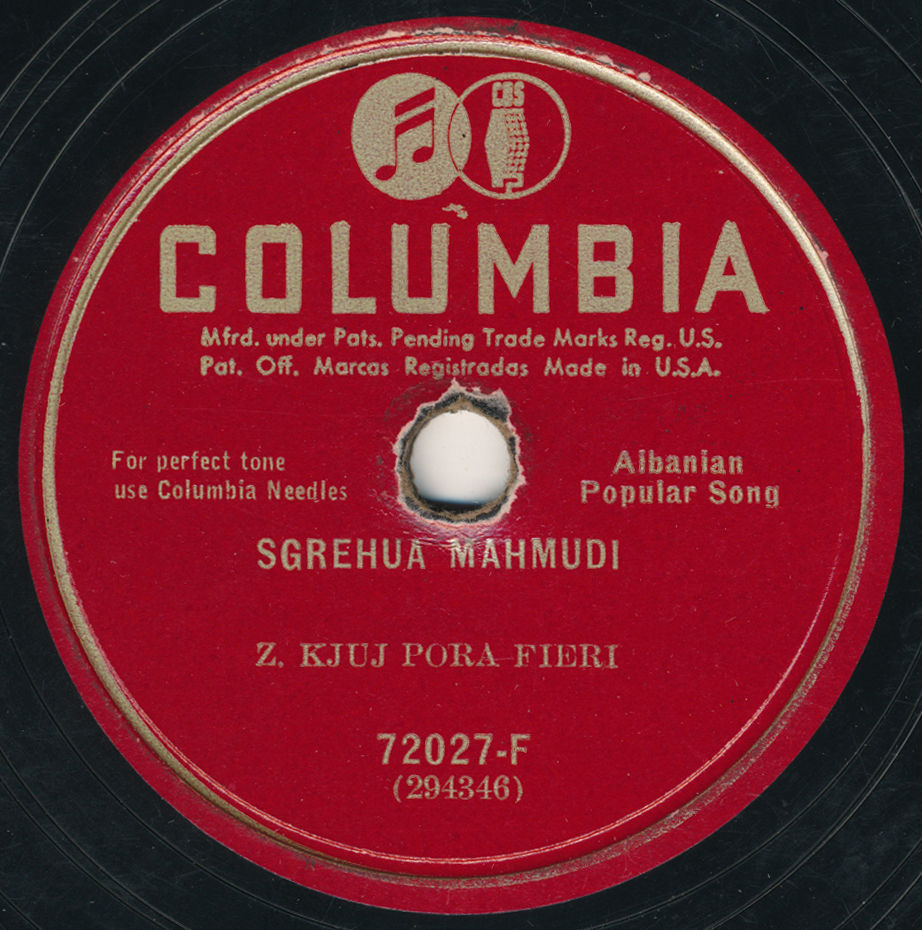
Z. Kjuj Pora Fieri – Sgrehua Mahmudi

About a year ago, I posted a rare example of Albanian dance music (closely related to Epirotic music from Greece) recorded in the United States by Albanian-Americans. Now it’s time for some music from the same period, this time recorded in Albania ca. 1929. If you are unfamiliar with this particular type of Albanian music, it could turn out to be one of the most powerful musical experiences you may have – it certainly was for me.

Many have written about how the landscape of Albania must have contributed to the preservation of such a varied and musically unique (sometimes even jarring) group of folk musics. The word “isolated” is often used to describe the country, largely because of the rugged mountain ranges that surround it (such as the Bjeshkët e Namuna, or “The Accursed Alps”). To this day, the majority of the Albania’s mostly Muslim population live in rural areas – quite the opposite of other European nations.

The music of Albania, however, is so spectacularly different than the rest of Europe (with the possible exception of Epirus in Greece, where there is considerable overlap), that it seems to an outsider to be born of a different age altogether. Rodney Gallop, reviewing several 1930 Albanian discs for the Gramophone Company, called the music “uncouth” overall, yet was completely captivated enough, at that early date, to write positively about a series of discs with pressing numbers as low as 200 copies!

A year before the Gramophone Company recorded in Tirana and Shkoder, the Columbia Graphophone Company made nearly 300 recordings in Shkoder in November 1929, and had already recorded numerous Albanian discs in Istanbul earlier that year. Some of these records – a total of 49 to be exact – were pressed in very small amounts in the United States, specifically for the Albanian immigrant population (in 1920, the Albanian-speaking population of the United States numbered a mere 6,000). They were “dubbed” from 10″ discs onto new 12″ masters, in an attempt to charge more money for them – a not-so-uncommon practice, unfortunately, as the sound quality lessens during this process, and it appears to be a crass attempt to gauge more money out of immigrant buyers, who might place more importance on these larger discs. This is one of those.

This is the music of the Tosks, in southern Albania, and this piece was performed by an ensemble that appears to have been from the city of Fier in the southwest of the country. The most obvious (or maybe captivating) element of the music of the Tosks is the drone-like polyphony of the male vocalists in the background, who augment the lead singer with extended, nasal accompaniment on syllables such as “ay” or “e.” Another standout element is the halting and seemingly erratic rhythm of the string intrument (possibly the çiftelia) and the everpresent Albanian-style qernëte (clarinet), which sometimes seems to push the very limits of the instrument. In terms of the group, I could find nothing about them. A reader has helpfully indicated that the “Z.” in the title likely means “Zoti,” or “Mister.” “Kjuj” may be a different transliteration of the name “Gjergj.” Further information is always welcome. At any rate, I hope this rates high.

Z. Kjuj Pora Fieri – Sgrehua Mahmudi

Technical Notes
Label: Columbia
Issue Number: 72027-F
Matrix Number: 294346

It goes without saying that Paul Vernon and Benno Haupl’s Albanian Village Music CD on Heritage is essential listening.

African test pressing, Number 4

For our fourth and final African test pressing in this little series, we’ll end with a bang. It’s both a favorite record of mine and a type of music that I find powerful – that is, Hausa praise music from Nigeria.

The recording of Hausa music began in the mid- to late 1920s. Some of the earliest were recorded by a man named John Barbour-James, from then-British Guiana, for the Duophone label, normally a company that issued British dance band tunes. A few years later, more songs in Hausa were recorded in London and issued on the Zonophone West African “EZ” series – a series that has been culled by reissuers repeatedly, with a total of 6 available CDs exclusively featuring Zonophone West African tracks.* The Germans appear to have been the first to record on-site in West Africa. They were in Nigeria ca. 1930-1931, and issued discs on the Parlophon label, which are now very scarce (although some excellent examples were reissued on the American Decca label 12+ years later). The late 1930s saw a little more activity. When Parlophon became Parlophone, after being purchased by the Gramophone Company, they recorded approximately 145 particularly excellent discs from West Africa in the mid- to late 1930s. How many Hausa recordings were released in that series? A grand total of five. However, they were all Hausa praise singers. I’m not sure precisely when labels began recording and selling Hausa music with more fervor, but by the 1950s, dozens of Hausa tunes were available, and were being issued by Parlophone, Decca, HMV, as well as by local independent labels like Tabansi.

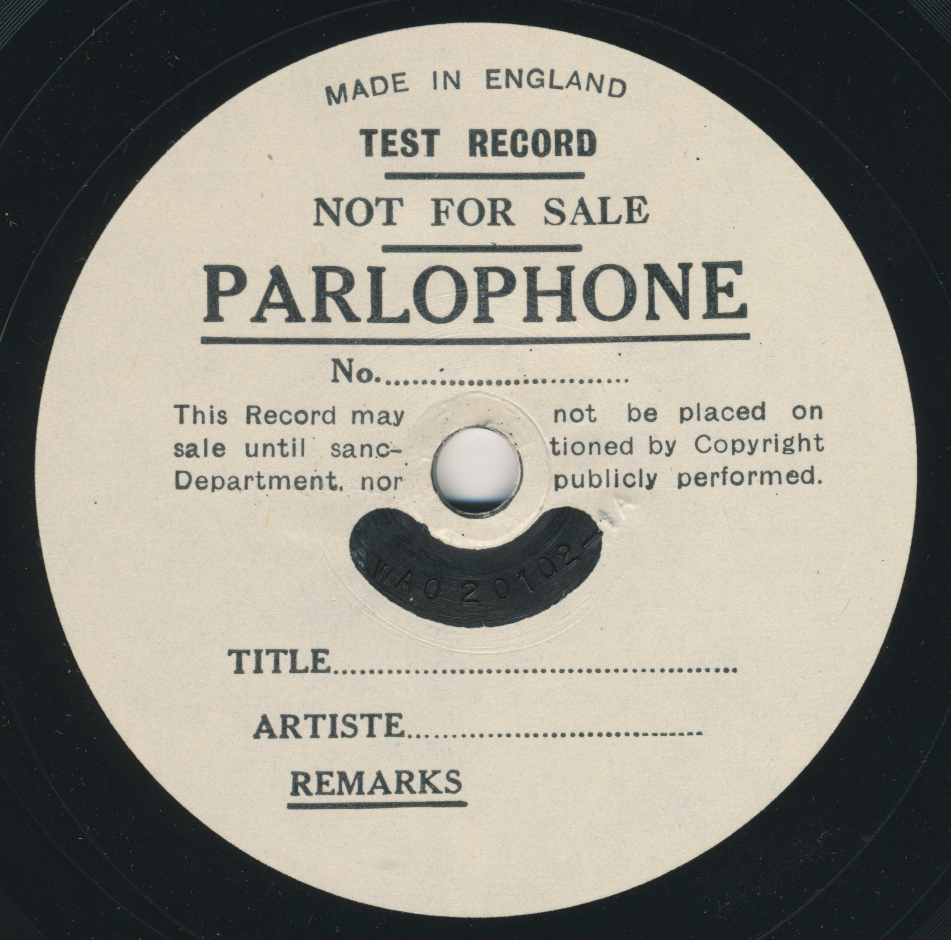
Unfortunately, I have no idea when this record was made. Its stamped matrix number matches no Parlophone series that I know of, and the number itself was stamped around the center hole, which was not a common practice used for issued discs. Judging by the erratic appearance of Hausa music until the 1950s, the chances are strong it’s from that decade, but I can’t be sure.

The Hausa, a Muslim people, primarily live in northern Nigeria and southeastern Niger. Hausa praise singing, known as roko, is a method of eulogizing and expressing adulation. It’s an art form that is everpresent, at weddings and celebrations, yet the practioners themselves, known as maroka, are often of low social status. There are different types of roko performance, but the roko on this record features a lead singer, the one-stringed stick fiddle known as the goje (or one of its variants, such as the kukuma), percussion, and a “praise cryer” or kwando, who intersperses the lead singer’s melodic singing with shouts and recitation. If you’ve never heard it before, you are in for a treat!

Update 6/25/11

According to reader Bill Dean-Myatt, this was likely an Odeon release, and recorded in Lagos, Nigeria, between December 1955 and January 1956.

African Test Pressing, Number 4

Technical Notes
Matrix Number: WA0-20102-1A

* Living is Hard (Honest Jons), Kumasi Trio 1928 (Heritage), Jacob Sam and Kumasi 3 (Heritage), West African Instrumental Quintet, 1929 (Heritage), Early Guitar Music from West Africa, 1927-1929 (Heritage), Roots of Juju – Domingo Justus (Heritage).

African test pressing, Number 3

It’s about that time to examine another unidentified disc from Africa. If the photo looks a little different, it’s because this disc is a “metal mother” – a one-sided 12″ disc with a positive image that was used to create what is known as a “stamper,” or the negative impression that created one side of a 78rpm disc that you would see in a gramophone store. It’s one step away from the master recording.

Like the previous entries, because of the matrix number stamped into the disc, I was able to determine the original label for whom this disc was pressed. And, this one is special – the J2172 number indicates clears as day that it’s an original recording for the independent Ngoma label, based in Kinshasa from the late 1940s to the early 60s, in the present-day Democratic Republic of the Congo (Belgian Congo when this disc was pressed).

While I’ve written about Ngoma and their musicians in previous entries, to me the history of recording in that part of the world remains a fascinating story. There was little to no recording made in what is now the two Congos, until after World War II – a full four decades after recording had begun in other parts of the continent (Egypt being the first recording market in Africa). For a lot of 78rpm and early music historians, that might seem strange – collectors and scholars are often looking for the “earliest example of” this, or “pre-war” that. But there was no “pre-war” anything in this region, save for perhaps some ethnographic recording. The fact remains that the recording industry, while very active on the continent, didn’t really get to much of Sub-Saharan Africa until after WWII. The hundreds of West African recordings made in the late 1920s for Zonophone remain the first serious foray into recording Sub-Saharan music. But, those were all done in London. From ca. 1930 on, things got more serious – the Germans and French began recording in earnest in West and East Africa, and South African recording began with the Gallo labels (Singer at first, then Gallotone). Yet, Gallo aside, the recording by the multinationals was quite spotty until after WWII, and by then, independent labels were cropping up in many major African cities.

Situated on the Congo River, and with navigable access to many parts of the Congo River Basin, Kinshasa was a natural spot for the humble beginnings of independent Congolese music  recording and production. Where the multinationals were absent, independent labels filled the void. Olympia from Belgium was the first, beginning ca. 1946. They hold the title for the first releases of Congolese, Latin-influenced popular music, and the first to issue records by Camille Feruzi and the great Wendo. The Ngoma label was next to appear – begun by two Greek brothers originally from Alexandria, Egypt, named Alexandros and Nicolas Jeronimidis. In a very short amount of time, a musical revolution took place. Ngoma’s releases of music by Feruzi, Leon Bukasa, and Henri Bowane (also Ngoma’s A&R man, so to speak), were huge sellers – and what was continuing to develop and formulate was the Latin-influenced rumba lingala. The story of rumba in Congo, it’s practitioners, it’s influences, and it’s effect on music throughout Africa has been studied by many others more learned than I. It simply flew off the shelves. In Kinshasa alone, by the late 50s, when the political situation during the rise to independence became difficult to say the least, the music scene was flourishing. There were so many 78 labels! Olympia, Ngoma, Loningisa, Opika (formerly Kina), Elengi, Lomeka and Kongo Bina (apparently affiliated with Olympia), Esengo, CEFA, African Jazz, Surboum…they were so popular that the European companies began to license the music on those independents!

But, what about the music that these labels recorded that was not rumba, not guitar music, and not pop? Hugh Tracey would make many recordings of local music in Congo in 1950, 1952, and beyond. But Ngoma, and to a lesser degree (it seems to me) Opika, appear to be the only Kinshasa-based labels that went beyond popular music to record music from other neighboring regions and cultures. The four main languages that Congolese popular music was performed in were Lingala, Kikongo, Swahili, and Luba dialects. Ngoma actually seemed to travel to record regional music in the Kele language, the Ngbandi language, and the Ngombe language among others. They also recorded local Cameroonian music in Bamiléké languages. They distributed their recordings in stores outside of Kinshasa, including Kisangani, Katanga province, Bukavu, and in Douala, Cameroon.

So, what is this track, exactly? Well, I don’t know. It’s a drum and vocal piece, and probably regional, that’s for sure. While I know there are Ngoma catalogs that exist, I doubt they list matrix numbers, so we probably couldn’t trace our J2172 number unless there’s someone out there who actually has the disc. Ngoma’s catalog numbers start at number 1. Judging by other Ngoma records that I have, I am guessing that it was released somewhere between 1020 and 1100 in their catalog….in the early 1950s, I’d say.

African Test Pressing, Number 3

Technical Notes
Matrix Number: J2172

Additionally: Dave Murray (of Haji Maji) has a fantastic new LP out on Parlortone, featuring his 78s of luk-thung music from Thailand. You can buy it here. Peter Doolan of Monrakplengthai wrote the liner notes, Michael Graves of Osiris Studios did the mastering and audio work, and I helped out a little bit, too. Be sure and check it out.

And in the scholarly department, the Centre for African Studies in Basel has digitized a considerable collection of Nigerian recordings originally issued on the Parlophone label in the early 1950s. There’s some wonderful music here and the original series is fairly obscure – you can listen and read transcripts here. Thanks to Zim for the heads-up.

African test pressing, Number 2

And here we go with another mysterious African test pressing. The last test pressing, although not yet officially identified, brought about some thoughtful conversation in the comments section, especially from well-known author and scholar Professor John Collins, who graciously found time to stop by. This time, we’re moving to another part of the continent.

One listen to this wonderfully easygoing track with its marabi feel, its percussion, piano, and concertina accompaniment, and it is clear that we’re in Southern Africa. However, as with the last test pressing, we’re left with very little to identify the record. Yet, I believe we can get very close to this one – it may all come down to that terribly arcane study of the matrix number.

Think of the matrix number as the “unique identifier” for each side of a record, stamped in the dead wax of the 78. As I described in the last post, each matrix number generally refers back to a one-sided master recording – or at least, a stamper. As you can see from the photo, the matrix number of this record also happens to be written in pen on the blank label: ABC10319. There’s one major African record company that used the “ABC” prefix on an abundance of their recordings and that was Gallotone (and its subsidiary label, Trek), the most well-known African independent label, which was based in Johannesburg and founded by Eric Gallo.

What’s also interesting is that the “ABC” number series was frequently used by famed African ethnomusicologist and recordist Hugh Tracey – a name that pops up frequently on Excavated Shellac – when recording artists for Gallotone/Trek. Thankfully, both Tracey’s International Library of African Music (ILAM), as well as the South African Music Archive Project are both online, and one can search matrix numbers – even those matrices that were not issued on commercial recordings (as far as I can tell). Unfortunately, this matrix is NOT found in either place. What is tantalizing, however, is that in the ILAM you can find matrix numbers that are very close in range to this one, and they appear to indeed be Hugh Tracey masters, possibly unissued. For instance, ABC10316 is a recording by legendary Zimbabwean guitarist George Sibanda. ABC10323 is by Mozambican guitarist Feliciano Gomes. And ABC10320 – just one number above this record – is an untitled piece simply credited to “Zulu Men.”

Could this record be from the same session? Was it ever issued? Of course, it’s important to remember that these questions should have no bearing on our enjoyment of the music. In fact, perhaps they even bog us down. Perhaps they say more about our need for mystery than anything else, or our need to compartmentalize various musical styles. Or, our need to equate a recording with a price tag on the open market, enabling future collectors to fetishize it. Part of what I enjoy about these anonymous (for now) recordings, is that they have the potential to challenge our assumptions about their origins, language, style, and worth. It’s a flat disc with a scribbled number on it – and yet it can be so much more.

African Test Pressing, Number 2

Technical Notes

Matrix Number: ABC10319

African test pressing, Number 1

For the next few weeks I thought it would be enjoyable to post some of my one-sided, African test pressings. By their very nature and format, these recordings are mysterious. There is no artist or title information on them. There is no African 78rpm music discography to consult for further information, and I would not hold your breath for one either as such an effort, no matter how worthy, would take at least a decade of full-time, backbreaking (some might say “thankless”) transcribing, research, and collaboration. So, in order to attempt to identify the music and artists on these records we have only what we can see – such as the paper label and the stamped matrix numbers in the shellac – and most importantly, what we can hear.

So, what exactly is a 78rpm test pressing, anyway? It’s the same as a vinyl test pressing, except the process to make a 78rpm record is a bit different. There are many complicated steps in that process, but the Cliff’s Notes version goes something like this: the life of a 78rpm record on shellac began, before the use of magnetic tape, with the creation of a one-sided wax or lacquer master created by a cutting stylus. The master was then copper-plated and the wax removed, leaving a “metal master.” These metal masters were negative impressions. The metal master was then electroplated in order to create a “metal mother,” which was a positive impression of the master. These metal mothers were used to create “stampers.” A stamper was also a negative impression, but was coated with chromium, enabling it to be strong enough to be used in a pressing machine and create a score of duplicates. These impressions made from the stampers were the 78s that were sold to the public – several steps removed from the original recording, as you can see. Very often, the first few discs from a new stamper were made as test pressings. They tend to sound better than your average 78 because the stamper was brand new, and hadn’t been overused in the creation of duplicates (a source of many a noisy shellac record).

Collectors of early jazz, blues, pop, and country records have the benefit of well-researched discographies notating primary and alternate takes of recordings – in other words, if you found a test pressing of an American jazz record from the 1920s, chances are high that you could ID that performer, artist, and song title simply from the matrix number on the record, if you had nothing else to go by. You might get incredibly lucky and find that hypothetical test pressing was a hitherto unknown take of a well-known performance. It’s not quite the same with recordings made outside the US, alas – far from it, in fact. Most of the time we are right back where we started, using our eyes and ears.

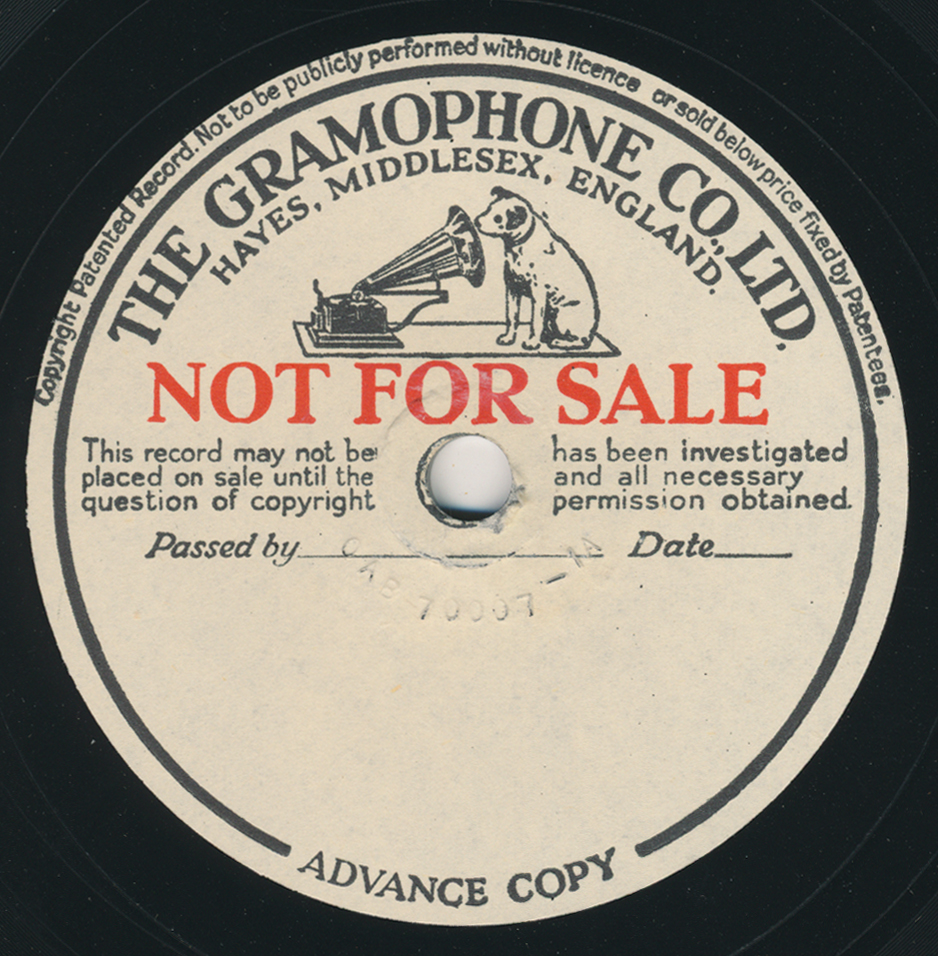
I’m gonna get a little nerdy here (if I haven’t already). Starting with the most obvious clue, it’s clear this record was made by the Gramophone Company in England. The second clue is the number impressed in the shellac: 0AB-70007-1A. I know that the company used the prefix 0AB- for His Master’s Voice recordings made in West Africa, beginning in the 1930s. However, checking all of my West African HMVs, I don’t have anything that goes as high as 70007, even up through the late-1950s. What does that mean? Well, this record, if it ever was released publicly, was likely issued on a series that I don’t have any examples of. It also could have been a private pressing, or a disc pressed by the Gramophone Company for a different label, or it may never have been issued to the public at all.

The music? Well, it’s clear as day to me that it’s definitely West African, and probably from Nigeria. The tell-tale signs are the percussion and rhythm style, and the addition of the pennywhistle, which was used frequently by highlife bands in Nigeria, such as the Jolly Orchestra and other groups that I have examples by. If I had to guess, I would say that it’s Yoruba, and from the late 1940s – mid-1950s. But, I could very well be wrong on both counts. It’s possible that this piece can be identified, either by another intrepid collector or by a trip to the EMI Archive. It’s possible that it may remain a mystery. But the music is here, for now…

Update 1/27/11

Following the comments on this thread, we seem to have narrowed things down a little – judging simply by the music, it seems this could be the band Congo Abana Club, from Sierra Leone (recording in Nigeria, perhaps) and their soloist “Piccolo Pete.” Thanks to all who have participated in the discussion here and on the Excavated Shellac Facebook page!

Update 1/30/11

Enlightening things further: we now have confirmation that the language is NOT Yoruba (admittedly, things were heading in that direction). Further, in the comments section, the well-known African music scholar John Collins has graciously stepped in, illuminating us with more important detail.

Update 6/25/11

Reader Bill Dean-Myatt has offered that this disc was likely recorded in Freetown, Sierra Leone, between September 1954 and February 1955.

Update 2/16/12

Reader nikiibu has confirmed that the language is indeed Mende, from Sierra Leone.

African Test Pressing, Number 1

Technical Notes
Matrix Number: 0AB-70007-1A

For more information on the production of 78s, you can visit here.

Jean Kamwema et ses amis – Cshala Paul

We’ll be visiting Africa for a while – I hope it will be enjoyable!

This piece, in the Lingala language of the Congos, was recorded by Hugh Tracey (see the Kankalongo Alidor post for more background on Tracey). While I’m unsure exactly where in the region Tracey recorded this piece, or where Kamwema and his friends hailed from, we do know that Tracey recorded four songs and a couple of demos by the group ca.  January of 1952 (some sources say 1950, but I am not yet convinced). While both sides of this disc are in Lingala, Kamwema also apparently sang songs in Luba and Swahili.

Tracey knew and loved the acoustic guitar music played across Africa, and recorded a significant amount for Gallotone and Tracey’s sister label under Gallo’s wing, Trek. Fellow Congolese guitarist Jean Bosco Mwenda, for instance, recorded dozens of discs on Gallotone, as did the famous guitarist of Bulawayo, George Sibanda. The rate at which these discs turn up, however…well, that’s a familiar refrain.

Enjoy, and welcome to 2011. I am aiming high!

Jean Kamwema et ses amis – Cshala Paul

Technical Notes
Label: Gallotone
Issue Number: GB. 1731 T
Matrix Number: XYZ.7060 T

(The “T” stands for “Tracey,” of course!)

The Bells of Kloster Einsiedeln

Happy New Year to all, and thanks for continuing to visit Excavated Shellac.

Let’s literally ring in the New Year with a personal field recording from Switzerland, dating probably from the 1940s or so. It features the bells of the Benedictine abbey at Einsiedeln, Switzerland. While the monastery has been rebuilt many times throughout centuries of existence, the present structure was built in the early 1700s. This record is an acetate, and a moldy one at that…but most likely one of a kind, and made by someone who appears to have been an intrepid hobbyist that recorded numerous other church bells across Switzerland. W. H. von der Mühll’s studio in Zurich, which pressed this disc, appears to have been active from the 1930s to the 1960s.

Here’s to 2011! And another post will be coming soon!

Kloster Einsiedeln – Bells

Samuel Pilip, John Karliak, i ich Lemkiwska Orchestra – Lemkiwsky Sztayer, Taneć

In Poland, on the slopes of the Carpathian mountains near what is now the Slovakia border, is the historical homeland of the Lemkos, also called Rus’, or Rusyns. For centuries, they have lived a rural, economically humble, agrarian lifestyle, centered around small villages. With the exception of a brief few years after World War I, they have never had their own representative government, and have been an ethnic minority under the rule of a larger entity, sometimes by force. During World War II, for instance, a hundred thousand Lemkos were driven from their homes and resettled throughout the Ukraine. Today, Lemkos remain in the Ukraine and Poland, in the Balkan states, Slovakia, and the United States, where Lemko immigrants began arriving in the late 19th century, in order to escape economic hardships.

In New York City, from 1928 to 1930, dozens of recordings were made of authentic Lemko folk music by immigrants, some of whom had only recently arrived in the country. There were some Lemko recordings made previous to 1928, but these were mainly ethnographic field recordings on cylinders. And, conversely, there were Lemko recordings made after 1930, but they had a more polished sheen. The recordings from 1928 to 1930 are truly the zeitgeist of early Lemko folk music. How did this happen, when Lemkos represented a very small immigrant population, especially compared to Ukrainians and Polish immigrants? How did this music ever get recorded in such a short window?

According to Walter Maksimovich and Bogdan Horbal’s fine history Lemko Folk Music on Wax Cylinders (1901-1913) and American Records (1928-1930), it’s all because of one man – a streetcar motorman from Brooklyn named Stephen Shkimba. Shkimba arrived in the U.S. in 1912, and essentially stewed for 16 years, waiting and waiting for someone – anyone – to begin to release recordings from his Lemko homeland. Finally, in 1928 he marched straight into Okeh records and demanded they record some! Okeh were skeptical, assuming that the music would be too close to Polish and Ukrainian music to make a difference – but they consented, and even charged Shkimba for the session. Shkimba was a bass player, and gathered musicians quickly. Their first Lemko record was considered a success, and Okeh signed Shkimba to a contract. Meanwhile, Okeh was bought by the American Columbia label, and Columbia also began recording Lemko music. Lemko wedding songs, folk dances, skits, religious music, and folk ballads began to hit the streets.

You’ll notice that this record doesn’t just say “Lemko” on it – it says “Lemko-Ukrainian.” How these records were marketed and sold to a small immigrant population is really interesting. Not only did Columbia and Okeh use the “Lemko-Ukrainian” qualifier, they also sold some as “Lemko-Russian.” Ukrainian and Russian records were often hot sellers for Columbia, so they must have wanted to capitalize on any potential cross-over and musical/cultural similarity. Further, Lemko musicians often recorded Polish songs during their sessions, and those were then issued on the Polish series, sometimes under altered names or pseudonyms. Likewise, some Lemko musicians recorded Ukrainian records, issued on the Ukrainian series – and the same with Russian, and Slovak. Lemko instrumental dance tunes, in particular, were cross marketed to all manner of cultures, including Hungarian and Lithuanian. My point is that the music of Lemko performers was in many immigrant households, whether they were aware of it or not, although they may not have been Lemko songs.

Maksimovich and Horbal also discuss where the records were sold. Some of the records were naturally sold out of local gramophone shops in immigrant neighborhoods, but a significant amount were sold by the musicians themselves, out of their homes. Some were sold in small businesses that catered to Lemkos – an ice cream store in Clifton, New Jersey, for instance. They were also advertised in small newspapers, such as the Lemko Association of the USA newspaper.

This recording, an instrumental taneć (dance) with wonderful strings, was recorded in March of 1929. Samuel Pilip immigrated to New York in September of 1923, and was originally from Zyndranowa, in the heart of Lemko country in Poland (and the current site of a Lemko historic museum). Pilip made about 5 records. Ivan (John) Karliak played with both Pilip, as well as his own band, with his brother, and issued several records, only one of them Lemko.

Samuel Pilip, John Karliak, i ich Lemkiewska Orchestra – Lemkiwsky Sztayer, Taneć

Technical Notes

Label: Columbia
Issue Number: 27177-F
Matrix Number: 110461

To buy Maksimovich and Horbal’s book, where I gleaned most of this information and which comes with a DVD featuring hundreds of mp3s of Lemko recordings, please go here.

To hear more Samuel Pilip on CD, check Arhoolie’s Ukrainian Village Music CD, which also features tracks by the Lemko group, the Orchestra Bratia “Holutiaky-Kuziany.” Dust-to-Digital’s Black Mirror also contains a track by Stefan Shkimba.

Dede Kurniasih – Djemplang Bangkong

I’m glad to present another guest post – this time from collector Michael Robertson. It’s a lovely example of a musical style we haven’t yet explored here – more proof of the depths of early recording! – JW

Out of all the great music of Indonesia, from the gamelan groups of Bali and Java to the swaying guitar and vocals of krontjong, the music that has tickled my ear the most has been tembang sunda. Tembang sunda is a genre of sung poetry of the Sundanese people of West Java. It is accompanied by a kacapi, a type of zither, and a bamboo end-blown ring flute called a suling. It seems to have started in the court of the Regent of Cianjur in the mid-19th century, and is still sung today.

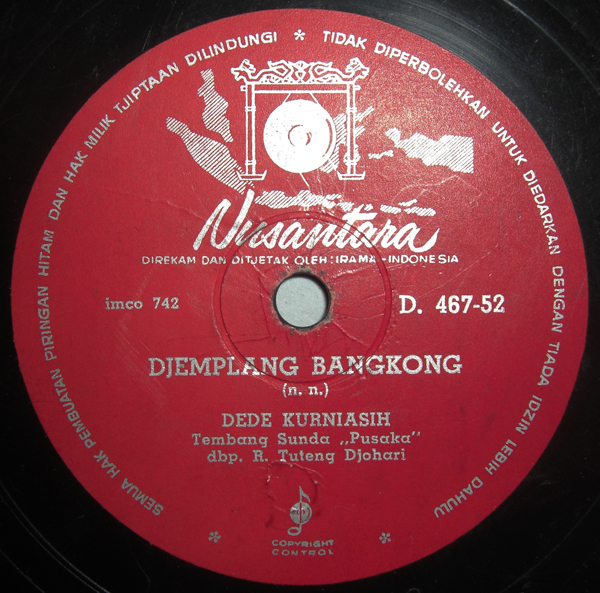
Unfortunately, I don’t have any information on Dede Kurniasih, except that she recorded at least seven sides for the Nusantara and Irama labels in the late 1940s, and possibly an LP. As you will hear, she has a very strong and expressive voice. The kacapi is a little far back in this recording, but overall it’s a fine example of the genre.

– Michael Robertson

Lyrics (thanks to Bambang Setijoso)

Daweng ngebang bang areuy dunungan

Bangkong dikongkorong kujang
Ka cai kundang cameti, da kole
Kole mah buah hanggasa
Ulah ngomong samemeh leumpang,
Da hirup katungkul ku pati
Paeh teu nyaho di mangsa
Hirup katungkul ku pati
Paeh teu nyaho di mangsa

Omong oyong oyong urang
pesini kunahu bisi da hate
Hate mah buah narasa ua ngomong samere rinti

Da hirup katungkul ku pati
Paeh teu nyaho di mangsa
Hirup katungkul ku pati
Paeh teu nyaho di mangsa

Dede Kurniasih – Djemplang Bangkong

Technical Notes
Label: Nusantara
Issue Number: D. 467-52
Matrix Number: imco 742