Antonio Soriano, Evaristo Payá, Chiquet de Bétera y Ceguet de Marchalenes – Albaes

sorianoFor this week’s post, I’ve decided to continue exploring the folk music of Spain’s many autonomous communities, each with its own particular type of traditional music – often multiple types. Previously, I’ve posted tracks from Galicia, Asturias, Andalucia, and Basque Country – and now we’ll move in a southeast direction to what is officially called Comunitat Valenciana, or the autonomous community of Valencia, which roughly reflects the borders of the medieval Kingdom of Valencia (1010-1238).

Several regions in Spain feature music with powerful unaccompanied vocals – Asturias and mountainous Cantabria being two examples. I do not know the origin of this often jaw-dropping trait in Valencia, but I have to think it may be related either to rural, peasant life (as it apparently was in Asturias and Cantabria), or at the very least related to performance outdoors. This piece, by Antonio Soriano and company, is a mix. The vocals are accompanied by a muted drum only and handled by multiple performers in succession, but are bracketed and bridged by duets on the dulzaina (also dulçaina), the extremely loud double-reed shawm of Spain, and the aforementioned tabalet drum (called tambor on the label). The piece is an “albaes” which, according to my research, is the Valencian version of the aubades, or alboradas – the “dawn song.” Traditionally known as a song sung by lovers before they part in the morning, the albaes is also sung after Midnight Mass at Christmas. It is also commonly known as a song type which features biting social commentary – the singer is accompanied by the “versaor,” who spontaneously invents the lyrics on the spot. This is a wonderfully unusual song type for public performance: a blistering outdoor screech of an instrument accompanied by a tiny little drum, singers who bellow amazing vocal runs, and a silent person who whispers lyrics into the singer’s ears. For a visual idea of what this may look like, please check out this video here.

This albaes was recorded in Valencia by engineer H.E. Davidson on September 30th, 1928. He must have known talent as this take is a keeper, made even more real by the coughing and throat-clearing throughout. Davidson spent much of his career with the Gramophone company recording in Spain. In 1928 alone, he was in Spain for virtually the entire year, recording upwards of 600 sides in Madrid, Valencia, Bilbao, and Barcelona. According to Paul Vernon’s article The Engineers (Vintage Jazz Mart 94, 1994), Davidson led an expat’s life, spending the better part of eight years traipsing around Spain recording artists, rarely returning to England, and frequently disappearing for months at a time with no explanation, much to the chagrin of the home office. As for the artists themselves, little is known (a typical refrain around here, alas), although Evaristo Payá, who accompanies Antonio Soriano, has been documented on 78s since ca. 1905.

Antonio Soriano, Evaristo Payá, Chiquet de Bétera y Ceguet de Marchalenes – Albaes

Technical Notes
Label: HMV
Coupling Number: AE 2333
Face Number: 2-264180
Matrix Number: BJ1436

Brahma Sri Tiruchendur Appadurai Aiyengar – Karaharapriya – Athi

aiyengar1I’m very pleased to have cajoled another friend with a fine collection into producing an Excavated Shellac-only guest post. This week’s entry is from Rob Millis, co-producer of the museum-worthy Victrola Favorites release on the Dust-to-Digital label. Rob, along with his partner Jeffery Taylor, is also one-half of the experimental Climax Golden Twins (who have a new release on the Journal of Popular Noise). I’m excited that Rob chose to highlight a type of music I also find fascinating – if it is new to you, and I hope to most it will be, I believe you will find this special stuff. – JW

Recorded in May or June of 1908, this lovely piece is set in the kharahapriya rag with an 8 beat time cycle called athi. The performer is Brahma Sri Tiruchendur Appadurai Aiyengar (or Iyengar), a Carnatic (Southern) Indian classical musician of some renown in his time. Most likely recorded in Madras (present day Chennai), the performer was perhaps from – or employed in – the city of Tiruchendur, in the Southern Indian state of Tamil Nadu, where Telugu is one of the primary languages. Tamil Nadu is the heart of Dravidian culture, and simply one of the most ancient places on Earth.

The jaltharangam, often written jalatarang, is an oddity. Meaning “water waves,” the jalatarang consists of small – often porcelain – bowls filled with water and struck with small – often bamboo – sticks. The bowls are arranged in front of the player in a semi-circle not unlike the tuned drums and gongs of Southeast Asia. The amount of water in each bowl determines the tuning (you can try this at home, kids). The jalatarang is mentioned in a 17th century Indian text, and under a slightly different name in even earlier texts (including the Kamasutra), where its mastery was considered one of the essential 64 arts to be learnt by women. The other 63 arts probably get more attention these days, but Alexander the Great is said to have taken jalatarang players back to Macedonia after his subcontinent sojourns which make this simple little instrument potentially over two thousand years old. Some call it, along with the rudra vina, the very oldest South Indian instrument. Rarely recorded, not given much credence by the stalwarts of Indian classical music, it has a crystalline, delicate, shimmering tone, making it an utterly ridiculous instrument to record in 1910. This was the era of acoustic recordings, when mid-range, volume, and voices like Caruso carried the day by simply (and effectively) shouting into a horn. But record it they did, those plucky English Gramophone Company employees, and thank heaven. Classical Indian music is generally improvisational and long form – taking as much time as the performers need to fully explore the raga and beat cycle. But they did what they could in the 78rpm era to provide a taste of this form. And old records such as this are often the only examples of nearly forgotten styles, performers, and ragas.

A beat up ancient record, found in a forgotten junk store in Tamil Nadu last year, about which I can find almost nothing. Who owned it? Who played it? How did it survive? It is like a venerable, wizened old monk. You have to work at listening to recordings like these and fill in the gaps with imagination. Plenty of crackle and hiss like London fog adds to the mystery. The shruti box, barely heard in the background, the drum, possibly a Mridangam (clay pot drum) practically blending in with the crackles and pops, and an ethereal melody in danger of being swallowed, drifting over the top, seeming to come out of thin air or down from the heavens…inscribed in the grooves as though by an angel…which actually was the logo at this time for the Gramophone Company before it adopted the more familiar faithful dog of His Master’s Voice fame. The label is gorgeous too, and wears its history well, as old – relatively – as the instrument it captures.

– Rob Millis

Brahma Sri Tiruchendur Appadurai Aiyengar – Karaharapriya – Athi

Technical Notes
Label: Gramophone Concert Record
Issue Number: G.C.-19455
Matrix Number: E 9274

Kemanî Amâ Recep – Çiftetelli Taksim

recepI suppose it’s no secret that I’m drawn to Turkish music, particularly taksims on instruments such as the clarinet, kanun, oud, tambur, etc. But taksims on the keman, the violin – those immediately get my attention. I’m quite sure my fascination stems from hearing the çiftetelli – not in the sense that the word ‘çiftetelli’ is most commonly associated with, the belly dance (although the dance and rhythm are all part of what makes up the çiftetelli). But instead, the original Turkish meaning of the word çiftetelli itself, which is “with double strings.” Upon listening to this track, you will hear what I mean.

The Columbia Records imprint had been in Turkey since at least the 1920s. By 1936 or so, because of a steep import tax put in place by the Turkish government, a Turkish pressing plant had been established by HMV/EMI (of which Columbia was a part). The pressings from that plant are, in my experience, of exceptional quality if found in clean condition. I have no idea how many records were recorded by the great Kemanî Amâ Recep, whose name means “Recep, The Blind Fiddler.” I have found two on Turkish Columbia, and they are both masterful performances, all of them taksims. I believe a few of Recep’s compositions were popular enough to even be released much later as 45s, believe it or not. This, a slowly played çiftetelli, is performed with a small group of players, including clarinet, percussion, and qanun….but the piece itself is all about the blind fiddler. It was recorded in Istanbul, between April and July 1939. Res ipsa loquitur: the thing speaks for itself.

Kemanî Amâ Recep – Çiftetelli Taksim

Technical Notes
Label: Columbia
Issue Number: RT 17856
Matrix Number: CTZ 6205

The Resources page lists a number of CDs featuring music from vintage Turkish 78s, but I would particularly recommend the Masters of Turkish Music CD series on Rounder, put together by Dick Spottswood and others.

Thanks to Bill Dean-Myatt for discographical information.

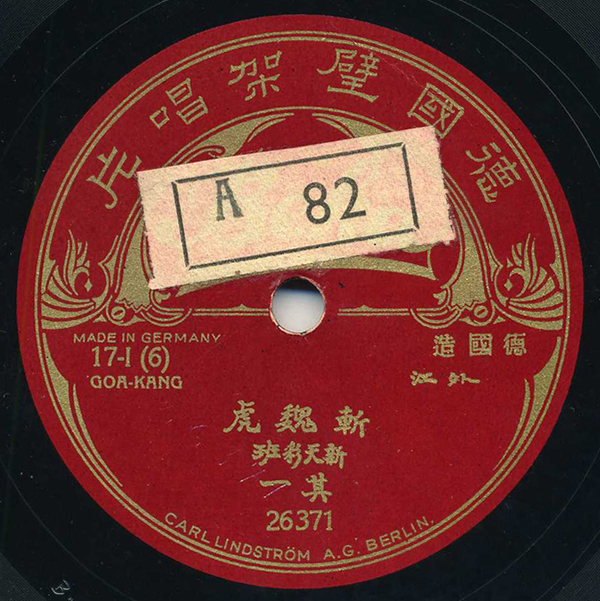
Xin Tian Cai Ban – Zhan Wei Hu, Pt. 1

xin_tian_cai_ban-beka1My friend Dave at Haji Maji posts the best vintage Chinese opera in town, but I thought I’d present another from my own collection. Before I prepped this track, of course I went to Dave and his helpful translators for assistance, and they came through with even more information than I had hoped for.

There are always some barriers when trying to find out information on old records besides what might seem the most obvious barrier:  language. There is no giant resource in a library somewhere that contains everything you’d need to know about record label activity in all the continents, dates of releases, or perhaps more importantly, the style and history of some of the music itself. A huge portion is a secret history. In the case of the rich and long history of Chinese opera, about which I know only a smattering, I am grateful for any information anyone can give me, or directions to be pointed in.

This is an example of Wai Jiang Opera (also known as Gua Gang, or Goa-Kang as it’s spelled on the label), which is related to Teochew Opera, popular in Southeastern China. Wai Jiang was popular with elites apparently, and generally tends to be about heroes, battles, and the like. This piece seems to be Part 1 of a finale in a 13-part opera translated as “The Execution of Wei Hu.” The Wei Hu of the story is the second brother-in-law of the famed Tang Dynasty general Xue Ren Gui. In short, Wei Hu tried to sabotage his brother-in-law’s rule, and this excerpt is the confrontation and subsequent killing of Wei Hu, at the hands of Xue Ren Gui.

It’s a wild and wonderful piece, apparently typical of Wai Jiang opera, with classic examples of blood-curdling screams, the everpresent clashing gongs, and soft, delicate interludes. Thanks to reader ChrisZ, we know it was recorded ca. 1926-1927 by engineer Max Birckhahn, likely in Singapore. Xin Tian Cai Ban, the troupe performing the opera, was from Chaozhou (aka Teochew) in Guangdong Province, and was popular during the very early part of the 20th century.

Xin Tian Cai Ban – Zhan Wei Hu, Pt. 1

Many thanks to Dave Murray and Ms. Javier Li Yong-En of the Thau Yong Amatuer Musical Society.

Technical Notes
Label: Beka
Issue Number: 17-1 (6)
Matrix Number: 26371

Rotorua Maori Choir – E Hara Te Waea

rotoruaI’ve been planning to upload a track by the Rotorua Maori Choir since April of 2008, when I posted a song by a Lithuanian choir. Besides the fact that I truly enjoy today’s piece, it brings up a number of issues which, while I can claim no expertise in discussing, I feel obliged to address nonetheless. So, the ruminations in this post are sort of a continuation of April’s thoughts.

There was very little so-called “ethnic” music recorded in either Australia or New Zealand during the 78rpm era. I know of a set of ethnographic recordings of Australian Aboriginal music made by the Australian Broadcasting Commission, but I’ve not once seen a copy. It may have been pressed as a limited edition. As for commercial releases, there were several sessions of Maori music from New Zealand dating from the late 1920s/early 1930s, on Parlophone and Columbia. The first recordings were by the singer Ms. Ana Hato and her cousin Deane Waretini. While ostensibly traditional Maori songs, they had a distinct Western bent. Both were trained as singers by westerners, and the songs they recorded were accompanied by piano – some were written by non-Maori songwriters. Despite this, Ana Hato had said that they sang “as Maori, not pakeha” – the latter being the Maori term for New Zealanders of European ancestry. Their recordings brought Maori culture and music to a larger audience, making the duo legendary and their music beloved.

The same can be said of the Rotorua Maori Choir, who formed in the early 20th century and recorded at least 30 songs for Columbia in April of 1930. The recordings were engineered by Reg Southey, and the music was conducted and directed by Gil Dech, a music director for Columbia. It’s been documented that it took an entire three months on the Columbia docket for Dech to learn the Maori songs, rehearse the choir of about 30 members, record the wax masters, and wrap up the sessions. Nearly all the tracks are solely choir, without piano. The group rehearsed in the Tamatekapua meeting house at Ohinemutu, often until 2AM, when they would make a recording. According to an article in Te Ao Hou, a magazine published by the Maori Affairs Department in New Zealand, Dech would let the choir harmonize naturally…except when he felt the need to step in, as when the group were singing in unison. The recordings remained in print for years, eventually making it onto LP almost three decades letter. None are in print now.

I must admit that it’s a little difficult to read accounts of a white man dutifully instructing a group of Maori on the finer points of western harmony, or the accounts of Dech becoming frustrated that he had to drag “choir members out of mud pools” in order to get them to rehearsal. But at the same time, when it comes to early Maori music on 78, this is what we have and little else. Further, these recordings are proudly held as an important part of Maori history and as examples of outstanding Maori music – yes, with the exception of two English hymns, it is their songs, their music, their lyrics, their poetry. And, to offer a comparison, what about the African-American “jubilee quartets” as we had here in the States, who sang a formal gospel style based on European/Western harmonies? As difficult as it is for me to reconcile direct interference such as this on a recording – whether from missionaries or simply hired guns from a record company – it’s just as difficult for me to judge these fine recordings as being simply “inauthentic.” Collectors of old music have the reputation for searching out only the raw, the plaintive, the music that stems from rural, poor cultures cut off from urban civilization or industrialization – and believe me, all of that makes me salivate too, with this website being living proof. But again, who am I to judge? In 1931, even the Rotorua Maori Choir’s hymns were strange to western ears, as a review in the April 1931 issue of Music & Letters states: “The singing is harsh, though that may be a national characteristic.”

So, I give you the Rotorua Maori Choir with E Hara Te Waea, or “Love Never Dies” – as good a sentiment as any to kick off 2009.

Rotorua Maori Choir – E Hara Te Waea

Technical Notes
Label: Columbia
Issue Number: DO.57
Matrix Number: T.910

Paris at 78rpm

With the advent of Google Street View starting to move beyond the U.S. (creepiness in tow), we can now investigate some of the forgotten locations that long ago were once gramophone record shops, dealers, or labels. Unlike the street views in New York City, Google snapped fairly crisp images on their jaunt through Paris. Here are some present-day locations that once played an important part in the dissemination of folkloric music on 78s throughout Europe. Click on the images for full-sized photos and locations via Google.

lesoleilbamdecca

leonspeiserphilipsafricavox

pathe-columbiaartinian1pathe

Top Row

Left: 26 Rue des Talliandieres, the former hardware shop and home of Le Soleil records, active from the late 1920s through the mid-1930s and owned by Martin Cayla. Le Soleil pressed hundreds of authentic recordings of French folk music from the Auvergne region, played on accordion, cabrette, banjo, and hurdy-gurdy.

Middle: 133 Boulevard Raspail, the former home of the Boîte Á Musique label, who pressed South American guitar music, African ethnographic recordings, and mainly lots of classical 78s.

Right: 30 Rue Beaujon, the home of Decca Records and Le Chant du Monde, among others. (This building might be new.) Decca was huge, of course – and instrumental in recording early West African music, as was Le Chant du Monde.

Middle Row

Left:  34 Rue des Rosiers, the former home of the gramophone shop of one Léon Speiser. Speiser was definitely active at least from ca. 1930-1940, and sold discs of early Algerian and Moroccan 78s. It is now rather fittingly a falafel shop!

Middle: 50 Avenue Montaigne, the former home of Philips. Philips was tireless in competing with the major labels by recording all across West and North Africa in the late-40s/early-50s, producing some amazing recordings.

Right: 48 Rue Pouchet, the humble (in comparison to Philips) former home of the tiny Africa Vox label. Africa Vox and it’s owner’s home were probably one in the same – they recorded and released a number of beautiful ethnographic recordings in rural parts of Western Africa.

Bottom Row

Left: 251-253 Rue du Faubourg Saint-Martin, the location where the French Pathé label and the French offices of Columbia Records used to reside.

Middle: 28 Rue Lesage, the former gramophone shop of H. Artinian, a one-time dealer in “Disques Armeniens, Grecs & Turcs.”

Right: 72 Cours de Vincennes, the former home of Charles Pathé’s first gramophone shop, opened ca. 1895, about a year before he opened the Pathé Frères company with his three brothers.

Tân-Thình – Chung-Vô-Diệm, Pts. 1 and 2

chung-vo-diem-odeonChung-Vô-Diệm, the title of this recording which dates from Vietnam (then Indochina) around the 1930s, is the name of a woman in a legendary Vietnamese fable. Her story is something along the lines of  “Beauty and the Beast.” Numerous variations must exist, but this is how it was related to me:

Chung-Vô-Diệm made a tragic error while living on Earth, so after she had died, she was dealt a punishment. She was sent back to Earth to live as a horrifically ugly person. She found her home in the mountains, living with a fairy goddess, isolated from the rest of society. While living in the mountains, she trained as a warrior under the goddess, and became blessed with incredible powers that soon became known throughout the country. It was said one arrow from her bow could destroy an entire army of foot soldiers.

Meanwhile, the Emporer had found out about Chung-Vô-Diệm. He summoned her to be his wife and help fight the invading armies. Although she was reluctant to leave because of her shocking appearance, she decided to accept, and wore a covering over her face. The arrival of this famous warrior was was highly anticipated, and she was carried on a throne to the Emperor. Soon, she was defeating throngs of soldiers with her bow.

Eventually, it was time for the Emperor and Chung-Vô-Diệm to consumate their marriage. When the Emperor came to her room that night and Chung-Vô-Diệm removed her covering, he ran screaming in fright. He was so repelled by her appearance that he jailed Chung-Vô-Diệm, keeping her in solitary confinement like an animal. Chung-Vô-Diệm longed for her home in the mountains with her caretaker the fairy goddess, and she escaped.

Time passed. The country was attacked again. This time, the Emperor needed Chung-Vô-Diệm desperately. However, he knew he could not treat her badly as he did before. He knew he had to apologize. He summoned her again and she returned to the city, but she refused to accept his apology. She said, “If you are truly sorry, you must show humility. Bow.” To her surprise, the Emperor bowed in front of her, and stayed bowed outside her bedroom door for days on end.

Finally, Chung-Vô-Diệm opened the door and let the Emperor in. To his surprise, her ugly appearance had disappeared, and she had turned into a beautiful woman. It turned out that the spell placed on Chung-Vô-Diệm could not have been broken unless someone truly loved her.

Unfortunately, there is little information on both the story of Chung-Vô-Diệm, or Vietnamese 78rpm records as a whole, in English. Most likely, this record is part of a multi-volume set, much like how Chinese opera was distributed across the region (though very often they are not found intact today). Clues to this are on the label. Both sides of the label are labeled “thứ  I” or “part 1.” On the upper left is “Tân-Thình” which is one of the performers, along with Dien Khi. Underneath the title is written “Ca Tử-dại,” which is a reference to the classical song the singers are singing over (Tử-dại Oan). The singers are accompanied by a fiddle (probably the two-stringed Ðàn Nhi), a flute (the sáo or tiêu), a plucked lute of some kind, and woodblock percussion (probably the song loan).

I’m including both sides of this record for this week’s post, with many thanks to Linh Dang, Lien Nguyen, Kathie Han, and Phillip Phan, for help with translation and meaning.

Chung-Vô-Diệm Pts. 1 and 2

Technical Notes
Label: Odeon
Issue Number: 157.524
Matrix Number: Tub 265/Tub 266

Giovanni Vicari – Occhi di Bambola

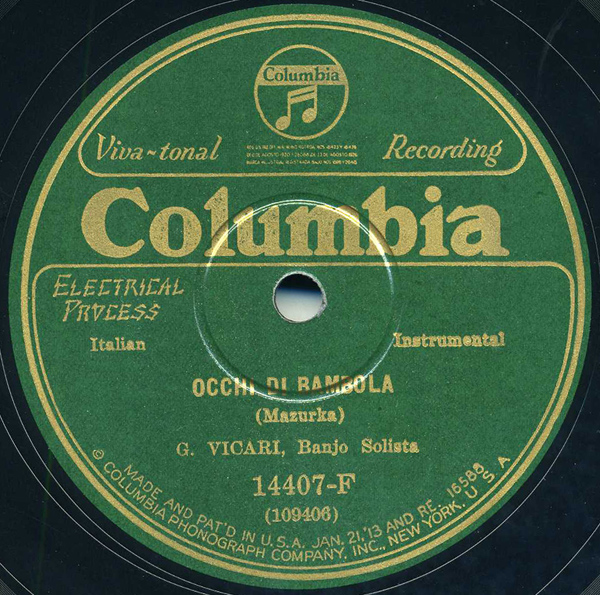
vicariIn previous posts I’ve raved about how the American green Columbia label released some of the very finest Irish, Ukrainian, and Polish folk music from the late 1920s through the early 1930s. Their “F” series (records where the catalog numbers ended in the letter F) stood for “foreign.” Despite the name, the vast majority of recordings on the F series were recorded in North America and marketed to North American immigrant populations. And in terms of output, no market was catered to more than the Italian-American market. Columbia released 1,292 “Italian” records in the F series. Only Polish and Greek records came remotely close, with 799 and 696 releases, respectively.

Giovanni Vicari (1905-1985) was an undisputed mandolin and banjo master, and recorded mazurkas, tangos, and folk melodies from Naples and Sicily, the earliest of which were for Columbia. According to possibly apocryphal legend, he rarely left New York’s Little Italy during his life, and still played for friends in local barber shops and the like. He had to have gotten out of the neighborhood a bit however, as he seems to be the same Giovanni Vicari who played mandolin on several Vivaldi pieces conducted by Leonard Bernstein for a 1958 session. Vicari apparently had many students as well, one of whom was filmmaker and 78 collector Terry Zwigoff (see comments). In the 1940s, Vicari had something of a parallel career, recording Latin music for the Harmonia label under the name “Juan Vicari y su Genial Orquesta”!

When I imagine New York City and its immigrant communities in the 1920s, I can really picture this recording being part of a traveling art form. The record company was located in New York, the artist was in New York, it was recorded in New York, and it was sold in Italian-American neighborhood shops in New York to Italian-Americans – with the New York metropolitan area still having the largest concentration of Italians in North America. The music went from neighborhood to neighborhood, from the shop to homes, and into the ears of families, friends and passers-by – all in a very short radius of one another. It reminds me of my favorite film about New York City and the traveling art form: Style Wars. The art of graffiti writers on subway trains went from borough to borough, day after day, communicating a certain message in a certain language to other graffiti writers. (That film had a major impact on me when I saw its premiere on PBS at age 11, and was partially responsible for me moving to NYC seven years later.) Perhaps the recording will only ever be a traveling artifact – the music itself is the art form.

This piece, “Doll’s Eyes,” was recorded in New York in June of 1928, when Vicari was just 23 years old. It’s got a beautiful sound to accompany the adroit banjo playing – nice and loud.

Giovanni Vicari – Occhi di Bambola

For more Vicari, check out Rounder’s CD Italian String Virtuosi.

Technical Notes
Label: Columbia
Issue Number: 14407-F
Matrix Number: 109406 (2-A-1)

Ukrainska Orchestra Pawla Humeniuka – Kozak-Trepak

humeniukA fiddle masterpiece by a master fiddler.

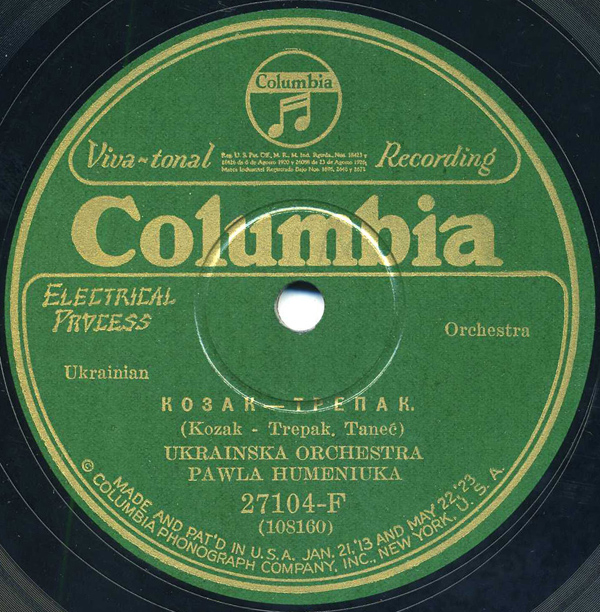
Pawlo Humeniuk was born ca. 1884 in Pidvolochys’k, in the Ukraine, immigrated to the United States around 1902, and began recording for Okeh records in late 1925. Legend has it that Humeniuk was in the store of Myron Surmach, a sheet music and record retailer, when an Okeh records representative came in to query Surmach on whether he knew of anyone who could play “village music,” whereupon Surmach immediately introduced Humeniuk. After several sides for Okeh, Humeniuk and his group of musicians (most of whom are anonymous, still) moved to Columbia Records for a stint that lasted about 10 years, until 1936. He made a few more records in 1940 and his career on records was over. Humeniuk died in 1965, leaving an amazing legacy of early Ukrainian folk music.

Today’s track is a combination of a kozachok (or kozak) and a trepak. The kozachok is derived from the word “Cossack” – and both dances are classically in 2/4 time. In other words, they can be raucous, uptempo numbers for social dancing! Besides Humeniuk’s outstanding fiddling, what makes this track particularly interesting is the addition of the cymbalom, a hammered dulcimer (played by one Ivan Lysechko, the only other known player besides Humeniuk on these sessions).

Ukrainska Orchestra Pawla Humeniuka – Kozak-Trepak

For more Humeniuk, check out Arhoolie’s King of the Ukrainian Fiddlers.

And a special thanks to Ian Nagoski, for his nice write-up on Excavated Shellac included in his article Pearl Diving, in the latest Arthur Magazine. Sadly, it looks like Arthur is hurting financially like so many others – which is not a good thing, as it has consistently been an entertaining and informative magazine. You can download a .pdf of the issue (and donate to the cause) on their website.

Technical Notes
Label: Columbia
Issue Number: 27104-F
Matrix Number: 108160 (2-A-5)

Salifu Titah’s Band – Babu Me-Ee-Say Ala

salifutitah3Approximately 24 million people in Africa now speak the Hausa language, from Western Africa across the continent to Eritrea. However,  it’s in northern Nigeria and the country of Niger where you’ll find the majority of speakers. It is an Afro-Asiatic language, which means it’s in the same general family as Berber languages and the Arabic of Egypt – languages spoken in the northern part of the continent. It can be written in an Arabic script, known as Ajami.

As far as research shows, the first commercial Hausa recordings were made in the Britain in the late 1920s when the Zonophone company, by then an arm of HMV, began releasing the very first recordings for African consumption (as opposed to ethnographic recordings made for study, or for the amusement of Europeans) – most if not all of Zonophone’s releases were actually recorded in England by native Africans, with the records being shipped back to West Africa for sale. There was also at least one Hausa song, recorded in Britain by native Hausa speakers, released on the small Duophone label as well. Odeon may have recorded Hausa material as well, on location, in the late 1920s. In the 1930s, 5 more Hausa recordings were made by Parlophone (by then also an HMV company) on their PO series – raw, rural music featuring the Hausa people’s fiddles, the goje or the kukkuma, with titles written in both Roman characters and Ajami script on the labels. HMV continued releasing Hausa recordings on their JZ series from 1937 onwards.

This record was made ca. 1952, and recorded in Nsawam, Ghana. By then, HMV had been joined by a cavalcade of competitors in the West African 78rpm market: mainly French labels such as Philips, Fiesta, Le Chant du Monde, Voice of Africa, Africa Vox, but also Decca, and near-lost independent labels such as Bassophone, Palmo-Tone, Nugatone…it’s quite amazing. There was a tremendous amount of recording going on, particularly in Ghana, Nigeria, and Sierra Leone.  But labels also went beyond the popular Creole groups of Sierra Leone and the high-life bands of Ghana and Nigeria, presumably to satisfy emerging markets, or simply smaller ones. HMV’s green-labeled TM series added recordings from Togo, as well as those in less commonly spoken West African languages like Adangbe and Awuna.

Which brings us to this Hausa recording, made for HMV and on the TM series. The guitars show an influence of West African pop, but the voices sound real and unpolished. The singers are accompanied by two (?) guitars, drum, and percussion (perhaps a bottle). Alas, I could find no information on Salifu Titah.

Salifu Titah’s Band – Babu Me-Ee-Say Ala

Technical Notes
Label: HMV
Issue Number: TM.1084
Matrix Number: OAB-3699-1

For more on the story of West African recording, there is Craig Taylor’s Savannaphone website, Paul Vernon’s article on the subject, and John Cowley’s excellent piece, “uBungca (Oxford Bags).”

Thanks to Bill Dean-Myatt!