The Excavated Shellac Resources Page

Two announcements today, along with the weekly post.

First, I’ve added a Resources page to the site. This contains a list of in-print CDs that feature international music culled from commercial 78rpm records. Despite the fact I’ve been working on this list for several months, this is definitely a work in progress. My goal is to have it as up-to-date as possible, and obviously I will need the help of contributors! Please don’t panic if you don’t see your favorite CD listed. Directions to contribute are found on that page. However, I can say for starters that the key phrase here is in-print. In this world, reissues sometimes disappear quickly – just as they might reappear out of the blue. Other sources cover out-of-print releases on LP, CD, and cassette. For now, I’m just trying to cover in-print material.

The second announcement is that Excavated Shellac is now on Facebook. If you’re into that, please look me up.

Sheikh Sayed El-Safti – Ana fi Sabil Allah

el-saftiToday’s post brings me back to my favorite music from Egypt – that is, classical works from the era before electricity. Yes, they sound far, far away, but the magic contained therein is worth the effort.

The renowned singer Sheikh Sayed El-Safti* (1875-1939) apparently began recording as early as 1907, possibly for the German independent Favourite label at first. Around ca. 1913 he recorded at least 2 dozen records for the Odeon company. He also recorded for Pathé ca. 1926, Polyphon, Columbia, and the Lebanese independent label Baidaphon in the late 1920s. His last recordings appear to have been ca. 1931.

El-Safti specialized in several song types: the mawwal, a non-metric vocal improvisation on 4-7 lines of colloquial text, the dawr, a song type from the 19th century noted for the choral responses that occur in response to the soloist’s improvisation in its second part (the ghusn), and the muwashah, a strophic song type in classical Arabic which originated in Al-Andalus. (These are simplistic definitions for what is a deep and detailed school of music, but I offer them to illustrate El-Safti’s virtuosity.)

This piece, however, is a qasida –  a classical Arabic poem. It’s English translation is “In the Path of God.” El-Safti is accompanied here by a small ensemble of violin, kanun, and ney. As to when it was recorded, it’s difficult to say. It was released on the German Parlophon label, which may (or may not) indicate that it was originally released on another German label (Baidaphon, Beka – perhaps even Odeon or Favourite). Therefore it truly could have been recorded anytime between ca. 1907 and ca. 1925 – a fascinating time in terms of recorded music in the Middle East.

Sheikh Sayed El-Safti – Ana fi Sabil Allah

Technical Notes
Label: Parlophone
Issue Number: Bx 5708-I
Matrix Number: 1344

* Also commonly spelled Sayyid al-Safti, Said el Safti and Sayed Safti.

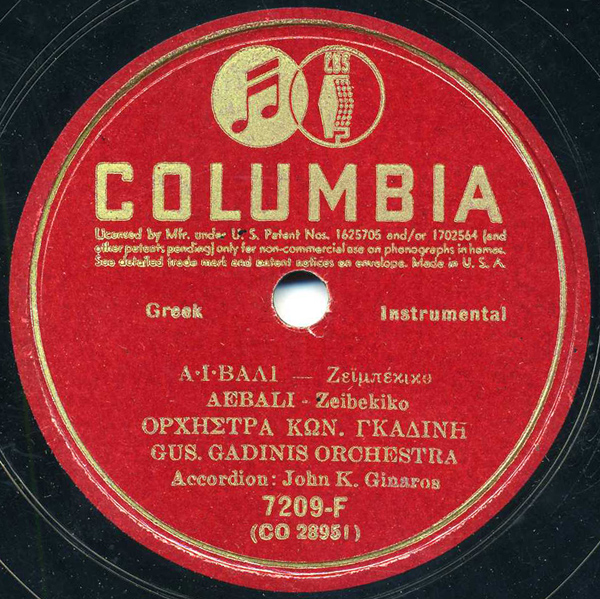
Kostas “Gus” Gadinis – Aebali

gadinisYears ago, when I was completely green when it came to collecting 78s, I sought out arcane knowledge* wherever I could find it. And since I was broke most of the time, I had nothing but time to spend listening to more experienced collectors talk and talk (and play records). During that period, I was getting into early American jazz, blues, and country, but really had no idea where to begin. These collectors were equally irascible and incredibly generous. There was, however, one piece of dubious information that was drilled into me: red Columbias are a waste of your time, son. The mere mention of a “red Columbia” would make older collector’s eyes roll. I’d hear things like, “I drove all the way down to Philly for that estate sale – and all they had were red Columbias!” or “The guy wanted $5 each for all his red Columbias!” They were the most plentiful 78rpm record around (and probably still are), and the vast majority of what you’d find would be Doris Day, Frank Sinatra, big band…top sellers. It wasn’t until a few years down the road that I realized that the red label Columbia 78 wasn’t to be ignored whatsoever – that everything I’d heard up to that point was an elitist myth.

The American Columbia imprint was ravaged by the Depression like many other labels, and it vanished by the early 1930s (after beginning around the turn of the century). By 1939, it had been resurrected with a new red label. And yes, while it is true that it quickly became a profitable bastion of mid-20th century popular music, the red label Columbia, at least in some ways, continued where the old-school Columbia label left off when it came to international folk music. They resurrected Syrian and Egyptian recordings from the 1920s Columbia “X” (for “export”) series, and brought them back to life. They reissued fado records from Portugal, tough to find and out of print for years. And with Greek music – forget about it. The red Columbia label issued loads of amazing rebetika and Greek folk – recordings originally made in Greece and pressed on the European Columbia imprint (by then run by HMV) in the 30s, as well as more current, and often no less rootsy, recordings made in the United States by Greek immigrants.

Which leads me to today’s offering, another continuation of our 4-week exploration into aerophones. Clarinet master Kostas Gadinis was born sometime between 1885 and 1890 in the town of Siátista, in West Macedonia. He immigrated to the United States ca. 1915, and began recording as soon as the early 1920s. Legend has it that Benny Goodman and Dave Tarras saw Gadinis play live, and were suitably blown away, with Goodman referring to him as the “Benny Goodman of Greece.” This terrific instrumental rebetika track, in the sabah dromo (or maqam), was recorded October 22, 1940 in New York, with John K. Ginaros on accordion, and unknown accompanists on oud and drum. The title “Aebali” is better translated as “Aïvali” in Greek or “Ayvalık” in Turkish, and is the name of a town located on the northwest coast of Turkey which had a large Greek population until the end of the Ottoman Empire. This song was apparently also released under the title “Remembrance of Aebali Village.” Gadinis died in 1987.

Kostas Gadinis – Aebali

Technical Notes
Label: Columbia
Issue Number: 7209-F
Matrix Number: CO 28951

Thanks to Tony K. for info, as always – and thanks to Dave M. for turning me on to Gadinis’ work to begin with. For more Gadinis on CD, there are a couple of tracks on Topic’s Blowers From the Balkans CD. There is also an entire CD of Gadinis’ work on the Greek Falireas label, but it appears they are not yet equipped to take credit card orders.

*”I wanna keep my place in this old world – keep my place in the arcane knowledge” – Jonathan Richman, “Old World”

Charles Péguri – Piétro

peguriI’m pleased to present another guest post this week – this time from David Seubert, the curator of the Performing Arts Collection at the University of California, Santa Barbara. David is the man behind the groundbreaking and renowned Cylinder Preservation and Digitization Project, which I’m sure many readers of this blog know quite well. He is also the current president of ARSC, the Assocation of Recorded Sound Collections (at whose conference we were introduced, several years back), and involved in their Copyright and Fair Use Committee which is trying to garner support to make changes to U.S. copyright law as it pertains to pre-1972 recordings in particular. In short – a rock star in the 78rpm world.  – JW

For my first guest post for Excavated Shellac, I’ve chosen a recording of Parisian accordion music by Charles Péguri. Since this is my first (but hopefully not last) guest post, I wanted to pick a disc that is interesting on many levels. First, it’s good music, which always seems to be the number one prerequisite for a record to appear on Excavated Shellac – obscurity never is an end in itself. That being said, as a record nerd I also love all the strange and obscure early French record labels like Disque Aérophone. There seems to be no end to their bewildering variety. This disc also highlights one of the newest collections to come to the UCSB library, where I curate the collection of historic recordings.

Charles Péguri (1879-1930) is the accordionist and composer who is credited as one of the inventors of the musette style of French music popular in the late 19th and early 20th centuries. The musette, a type of bellows-powered bagpipe from the Auvergne region of central France became popular in the Bal-musettes, small Parisian dance halls that catered to the Auvergnat immigrants in Paris in the late 19th century. Later, when Italians like Charles Péguri (whose father, an accordion maker, emigrated from Piedmont in the 1870s) brought their accordions to the dance halls and began playing the traditional minor-key dance forms, one of the world’s classic forms of accordion music was born. Piétro, performed and probably written by Péguri, is an example of this quintessential style of Parisian accordion music that can still be found being played by buskers in the Paris Métro today.

Musette records remained popular through the 1940s, but this early example on Disque Aérophone dates from around 1911. All the Aérophones I’ve seen, including this one, are 27 cm (10 3/4″) discs. Some have paper labels and some have etched labels. Surprisingly (or not, since Aérophone was a French company), some Aérophones like this one are lateral cut and others are vertical. Aérophone discs aren’t common, but they aren’t impossibly rare either. This and about 20 other Aérophones are a recent acquisition by UCSB and are part of the Bruce Bastin/Interstate Music collection. Folklorist Bruce Bastin founded Interstate Music in the 1970s to reissue folk, jazz, country, blues, and ethnic recordings on LP. Over the years, he issued some 850 compilations on LP and CD, featuring music from The Americas and the Caribbean, Europe, Asia, and Africa. His compilations of ethnic music primarily appeared on his Harlequin and Heritage imprints. Ethnic 78s are one of the focal points of UCSB’s collection and the library recently acquired a large portion of Bastin’s collection, consisting of about 10,000 78rpm ethnic and folk recordings from Latin America and Europe, as well as recordings in popular traditions, such as the Argentine tango. This disc is one of hundreds of similar recordings from continental Europe in the collection that falls outside the conventional boundaries of European classical and popular music.

Thanks to Jon for the opportunity to share one of our records and I hope you enjoy the selection. Feel free to send feedback or ask me any questions. David Seubert, UC Santa Barbara

Charles Péguri – Piétro

Technical Notes
Label: Disque Aérophone
Issue/Matrix Number: 874

Note: The French Fremeaux company offers an entire CD of early Péguri recordings which is currently in print. It contains a version of Piétro which may or may not be the same one offered here (we were unable to locate a copy in time).  Regardless, we still thought it was important to highlight this important early recording and label.

Kiko-Kids – Patricia

kikokidsThe events of this week find me wanting to temporarily curtail my sojourn into woodwinds in world music and present something both fun, and from Kenya. So here we are, spending a little time with an East African bar band; a bar band putting their own particular spin on a classic Perez Prado tune, in fact. While the Cuban influence was felt from West Africa, across Central Africa, and into East Africa in the 78rpm era – boleros, rhumbas, and cha-chas galore, especially in Congo – this is one of the few 78s in my personal collection where Africans actually cover a Cuban pop song.

Where were the Kiko-Kids from exactly? According to the scant information available, they were from Kenya, though there’s at least one source that indicates they were itinerant. The independent Tom Tom label, who released this week’s post, was based in Kampala, Uganda, and recorded music from across East Africa. The sleeve for this record, however, indicates that it was recorded in the Equator Club in Nairobi. (Boy, would I love to see some photos from that place in full swing.) Making things more complicated, on one of John Storm Roberts’ long out-of-print CD releases on his phenomenal Original Music label (Dada Kidawa Sister Kidawa) they are credited as Kiko Kids Jazz, from Tanzania. So, it’s quite possible that they should be best referenced as an “East African” band, but let’s, just for today, say they’re from Kenya.

As mentioned, Tom Tom was based in Kampala and their records were pressed there too, by the Opel Gramophone Record Factory, Ltd. “Opel” stood for Dr. Georg von Opel (1912-1971), the German industrialist. Opel was the grandson of the founder of the Opel automobile company, a member of the International Olympic Committee, and Vice-President of something called the International Leisure Association (I must remember to emulate that career track). According to reader Peter Steinringer, the Opel Gramophone company was founded in 1956 and closed in 1960, due to a Ugandan boycott of businesses owned by foreigners. Also according to Steinringer (in the comments), Opel produced 50,000 discs a month and had nearly 200 employees. The independent 78 rpm record label scene in East Africa was varied and broad, with dozens of small and large labels securing their places in the market. Most are also quite scarce, today.

Kiko Kids – Patricia

Technical Notes
Label: Tom Tom
Issue Number: TR 683
Matrix Number: T 5007

Txistularis Hermanos Landaluce y Sr. Elola – Fandango Contradanza

After a long break, we’re back in mountainous Basque country – País Vasco – continuing the theme of woodwinds that aren’t particularly well-known in the West. As I’ve mentioned before, I’m always amazed at the variety of Spanish folk music captured on 78. According to Paul Vernon in Arte Regional, it’s quite possible that no other single country except for the United States had such a wide range of regional styles. The fact that such a broad palette of recordings were made makes sense for several reasons. First, Spain was quite accessible in the early 20th century by record companies in operation in Europe (England, Germany and France – and Spanish independents). But second, and just as important, many of Spain’s rural regions, while comparatively close for engineers to travel to, were remote, autonomous communities. Real roots music was recorded in Spain during those years. Well, phenomenal roots music was recorded throughout the vast majority of European countries during this period (with a few notable exceptions) and it’s all tough to locate, let’s face it.

The txistu is the three-holed, Basque wooden flute, which can be held and played with one hand, so the player can usually play a drum at the same time. Instrumental Basque music during this period was used mainly for dancing – which is obvious in the title to this track, “Fandango Contradanza.” To many listeners this music might sound like processional or formal fife and drum music – but indeed it is authentic, traditional folkdance music.

The Txistularis (“txistu players”) Hermanos Landaluce were a trio, it appears – with Sr. Elola on the tamboril drum, I’m betting. They recorded this and several other tracks in Barcelona, on December 12th, 1928, for HMV. Gramophone’s engineer for this session was H.E. Davidson, the man who managed to record some of the most important Spanish folk music in history – peasant songs from La Montaña, Valencia, and Asturias, actual cave-dwelling gypsies in Andalucia, a true, live “Saetas” flamenco recording made from a bell tower – radical stuff for the company used to planting recording horns in front of Caruso and Chaliapin. Not that you would know it, as next to none of it is available in any format today.

One person did notice the music at the time, however: Rodney Gallop, a British ethnomusicologist before the term was coined, was particularly interested in music from Spain and the Basque region (his Book of the Basques, originally published in 1930, is still in print today). Gallop was one of the first – perhaps THE first – person to champion international folk musics on commercial 78rpm records and it’s a shame he isn’t known more today. He had his particular tastes for sure, but his series of articles for The Gramophone in the 1930s are pieces I turn to for inspiration, once I had read of their existence (thanks to Paul Vernon’s articles and books mentioning Gallop, I found copies of my own). In fact, in the November 1930 issue of The Gramophone, Gallop recommends two Basque recordings by this very band, including this record, to his staid, British audience.

Txistularis Hermanos Landaluce y Sr. Elola – Fandango Contradanza

For more of Gallop’s legacy and Spanish regional music from this era, seek out the Voice of Spain CD on Heritage, the only broad collection of Spanish regional 78s from this period that I know of (though there are 3-4 nice cuts scattered about the Secret Museum series). Unfortunately, while it contains terrific music from nearby Asturias and Santander, it does not contain any of the Basque recordings that Gallop loved so much.

Technical Notes
Label: HMV
Coupling Number: AE 2467
Face Number: 2-260706
Matrix Number: BJ1692

Emin Efendi – Hale Makame

Some of the loudest instruments known to man are double-reed folk instruments in the woodwind family. There’s the dulzaina in Spain, the nadaswaram in India, the bombarde in France, the suona in China, among others. They are classically difficult to play – without continuous practice, a player’s mouth can get tired in a very brief period of time, due to the immense amount of air pressure needed to make a single sound, much less sustain a note. Some even demand circular breathing. Double-reed instruments developed over centuries, beginning in the Middle Ages, as instruments to be used primarily outdoors.

The zurna is the Turkish, or more precisely the Anatolian, double-reed folk instrument, in the shawm group of double-reeds. Similar variations of the zurna exist throughout the Near East. The word itself derives from the Persian “Surnay” – “Sur” meaning “wedding” or “festival”, and “nay” meaning reed or flute. It has 5-7 wide finger holes and can be as small as 14 inches long. It’s an important instrument in Turkish folk music, and I have to say it was interesting to read how writers in the past have tried to grapple with describing its sound. “…A wide-mouthed clarinet, emitting strident, nasal sounds” was how Ottoman scholar Robert Mantran described it. “A kind of shrill pipe” was how H. C. Hony’s 1957 Turkish-English dictionary defined it. It may have been simply noise to those poor souls, but I find it a terrific combination of jarring and captivating.

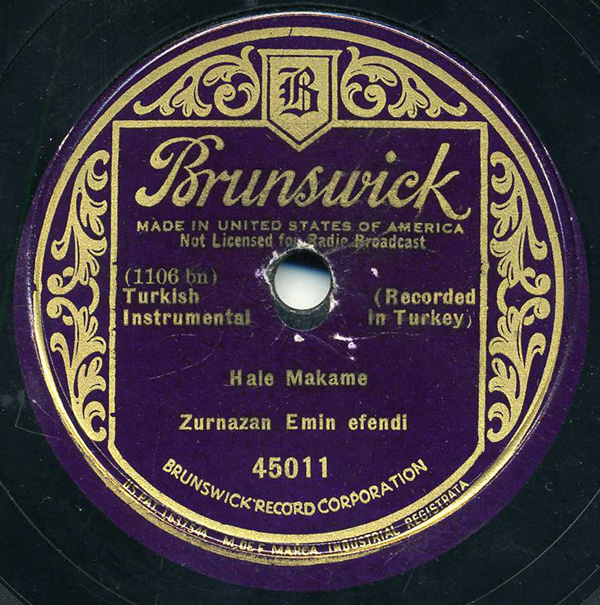
Today’s post is an exceptional, scorching workout on the zurna with accompaniment on oud and percussion (not the usual davul drum); a sparkling recording made in 1930 by the German Polydor company, and also released on a next-to-unknown Turkish series on the American Brunswick label. Interestingly, this recording was bootlegged in the late 40s/early 50s on a small label called Kurdophone, which was part of a family of labels I’ve discussed in other entries (Dictaphone, Perfectaphone, etc.). That is not to say it is common, I’m afraid! As to whether or not it’s definitively Kurdish, I cannot say. My hunch is that it is not, though perhaps some experts can comment. I could find nothing concrete about the soloist, Emin Efendi, except that he was considered a great, along with another zurna master who recorded later for Columbia, Sabahattin Tanınmış. I believe “Hale” in the title refers to halay, the traditional dance. Please see more information on this track from the always helpful volkan, in the comments section.

Emin Efendi – Hale Makame

I would also recommend the Bo’Weavil release of zurna melodies by Zadik Zecharia.

Technical Notes
Label: Brunswick
Issue Number: 45011
Matrix Number: 1106 BN (Polydor matrix)

Brief Ruminations on Sharing

A nice post over at Diagonal Thoughts (in which you’ll find some familiar names) introduced me to an excellent series of articles in the latest print edition of The Wire titled “Unofficial Channels.” It’s a series of short essays on non-traditional methods of sharing and spreading music. Among others, there are pieces on mix tapes, online mixes and compilations, hiphop battle tapes, bootlegs, and “sharity” blogs.

The latter of course interests me greatly. Author Simon Reynolds’ piece mainly focuses on “whole-album blogs” and is basically positive, but he brings up some philosophical criticism of the practice of sharity blogging in general, and its “exhibitionistic quality”:

“The impetus used to be: I have something that no one else has. But with the advent of sharity blogging that’s shifted to: I’ve just got hold of something no one else’s got, so I’m immediately going to make it available to EVERYBODY. While definitely a giant evolutionary step in terms of emotional health, on the level of subcultural capital and the gamesmanship of hip, it’s kinda self-subverting. Or perhaps not, since there is still an element of ego involved, a kind of competative generosity contest between the blogs.”

Then, later:

“Perhaps the real danger represented by the sharing scene is actually to music fans. The whole-album blogs – like the web in general, with its vast array of net radio stations, DJ mixes, official giveaways, etc – drastically exacerbates the condition known as collector-itis, whose symptoms were recently identified by Johan Kugelberg as “constipation, indigestion, flatulence.” Writing in Old Rare New, an anthology of elegiac paeans to the record shop, he described how the music fan succombs to “Falstaffian gluttony…””

I am, in fact, in partial agreement with Reynolds’ & Kugelberg’s criticism regarding “Falstaffian gluttony” – and this is coming from someone who is steeped in the memory institution. There is simply no way to process all available online musical data that one might be interested in. For this website, it has been my premise from the beginning to only post one 78rpm record at a time, in an order that is more or less unexplained yet somehow logical to me, and with corresponding text that hopefully pertains to the experience of listening to those three-to-six minutes. This, with the hope that someone out there – somebody – will respond to that music and go “AH!” as I did, and maybe see that as respite from the “download everything” philosophy. I think – I hope – the experiment continues to be successful.

There is more at work, however, than Reynolds’ assumption that music bloggers use their medium to simply brag about their rare finds and then immediately make them available to the entire world. I’m sure it’s true in many cases (like Mutant Sounds, which is the subject of that paragraph), but I am absolutely resolute in the fact that I use this medium as an exorcism for my own peculiar obsessions. There is no good goddamn reason to be a music collector – they’re a dime a dozen these days. Because being a music collector means that you’ve transcended simply being a lover of music, and moved on to a person who accumulates and obsesses. I am under no allusions that providing music here is some kind of noble act. No way, Ray. But in order to continue to justify this obsession, I must actually do something with it that rewards me somehow – and obviously that is sharing something personal with a listener/viewer.

There are different ways to deal with this obsession. Some collectors I know are musicians and learn from the music on their records, studying it. This has to be extremely rewarding. Other collectors I know produce CDs from their collections with fine transfers and beautiful artwork. Again – another personal triumph in a way, with lots of hard work. Others move online. Right now, I am trying this method – for some reason I believe in it, and the idea that less is sometimes more. It doesn’t come close to being in the same room as the record spins around, but it will have to do until I get a very large house and can invite you all over.

A new post in a couple of days, on schedule, and in musical servitude…

Georgian State Folk Song and Dance Ensemble – Chakrulo

First item of business: a huge thanks to painter, sound artist, and friend of the site Steve Roden for his write-up on Excavated Shellac in The Wire this week (found here). A generous gesture, and I appreciate it.

And now, some music to greet your week with, and to play loudly.

Georgian polyphonic singing is an art that apparently pre-dates Christianity, though it’s used in Orthodox religious practice as well, having been brought to the church most likely through the influence of folkloric tradition. It’s a positively ancient type of music that, since 2001, has been protected from extinction by UNESCO as a “Masterpiece of the Oral and Intangible Cultural Heritage.”

There are disagreements about the precise origins of polyphonic singing in Georgia, although many traditional Georgian choral songs actually date back to a “cult of the grapevine.” There are work songs, songs for festivals, and “table songs” – songs for singing around the table, so to speak: with food and wine. There are several types of polyphonic singing as well: complex polyphony from the Svaneti region in northwestern Georgia, three-part polyphony from western Georgia, and two-part polyphony over a bass drone, which is from Kakheti. They frequently take unconventional harmonic turns.

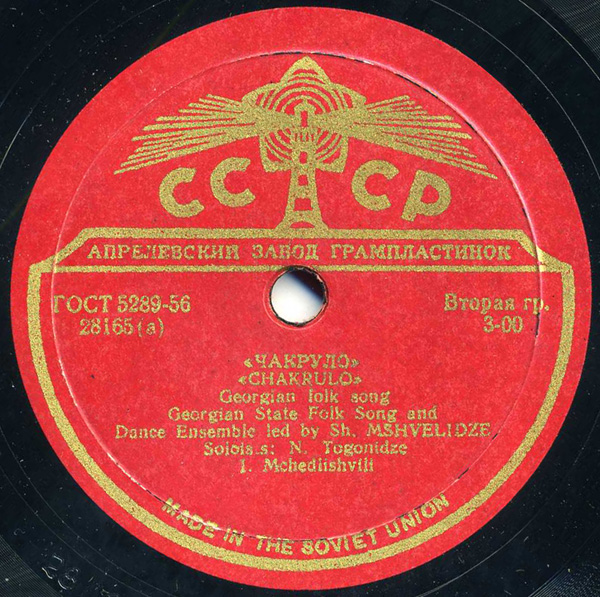
Today’s piece, the Chakrulo, is a table song, and is from the Kakheti region, featuring two soloists (N. Togonidze and I. Mchediishvili) and the aforementioned bass, choral drone. The recording was organized by Georgian composer Shalva Mshvelidze, who since 1930 had been traveling around Georgia recording folk music. This was most likely recorded in Kakheti ca. 1957, and supervised by Mshvelidze (rather than “led by” him, as the label states – that’s my guess, though I could be wrong).

It is also worth bringing up the influence of the Soviet state on such recordings of folk music: it was everpresent. Perhaps with Georgian music, a little less (a sizeable portion of Georgian choral music is made of vowel syllables as opposed to words – less content to worry about!), but certainly all aspects of religion were removed from most folk ensemble recordings. Then again, CCCP released recordings of choir music from the small town of Martvili (then known as Gegechkori), known for its ancient monastery, at around the same time. One thing is for certain, earlier Georgian choral music first recorded by the Gramophone company in the early part of the 20th century features voices that are incredibly raw – though the types of songs and styles are the same. By the same token, a 1988 recording of the Chakrulo by the Rustavi Folk Choir is exceptionally polished. I believe this piece, whatever influence the Soviet monolith had on it, is moving, and exceptional. The concept of “authenticity” is always tricky – when in doubt, lead with your ears.

Georgian State Folk Song and Dance Ensemble – Chakrulo

For early Georgian choral music, we are lucky to have the CD Drinking Horns and Gramophones, released on the Traditional Crossroads label.

Technical Notes
Label: Aprelevski Zavod (SSSR)
Issue Number: 28165 (a)
Matrix Number: 28165/3-1

Lili Labassi – Mazal Haye Mazal

“She’s Still Alive”

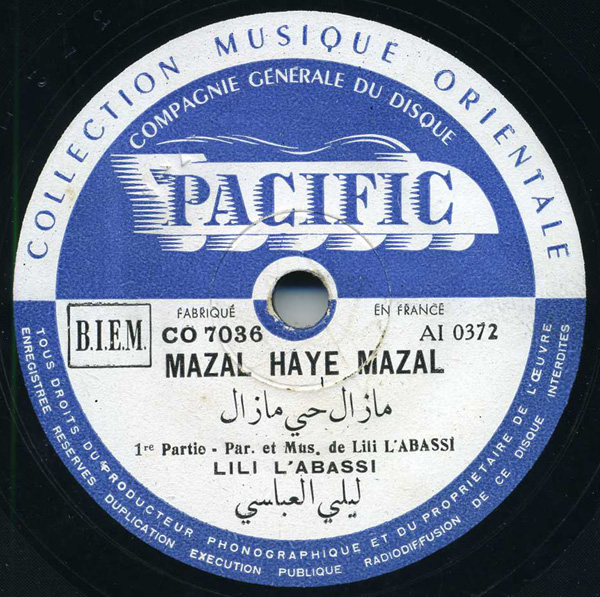
That is the English translation of today’s track from the great Lili Labassi (spelled L’Abassi on the label, and also known as ‘Lili El Abbassi’), a well-known Jewish chaabi singer and violinist from Algeria. This piece was released in the early 50s on the French Pacific label in their “Collection Musique Orientale” series, and was likely distributed in both North Africa and Algerian enclaves throughout 1950s Europe (Marseilles, for instance).

Labassi began his 78rpm-era recording career in 1929 with HMV. He later recorded with Polyphon in the 1930s, Columbia, and finally Pacific. Chaabi, what Labassi is known for, is a loose term essentially meaning “popular” or “of the people.” There is chaabi from Algeria, such as we have here, but there is also chaabi from Morocco as well. Algerian chaabi developed in Algiers and is indelibly linked to the masterful Hadj Mohamed El Anka, considered the father of the genre. His chaabi was an older style, employing rootsy folk melodies and poetry. But by the mid-1950s and the start of the Algerian War (1954-1962), a modern chaabi style had become popularized.

Labassi was a contemporary of El Anka, but I think this piece seems to fall right in between the rootsy and the modern. Playing violin and singing, Labassi is accompanied by oud, piano, kanun, and percussion. Both sides are included on this track, and you’ll hear why I decided to include both – not just because it’s a lengthy piece and it would be necessary to include both sides anyway, but because the second side (beginning at about 2:47) is the more improvisatory side, with Labassi showing off his considerable vocal skills. This was very common in recordings in North Africa and the Middle East, when it came to extended, 2-sided songs – time would nearly always be made for improvisation, or a brief ‘taxim.’

Lili Labassi – Mazal Haye Mazal

Technical Notes
Label: Pacific
Issue Number: CO 7036
Matrix Number: AI-0372-2/AI-0373-2

Thanks to Karim Boughida for the title translation [updated and changed 10/14, as Karim listened to the song and realized that the title’s meaning was different]! For more Lili Labassi, try the Secret Museum’s North Africa volume. In 1998-1999, two volumes of a CD set of Labassi’s work titled “Le Genie Du Chaabi” was released, but it seems all but impossible to find now. I have no idea about sound quality, either…

And the new Honest Jons release is upon us. It looks wonderful, and it includes a track by the one, the only, Rizeli Sadik. Hmmm, I wonder where I’ve heard that name before…