Tamburacı Osman Pehlivan – Anadolu Kaşık Havası

pehlivan.jpgI became completely obsessed with Turkish psychedelic music several years ago and began searching out and accumulating Turkish 45s at a rapid clip. Since then, “Anadolu pop” has been discovered so to speak, with excellent reissues on the market by labels like Finders Keepers and Shadoks.

One of the first Turkish psych tracks that knocked me out was the Lambaya Püf De single by the great Bariş Manço (you can hear it here, archived on WFMU courtesy of DJ Trouble – or on the stellar Andy Votel compilation Prog Is Not a Four Letter Word).

I noticed at the time that Manço’s song was credited to one Osman Pehlivan. Not long after, I found another version of Lambaya Püf De – a harder-edged cover by Urfali Babi, this time with a song credit to Merhum Osman Pehlivandan. Who was this person? I gradually pieced it together.

This melody, in Turkey, is historic. Today’s post, long overdue and unavailable in any form as far as I can tell, is the original performance by tanbur soloist Osman Pehlivan (1847-1942), from which all of these blistering Turkish psych versions are based. Pehlivan’s wonderful solo was recorded in Istanbul by engineer Edward Fowler ca. July 1928, and still pretty much rocks. The title, loosely translated, means “Anatolian spoon song” which refers to a folk song which would be traditionally accompanied by wooden spoons, which are held in each hand and played a little like castanets. Pehlivan would have been 81 when this was recorded.

It’s still commonly performed today. For visual accompaniment, take a look at this performance of the kaşık havası here. Or here. And here are two terrific kaşık players. Even just a few weeks ago, I heard Arif Sag’s version of the song, which is actually titled Osman Pehlivan, and has since been reissued on the new compilation Obsession (and can be heard here, archived by Brian Turner, also on WFMU). The melody will certainly live on.

Tamburacı Osman Pehlivan – Anadolu Kaşık Havası

UPDATE: An intrepid reader pointed out to me that a version of this song performed by Pehlivan is available, under a slightly different title, on the Folkways collection “Folk and Traditional Music of Turkey” on an out of print LP, or custom made CD. However, if you listen to the sound clip, one can immediately tell that the Folkways recording is a completely different version than this one, which was no doubt recorded much earlier.

Technical Notes
Label: HMV
Coupling Number: AX 853
Face Number: 7-219429
Matrix Number: BF 2129
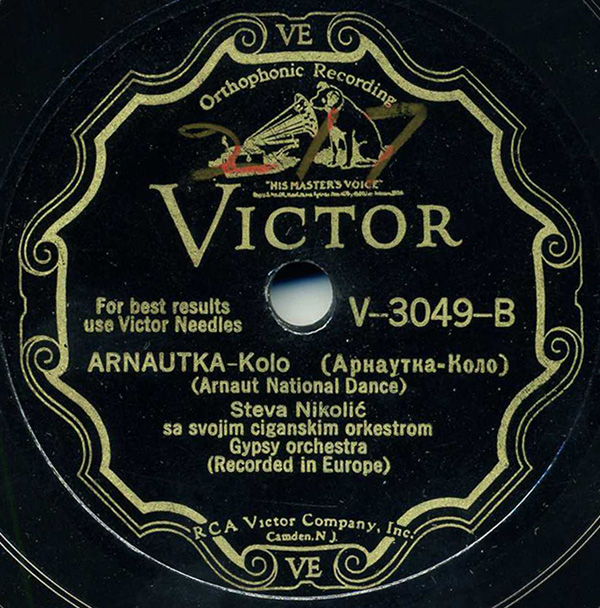
Steva Nikolič – Arnautka

nikolic.jpgSometimes I catch myself being overly swayed by certain music because of its rawness, or because it seems on its surface completely alien to me, as I close my eyes and ignore that I live in 21st century California. This is not a terrible thing to be swayed by (and perhaps is what keeps me alert), but I am often flung out of that narrow listening mode by music that I might have otherwise passed over that isn’t ostensibly “raw.” Today’s post is one of those recordings.

I had found this record years ago and played it once, quickly forgetting about it. Recently, I spun it again and was captivated. Recorded in December of 1927 in Belgrade, Serbia (then Yugoslavia), Steva Nikolič’s brilliant violin playing and the murky, sonorous backup accompaniment are haunting in a way that other “gypsy orchestra” records are not, in my listening experience. “Gypsy” music – music of the persecuted Roma people – is varied. This piece sounds similar to Hungarian Roma/gypsy music from the same period, but is a far cry from the music of the Roma in Spain, flamenco.

The title “Arnautka” is, according to the label, an “Arnaut National Dance.” Arnaut is the Turkish word for Albanian, so this may have roots there as well. Perhaps someone can help us out. Also of interest, this track was recorded in Belgrade by HMV engineer George Dillnutt, who, 25 years before he recorded this track, accompanied Fred Gaisberg on the very first recording expedition to the Near and Far East.

Steva Nikolič – Arnautka

Technical Notes
Label: Victor (from HMV master)
Coupling Number: V-3049
Matrix Number: BK2636

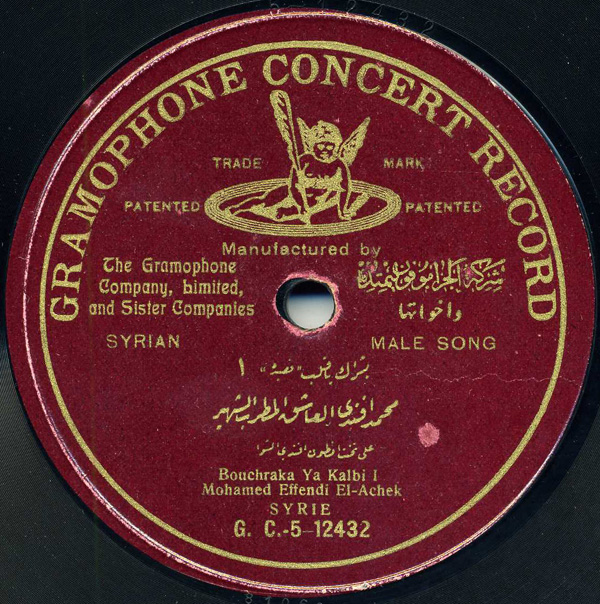
Mohamed Effendi El-Achek – Bouchraka Ya Kalbi

el-achek.jpgJournalist Eddie Dean, in “Desperate Man Blues,” says some wise words about rural American musicians recording in the 1920s:

“They had three minutes of immortality…You hear, like, not a wasted note.”

He speaks the truth. Most early recordings were done in one single take, or perhaps two. In the U.S., for the most part only the best selling artists, generally pop or jazz artists, were allowed multiple takes. Lesser-known or rural musicians and singers had to be prepared to bring their best to the session.

Perhaps this is a more salient factor to ponder in terms of global musicians in cities or rural villages, most of whom were never in a million years given more than one chance to record their songs. And Dean was speaking of the U.S. niche country and blues markets of the 1920s. What about the super-niche markets of, say, Malaysia, Uzbekistan, or Tunisia during the first decade of the 20th century? One would imagine that those musicians had even less room for error, if that’s at all possible.

Then again, ten to twenty years before U.S. companies were recording their own country’s rural or regional musics, their sister companies in Europe had been traveling much of the world in search of these niche markets and recording thousands of records. Sure, most likely the European engineers had no idea what they were recording and disliked the music, but they were captured, nontheless.

Today’s post is an example of the thriving market in the Middle East. Over 100 years old, it is a genuine artifact. Even in beautiful shape, the surface noise that is normal from recordings of this vintage is unavoidable. A tangent: if you are interested at all in old recordings of any stripe, you must learn to love surface noise. It has, in a way, become part of the music itself. I’m speaking of the inherent sound of needle on shellac groove, not necessarily damage to the record itself. (If you’re not already familiar, there’s a whole arcane language that has evolved around 78rpm damage: tics, pops, lams, hairlines, stressed grooves, edge chips…sigh.) Remastered CDs that remove all semblance of surface noise inevitably end up removing much of the music itself, and a crucial part of the listening experience.

Mohamed Effendi El-Achek was from Damascus, and recorded this and numerous other songs ca. January of 1908, in Beirut, which was a center of Middle Eastern recording. He sings over a subtle accompaniment of kanun and violin – the musicians shouting encouragement throughout! (Both sides are included here.) The title translates to “Be Happy, My Heart,” and it is a love song. A total of seven minutes of true immortality.

Mohamed Effendi El-Achek – Bouchraka Ya Kalbi

Technical Notes
Label: Gramophone Concert Record
Issue Number: G.C. 5-12433
Matrix Number: 8106o/8107o

Boateng – Nofeno Ye Nagbe, Pt. 1

boateng.jpgIt’s one of those balmy, breezy days that occasionally crop up during a Southern California winter…the old French doors are open and the sun is shining in. A tease to make you yearn for summer, which I do quite often – it doesn’t take much.

To counter this yearning, I thought I’d offer up some balmy, breezy, and very early highlife from Ghana. Boateng and his guitar-less group with his piano (possibly one of the first highlife groups to ever include a piano in their band?), sax, and fiddle, recorded this and several other songs in Accra, ca. October 1937 for HMV. It’s got a swoony quality that I like. These are not common.

Under its sister label Zonophone, HMV had recorded over 500 records of West African music in the late-1920s. However, financial collapse within the recording industry during the Depression caused a 6 year gap in West African recording by HMV. They returned with gusto in 1937 however, with a whole variety of number series’ (including this one, the JZ series) for export to West Africa.

Geek talk: despite that my copy of this record is in “New” condition, there’s the issue of the 1930s HMV pressing, which can often be hideous. This is a prime example. I did my best to clean it up, which was not easy with my humble utilities, but I think it ultimately holds up.

Boateng – Nofeno Ye Nagbe, Pt. 1

If you’re interested in more 1930s music from West Africa, definitely check out the fine work that Craig Taylor is doing over at Savannahphone.

Technical Notes
Label: HMV
Issue Number: J.Z. 220
Matrix Number: OAB.413

Thanks to Bill Dean-Myatt for details!

Juan Rodríguez – Prenda Gaucha

rodriguez.jpgReturning to South America for a moment, I thought I’d post another pre-tango folk song, this time from gaucho country.

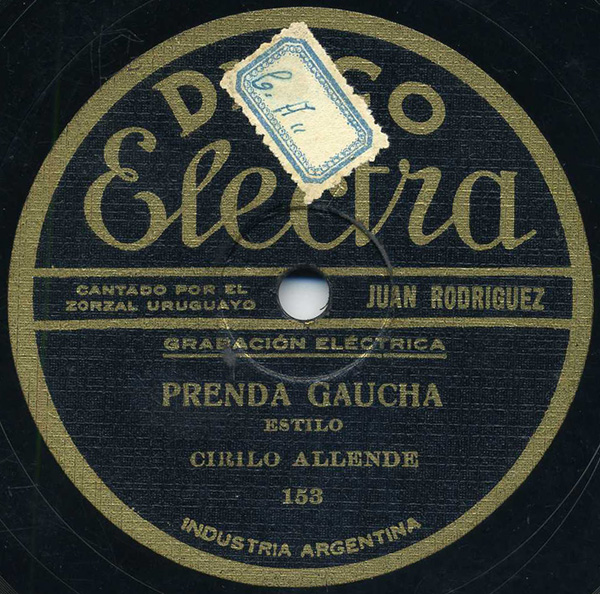
Little is known about Juan Rodríguez, except that he settled in Buenos Aires around 1920, and eventually became an artistic director for the fledgling Disco Electra label. According to the information I’ve been able to dig up (most of it from Omar Facelli in Montevideo), Rodríguez recorded approximately 25 records for Disco Electra, most of them stellar examples of criollo folk songs from the River Plate region, accompanied by guitars. He later recorded some for Columbia before passing away ca. 1935. This piece stems from ca. 1928, by my best guess.

Disco Electra was, as far as I can tell, an early independent label out of Buenos Aires. Because Victor, Columbia, and Odeon essentially monopolized all the recording in the region, smaller outfits like Disco Electra probably had to work hard to compete. Despite the fact that the quality of their pressings can’t hold a candle to the major labels’, and that they were still recording acoustically until at least 1928-1929 (most companies worldwide had switched to microphone recording by 1926), important music was recorded on Disco Electra…and here’s but one example!

Juan Rodríguez – Prenda Gaucha

A note: my bandwidth usage has skyrocketed this month, interestingly. While this heartens (and kind of amazes) me that so many people are downloading and listening to this lost music, I will have to (insert hangdog look here) keep a sharp eye on usage. In other words, I may have to resort to what every other blog does – keeping only the most recent tracks downloadable. I’ve kept this issue at bay by purchasing what I thought was a massive amount of bandwidth, but I may have to humbly ask your forgiveness in this arena. If you see early tracks disappear in the next week or so, don’t be surprised. Get ’em while you still can!

Technical Notes
Label: Disco Electra
Issue Number: 153
Matrix Number: 815

Pandit Omkarnath Thakur – Garawa Mayi Sang Lage, Pts. 1 and 2

omkarnath.jpgThe life and long career of renowned Khyal vocalist Pandit Omkarnath Thakur (1897-1967), or Pujya Pandit Shree Omkarnathji Thakur as the record label at right would have it, is documented colorfully elsewhere. Born in poverty, he eventually spent years in Pandit Vishnu Digambar’s music school in Bombay, and became the principal of a music school by age 20. By ca. 1934-1935, when this record was pressed in India, he was already recording masterworks.

Blessed with, according to legend, his father’s “precious mantra” written on his tongue, Thakur’s vocal style is immediately dramatic. He improvises and modulates his voice on lyrics and syllables in an almost dizzying fashion (most apparent in Part 2 of today’s post), known as bol taan in Indian classical music.

This well-known track was most likely released decades ago on LP – it was also released on a hard to locate Indian CD titled “Golden Milestones” but as far as I can tell, the sound quality on that CD is quite poor. Therefore, I offer both sides of this fine performance here.

For more Thakur music on the web, check this post on Mehfil-E-Mausiqi.

Omkarnath Thakur – Garawa Mayi Sang Lage, Pts 1 & 2

Technical Notes
Label: Columbia
Issue Number: VE.1016
Matrix Number: CEI.7358-1, CEI.7359-1

Levon Hampartzoumian – Menk Arghez Zinvor

levon.jpgNow, we move from Azerbaijan to Armenia. Well, not exactly Armenia per se, but Istanbul/Constantinople, where this Odeon recording was made probably in the late teens-early 1920s.

While I could not locate any information on the singer, Levon Hampartzoumian (not to be confused
with the present-day banker in Bulgaria of the same name) or the accompanying two violinists, the song is a stirring, Armenian classic. It’s true title is transliterated as “Menk Angeghdz Zinvor Enk” and is an example of an Armenian patriotic, revolutionary song. A song sung by many in the past to unite Armenians across the world and give recognition to their struggle, it is still sung today (see here).

The English translation is roughly “Honest Soldiers Are We” (thanks, Tina!), and is associated with the Armenian Revolutionary Federation. I was able to find the lyrics translated into Western Armenian, so you can follow along here.

Levon Hampartzoumian – Menk Arghez Zinvor

Technical Notes
Label: Odeon
Issue Number: 46266
Matrix Number: x.c. 2085

Teyyub Damirov – Jeirany

damirov.jpgI’m kicking off February with a series of musically intense posts. Get ready.

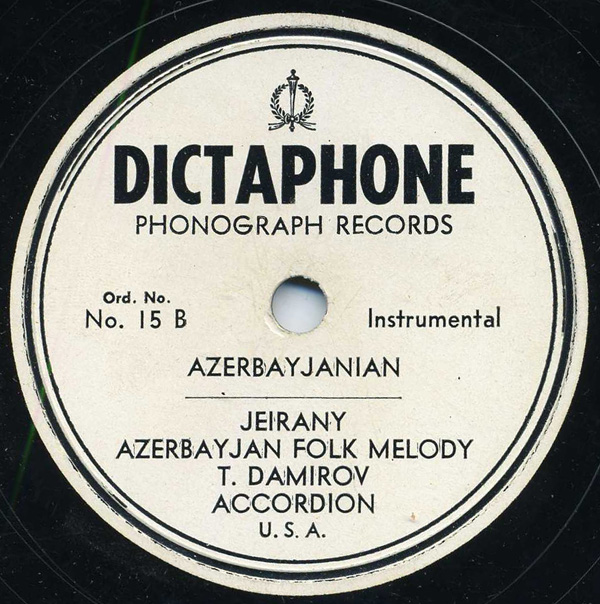
Today, we move over to Central Asia for a blistering solo by Mr. Damirov, performed, I believe, on the garmon, a Russian button accordion commonly used in Azeri folk music. I find this piece to be absolutely perfect – both frenetic and fluid, deeply traditional yet utterly contemporary.

The “Dictaphone” label – well, that’s a story in itself. In the US in the early 1950s or so, someone, somewhere (a record shop? a multilingual entrepreneur?), decided to bootleg music from the Near and Central East, presumably for sale to immigrants in the States, likely in New York City (the Balkan record label shop, perhaps?) or in Fresno, California. This someone set up a series of more or less uniform-looking record labels with the same typeset, and little to no pertinent information on them, save for the artist and title. Sometimes, the original title was changed or altered. “Perfectaphone” is the label that I’ve seen most often – that was for Turkish music. “Armenophone” is another that crops up, obviously the Armenian imprint. Then there was “Dictaphone” for music of Azerbaijan, Uzbekistan, and other Central Asian countries, there was Smyrnaphone, a label called simply Eastern – and maybe the least common, “Kurdophone” for music from Kurdish regions (though most if not all of the discs I’ve seen on this label are Turkish).  This beautiful Dictaphone record was almost certainly bootlegged from Russia’s state-run Melodiya label, which was a real giant in terms of output.

Whomever was running this outfit had a pretty good ear – most everything I’ve heard on all of these labels is really quite good, if not stone beautiful. Yes, Perfectaphones have quite a bit of Turkish popular music from the mid-20th century on there, but also plenty of folk and classically-tinged material. And, surprisingly, as bootlegs they sound pretty nice.

For more Damirov, check the Secret Museum’s Central Asia CD. There are some garmon players on YouTube, as well – try here.

Temiuv Damirov – Jeirany

Technical Notes
Label: Dictaphone (originally from CCCP, most likely)
Issue Number: No. 15
Matrix Number: n/a

Stapleton Brothers – Call of the Whip-Poor-Will

stapleton.jpgTwo posts today.

I received an e-mail request asking to post some early American country music. Since early country music was what originally led me to collecting traditional music from outside the U.S., I thought: great idea! However, like the rest of the material on Excavated Shellac, I wanted to stick to music that had not already been collected on CD. This was a difficult task. Sure, all my 78s by essential artists like Uncle Dave Macon and the Carter Family were on CD. But, so were slightly more obscure and harder-to-find country records. The three records by the Binkley Brothers Dixie Clodhoppers? On CD. “Texas Quickstep” by The Red Headed fiddlers? On CD. Cousin Emmy? On CD.

Then I started combing through the records that I simply had an attachment to…”Methodist Pie” by Bradley Kincaid? On CD, too. “Gonna Swing on the Golden Gate” by Fiddlin’ John Carson? On CD. On and on…

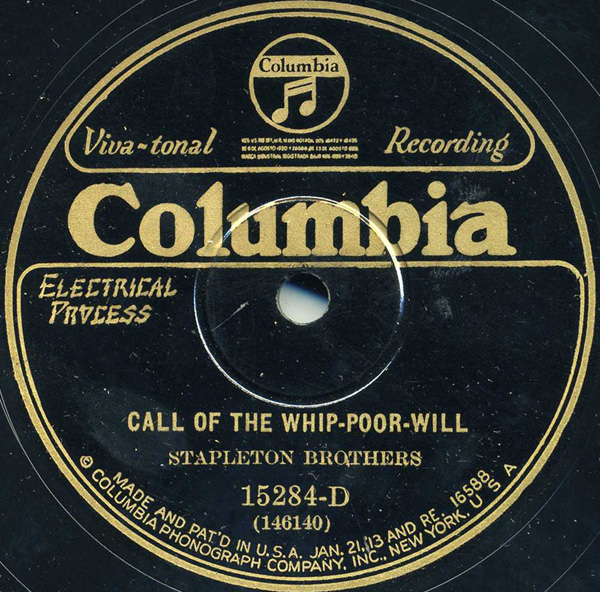
Then I remembered this record – the quaint yet lovely “Call of the Whip-Poor-Will” by the Stapleton brothers, recorded by Mitchell and Mason Stapleton in Atlanta, Georgia on April 19, 1928. Not on CD, at least as far as I can tell. It’s always been a favorite of mine for those inexplicable reasons one has for liking a particular song.

Stapleton Brothers – Call of the Whip-Poor-Will

Technical Notes
Label: Columbia
Issue Number: 15284-D
Matrix Number: 146140 (1B-2)

Ode to the “Istwanat”

sleeve.jpgIf you’ve encountered 78 rpm records from across North Africa including Egypt, you’ve probably run across the phenomena of the spoken introduction. A voice – not the voice of the performer, generally – states the name of the record company and the artist, and then the music begins. The announcement always begins with the Arabic word for Gramophone record, or disc, which I have seen transliterated in CDs as “istwanat” (or “astwanat,” and also “estwanat” depending on the accent), which is then followed by the name of the record company. These brief, sonically beautiful little announcements appear on many – but not all – 78s from the region, and even on mid-century Arab-American 78 recordings on labels such as Alamphon.

Why? Most likely because of the strong oral tradition in North African and Arab culture. I’ve edited a very brief collage of them for download, where you’ll hear announcements for Pathé, Polyphon, Pacific, and others. Loop this, and listen to it repeatedly before sleeping, like The Conet Project. Like voices from outer space, they have traveled long distances especially for your ears.

Istwanat