Ukrainska Orchestra Michala Thomasa – Kolomyjka Buczaćka

thomasa.jpgTo the person who spoke another language the phonograph assumed a more important role. In a country with strange customs and values, where other people spoke an unfamiliar language, a phonograph could and did provide a means of emotional retreat to one’s homeland. Records of familiar songs reinforced traditional values and an immigrant’s sense of self-worth…It meant that at least one American business was soliciting his patronage by recognizing, respectfully, who he was. — Richard K. Spottswood, “Commercial Ethnic Recordings in the United States,” in Ethnic Recordings in America. Washington, DC: Library of Congress, 1982.

Earlier in the blog I posted some Polish-American village music, so today I’m offering up a nice example of Ukrainian-American village music, complete with strong fiddle playing by Michal Thomas, recorded in New York City in March of 1931. Thomas, on the lead fiddle, is accompanied by a second fiddle, piano, tuba (I believe) and percussion in the form of bells.

The Kolomyjka (or kolomyika) is a well-known, traditional folk dance from the western Ukraine, getting its name from the Carpathian city of Kolomyia. Like many folk dances, it can be danced in a circle, and is usually performed on special occasions, such as weddings.

Columbia ruled the Ukrainian-American market in the late 1920s and early 1930s, recording approximately 430 Ukrainian records beginning in 1925. Interestingly, very few recordings were made by the major labels’ counterparts in Europe during the 1920s, making Columbia’s series especially important, musically and historically.

Ukrainska Orchestra Michala Thomasa – Kolomyjka Buczaćka

For more Michal Thomas, you can find a track on Arhoolie’s Ukrainian Village Music CD, and a track on the out-of-print LP on New World, Song of the Shepherd: Songs of the Slavic Americans.

Technical Notes
Label: Columbia
Issue Number: 27296-F
Matrix Number: 112873 (1A-1)
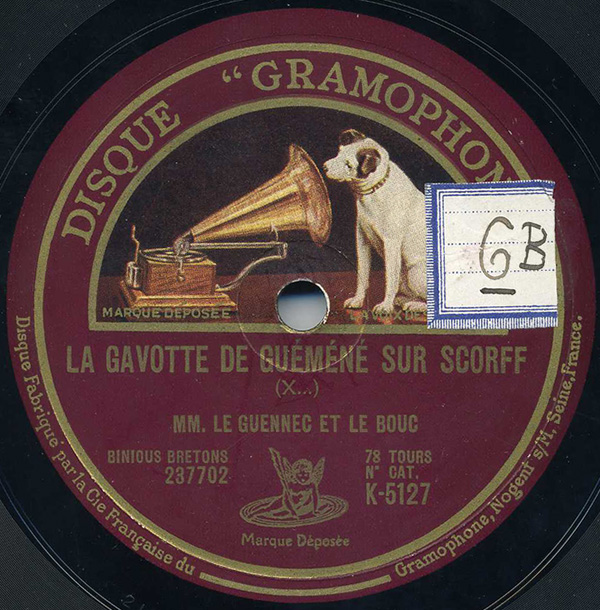
Mm Le Guennec et Le Bouc – La Gavotte de Guémené-sur-Scorff

guennec.jpgToday’s feature: the Breton bagpipe.

If you haven’t heard Brittany bagpipe music, you’re in for a treat. It’s different from others simply because the older, small-in-scale Breton pipes, known as the binioù (or the binioù kozh), are tuned very high – the lowest note on the binioù is equal to the highest note on the typical Scottish bagpipe, for instance. As with this piece, a gavotte meant for folk dancing, the pipes are typically accompanied by a bombarde, an oboe-like reed instrument tuned an octave below the binioù. The two play together in the traditional style, overlapping musical lines.

This track appears to have been recorded by two Gramophone engineers, Edward Fowler and Douglas Larter, in January of 1927. The title refers to the small village of Guémené-sur-Scorff. And, I should mention that the flip side of this record, equally as nice, is featured on the Ace & Deuce of Pipering CD released by Heritage…which looks to be out of print now, so best to search the usual avenues for that one.

Mm Le Guennec et Le Bouc – La Gavotte de Guémené-sur-Scorff

This week’s mail brought me the latest Dust-to-Digital 2-CD release Victrola Favorites, which is just a beautiful work of art. I highly recommend this as well as the other D-to-D releases that I’ve previously raved about (Black Mirror, and there’s also Melodii Tuvi). Friend of the site Rob Millis put this together with his partner Jeffrey Taylor and the accompanying 100+ page book is museum quality.

Technical Notes
Label: HMV
Coupling Number: K-5127
Face Number: 237702-R
Matrix Number: 2L-BFR 294

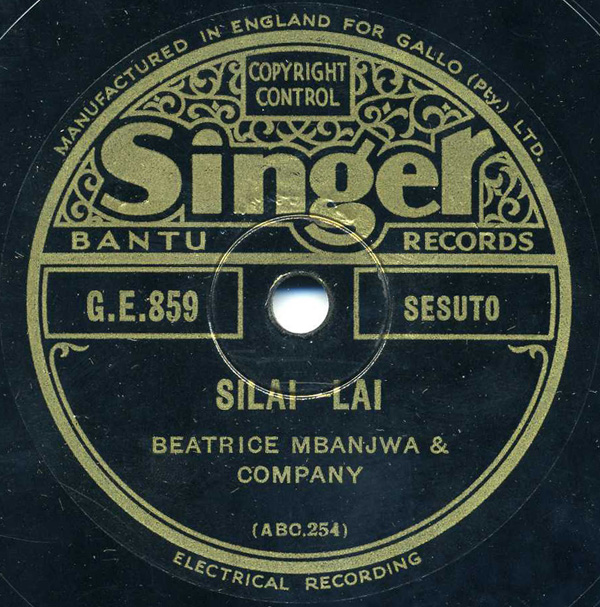
Beatrice Mbanjwa & Company – Silai-Lai

mbanjwa.jpgIn a way, the person we have to thank for this record is probably Eric Gallo. In 1926, Gallo was a 21-year old budding entrepreneur in Johannesberg, S.A., and owner of a small gramophone shop. Around 1930, after noticing that companies such as Columbia and HMV had begun to send engineers to South Africa to record local music, he decided to record local musicians on his own and attempt to start a business, with records being pressed in England and sold out of his own shop. Success followed. By 1932, he had set up the very first sub-Saharan recording studio. In 1949, he built a record pressing plant.

At first, his label was named Singer, then later Singer-Gallotone, then, by the early 1940s, simply Gallotone. It was a major challenge to all the foreign labels attempting to do business in the country – certainly the most important South African label in history. Gallo branched far from South Africa to reach other markets, contracting ethnomusicologist Hugh Tracey to travel as far as Uganda to record local musics. This was foresight on Gallo’s part, as the bulk of the income generated by Gallotone came from sales of Afrikaans records.

This piece by Beatrice Mbanjwa and her group, accompanied by piano and strummed banjo, was probably recorded around 1939 or 1940 when Gallo’s label was still named Singer. I could find little information on Ms Mbanjwa, except that she did take part in Johannesberg’s massive 1936-1937 “Empire Exhibition” as a performer, along with the Darktown Strutters, and many other musicians.

Beatrica Mbanjwa & Company – Silai Lai

Technical Notes
Label: Singer
Issue Number: G.E. 859
Matrix Number: ABC.254

Jianhong He – Yu Wang Tan Ming

jianhong_he.jpgI had the chance to visit with my friend Haji Maji, aka Dave, this weekend, while I was out of town. Although the visit was too brief, it was fun to be around someone equally as obsessed, and with a genuine love of lost and found early music from outside of the U.S., on 78rpm. Great, rare music was spun.

So, with his musical interests in mind, I decided to upload one of my Chinese records. I believe it stems from Hong Kong, and was recorded by the independent German Beka label, probably from the late teens/early 20s…give or take. The title, Yu Wang Tan Ming, translates to “The Fisherman’s Lament.”

A detailed history of the Beka label, founded in 1903, has yet to have been written, but surely would be fascinating. The German record industry was hugely dependent on export sales, and Beka were already recording in Asia as early as 1905-1906 (see the Excavated Shellac Vietnam entry). Several years later, the company was then bought by Carl Lindstrom, A.G., a maker of gramophone players. Lindstrom was eventually sold to the Columbia Graphophone Company in 1926, although the German branch of Lindstrom seems to have operated independently for some years afterwards. Asleep yet? Then, time to listen!

Jianhong He – Yu Wang Tan Ming

For more on the history of early recording in Asia, check Pekka Gronow’s article “The Record Industry Comes to the Orient,” from Ethnomusicology 25/2 (1981): 251-284.

And for more Chinese opera, head over to Haji Maji!

Technical Notes
Label: Beka
Issue Number: 223 (2)
Matrix Number: 22769 (Bn)

Finally!

Here’s to the people at Crammed Discs for their Roots of Rhumba Rock CD set. Not only is it a beautiful collection of Congolese music from 78s on the stunning Loningisa label (something I love to collect!) they also printed this message in the CD’s booklet:

“WARNING: Although the greatest care has been put to the digital transfer of those original 1953-55 Congolese classics, the limitations of the Compact Disc can obviously not do justice to the glorious 78 rpm disc analog sound.”

Wow, somebody really GETS IT!

See you around the 1st. Happy all that stuff to you and yours.

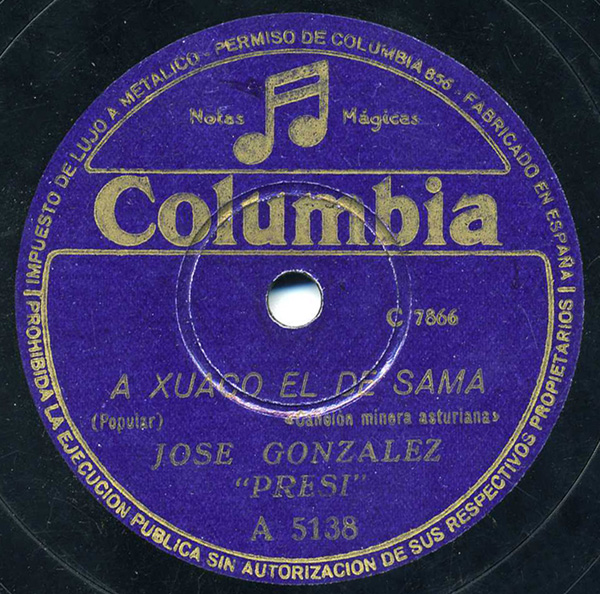
Jose Gonzalez, “El Presi” – A Xuago el de Sama

gonzalez.jpgThis week, instead of tiresome, phony holiday cheer, I offer this instead: one of my favorite records in my collection. Something which, when I first spun it on the player, made me red in the face with the excitement of hearing something new, at least new to me. Although from Spain, it is not raw (or rhythmic) like flamenco, nor stately like the cobla, nor is it dance music such as the kind you’d find nearby in Basque Country.

The Asturian tonada, also known as the asturianada, has been ignored in English-based world music texts. Neither the Garland Encyclopedia of World Music or the Grove Dictionary of Music and Musicians, both well-known, massive, essential works which at the very least give a passing glance to the most obscure of regional musics, leave the asturianada, the popular vocal song of the mountainous Spanish province of Asturias, out of the picture entirely.

Is it because tonada simply means “song”? Is it eclipsed by music featuring the Asturian bagpipe, the gaita (similar to Galician bagpipes, though tuned differently)? I have no idea – the gaita can often be played in an asturianada, in fact. Anyhow, discovering information about the tonada in English has led me to Asturian newsgroups, and detailed articles about Asturian music, such as this – written in Asturian.

What I do know is this: Jose Gonzalez, nicknamed “El Presi” (1908-1983), was one of the most renowned early tonada singers and began his career in the late-20s/early-30s, making several hundred recordings. As with most good regional music on 78, good luck finding those! Gonzalez, in this piece, is accompanied by a subdued guitar, and the song appears to be a lament for the death of another great tonada singer, Xuacu’l de Sama, who died in 1935 (note the northern Spanish pronunciation of the letter ‘x’ as ‘zh’).

Jose Gonzalez, “El Presi” – A Xuago el de Sama

Finding early Asturian song on CD is not easy. Heritage’s Voices of Spain CD contains one beautiful piece by Obdulia Alvarez, “La Busdonga.” There is also what looks to be an excellent CD with performances by two singers, from 1948 and 1955, offered by a company dedicated to Asturian-related products, found here. There are also some recordings of Asturian works by a Galician gaita player, Manuel Dopazo, available from this (really wonderful) company.

Technical Notes
Label: Columbia
Issue Number: A5138
Matrix Number: C 7866-2

Ahmed Djewdet – Taxim Hicaz

djewdet.jpgA taxim (taksim, taqsim, takssim), in Turkish classical music, is an improvisation played on a single instrument – but, an improvisation within the strict guidelines of a given makam (maqam), or melodic mode. You will find taxims played on the oud, the kanun, the kemençe, the ney flute, the tanbur, and other instruments including the keman – the western violin – which is featured in this week’s post. Turkish instrumentation and improvisations are very interesting to my ears, and I have been lucky to find some stellar examples.

This elegant taxim, in the Hicaz mode (Hijaz in Arabic), was probably recorded in the ca. 1928-1930 by Polydor, most likely in Istanbul, then Constantinople (Polydors of this vintage often have “Mechanical copyright” dates on them, however, this series does not). It starts off being played on a single string, then to two strings, then back to one. Interestingly, it’s also over 3 minutes and 40 seconds long, which is about as much sound as you could possibly cram onto one side of a 10″ 78rpm record.

The performer is Ahmet Cevdet Çağla, who was a lead performer in the Dar’üt-Ta’lim-i Musiki group, who also recorded for Polydor (thank you to reader Cem Çoker).

Ahmed Djewdet – Taxim Hicaz

If you’re interested in other taxims by Turkish classical artists in the early 20th century, I would recommend the masterful works by Tanburi Cemil Bey available on several CDs on the Traditional Crossroads label.

Yup, this label is the same that I used for the CD cover on November 2nd. Why does it haunt me?

Technical Notes
Label: Polydor
Issue Number: V 43163
Matrix Number: 243 Bn

Jimmy Masuluke – Sour Milk For Xmas

masuluke.jpgHere’s a bit of holiday nonsense, as promised, in the form of a goofy sax jive from South Africa, from sometime in the mid- to late 1960s. There’s not much else to say, except that it has a pretty solid chunka-chunka guitar riff going for it!

F.M. was yet another in a stable of South African independent labels in operation during the 60s (see the Trutone Dolls track on this site), which also included Tempo, Winner, Stokvel, and Tee-Vee among others. All were in competition against the majors, being Columbia, H.M.V., and the large South African independent, Gallotone (with it’s subsidiary, New Sound).

Jimmy Masuluke – Sour Milk for Xmas

Incidentally – Matsuli must have this record too, as he used the flip side, “Happy Happy Make It Snappy,” on a mix he made in 2006. The mix itself is no longer available, but you can check the tracklist here!

Technical Notes
Label: FM
Issue Number: FM 120
Matrix Number: 68265/2

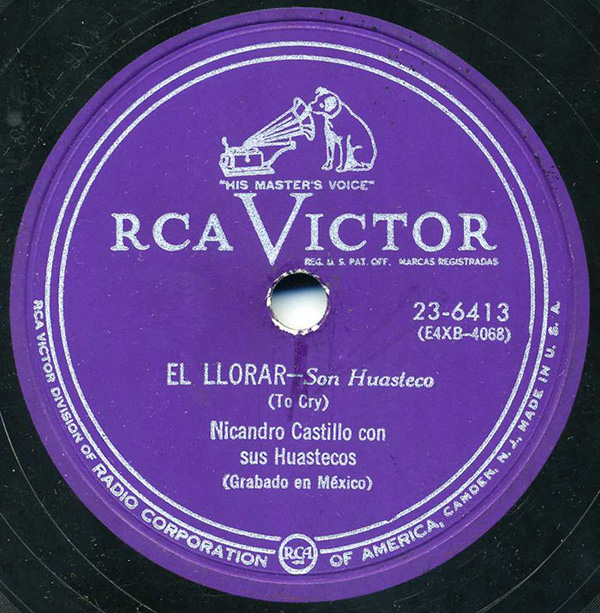
Nicandro Castillo con sus Huastecos – El Llorar

castillo.jpgA few years ago, I was introduced by Chimatli to Son Huasteco music from Eastern and Northeastern Mexico, and immediately took a liking to it. Interestingly, it’s taken me some time to locate authentic sones huastecos on 78rpm, though I’m sure quite a number were recorded – as were numerous inauthentic sones huastecos, but more on that in a minute.

Son Huasteco music is played by a trio: two players on guitars (often local guitars from the region, such as the juarana huasteca and the eight-stringed guitarra quinta), and the determining factor, a fiddle player who plays hard and fast, in a rough-hewn style that’s completely engaging. There have been several times where I’ve taken a chance on a 78rpm Son Huasteco record only to find that it’s simply a vocal trio with no violin – a cover band of sorts. This record, which I received in the mail last week and thought would be a fine companion to last week’s entry, is getting to closer to the real thing. “El Llorar” was recorded by a few different artists in the 78rpm era, besides Nicandro Castillo, featured here. It continues to be a perennial classic performed by current huasteco trios in Mexico, such as the incredible Los Camperos de Valle. Castillo’s version was released on a 2-CD Mexican set titled Huapangos Y Sones De Le Huasteca, but that appears to be out of print and unavailable – so I offer my copy here.

Also, I would be foolish if I did not mention the unbelievably important work being done by record collecting giant Chris Strachwitz and his Arhoolie Foundation in conjunction with UCLA. Their Frontera Collection of Mexican American Music is something that should be used as a model for future preservation efforts of music from the 78rpm era. Chris Strachwitz, as well as the others that I have mentioned throughout this blog, is someone whom I humbly look up to as a pioneer in broadening musical taste and knowledge through the preservation of early music.

Nicandro Castillo con sus Huastecos – El Llorar

Stay tuned for a holiday-related update in a few days.

Technical Notes
Label: RCA Victor
Issue Number: 23-6413
Matrix Number: E4XB-9068

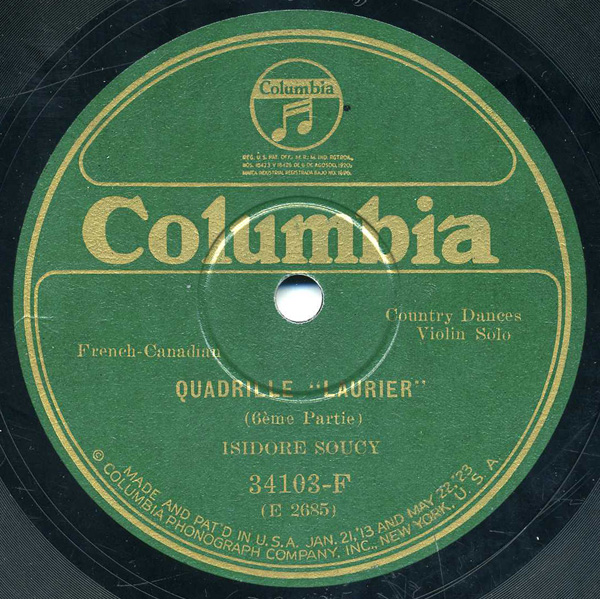
Isidore Soucy – Quadrille “Laurier” (6ème Partie)

soucy.jpgWhile there’s plenty of incredible American, Cajun, and Irish-American fidders, there’s also a rich history of fiddle-based folk music from Canada. And while some diehard fans of the back-woods American fiddlers might scoff (and I, myself, first gained interest in 78s through early American country music), it’s difficult to deny a track like this, Isidore Soucy’s quadrille, which is similar to a square-dance, except without calls. According to one source I found, a quadrille is historically a dance representing a maiden fleeing a young man’s advances, and like much folk music, was performed at community gatherings, parties, or with family.

Isidore Soucy (b. Ste-Blandine, Québec, 1899, d. Montreal, 1963) was a force in traditional Québécois folk music. His recording career began in the late 1920s as a soloist, and lasted well into the LP-era, recording often with his wife and four children as the Famille Soucy. His fiddling is not as raw as some American country fiddlers, it’s more stylish and rhythmic, and its European influence is more apparent (especially with it’s piano accompaniment, like many Irish-American fiddling records of the day) – but the virtuosity is there. This track was recorded at a very early point in his career, ca. 1927.

Isidore Soucy – Quadrille “Laurier” (6ème Partie)

You can find more Soucy at the virtuous Virtual Gramophone website, which has dozens of fine French-Canadian folk music tracks for download (though, not this one). I would also recommend listening to some tracks by Joseph Allard.

Technical Notes
Label: Columbia
Issue Number: 34103-F
Matrix Number: E 2685