

Sears Orchestra – A Chamarrita Nova
 The volcanic archipelagos of Cape Verde, Madeira, and the Azores – all former Portuguese colonies or current Portuguese autonomous regions located in the Atlantic Ocean – have historically seemed remote in terms of their geography, but also unreachable when it comes to early recordings. Although there is some scientific disagreement, it appears that all three of these island chains were uninhabited before the Portuguese began stopping by and subsequently claiming and inhabiting them in the 1400s. While there is an indelible musical link between the music of the islands and the music of Portugal, as islands located between continents, their music has also been influenced from centuries of connectivity with sailors and people of other cultures (in terms of Cape Verde, for example, African slaves), thus giving their music a particular uniqueness.
Unfortunately, there is very little evidence in terms of early recordings featuring music from these islands. Cape Verde fared the best. In the early 1930s, the Columbia label in the United States issued about 12 discs featuring Cape Verdean music by Augustus Abreu and Johnny Perry’s bands, respectively, as well as a handful by the lesser known Orchestra Da Notias. These recordings were made in New York City, and it’s highly probable that all three groups were from coastal New England, where many Portuguese and Portuguese island immigrants settled. They also happen to be fantastic examples of regional music, with the Abrew and Perry bands featuring excellent fiddle players. Unfortunately, it does not appear that any Cape Verdean music was issued on 78 by any other major record labels until Parlophone issued quite a few in the 1950s, though I have turned up several on an small label simply named “Capeverdian Music” featuring music by “Pitrinha” and his group, possibly recorded in Argentina. While still unique, Parlophones I’ve found are not nearly as exciting as the earlier US-recorded discs or the Capeverdian Music discs. (To hear some of the early recordings, I recommend tracking down the out of print LP/CD Portuguese String Music, on Heritage.)
Madeira, on the other hand, fared the worst. Paul Vernon has noted that in the 1950s, Decca issued some 33rpm EPs featuring Madeiran folk music, therefore it’s possible that 78s do exist, but he hadn’t documented any, nor have I. There were some commercial pop discs by Portuguese band leaders where songs were credited as being Madeiran, but in fact are simply pop songs.
Now, to the Azores. Throughout the 20th century, due to varying economic problems, Azoreans immigrated to North America, primarily settling in coastal New England towns, but also places like Toronto and Alameda County, California. In 1919, there were approximately 100,000 Azoreans in the United States. One would think that such a sizable immigrant population would warrant a substantial amount of original folk music being recorded! For example, there were only a few thousand Albanian-Americans in the United States at that time, and discs of Albanian music were issued on both major and independent labels. But, that was not the case with music of the Azores.
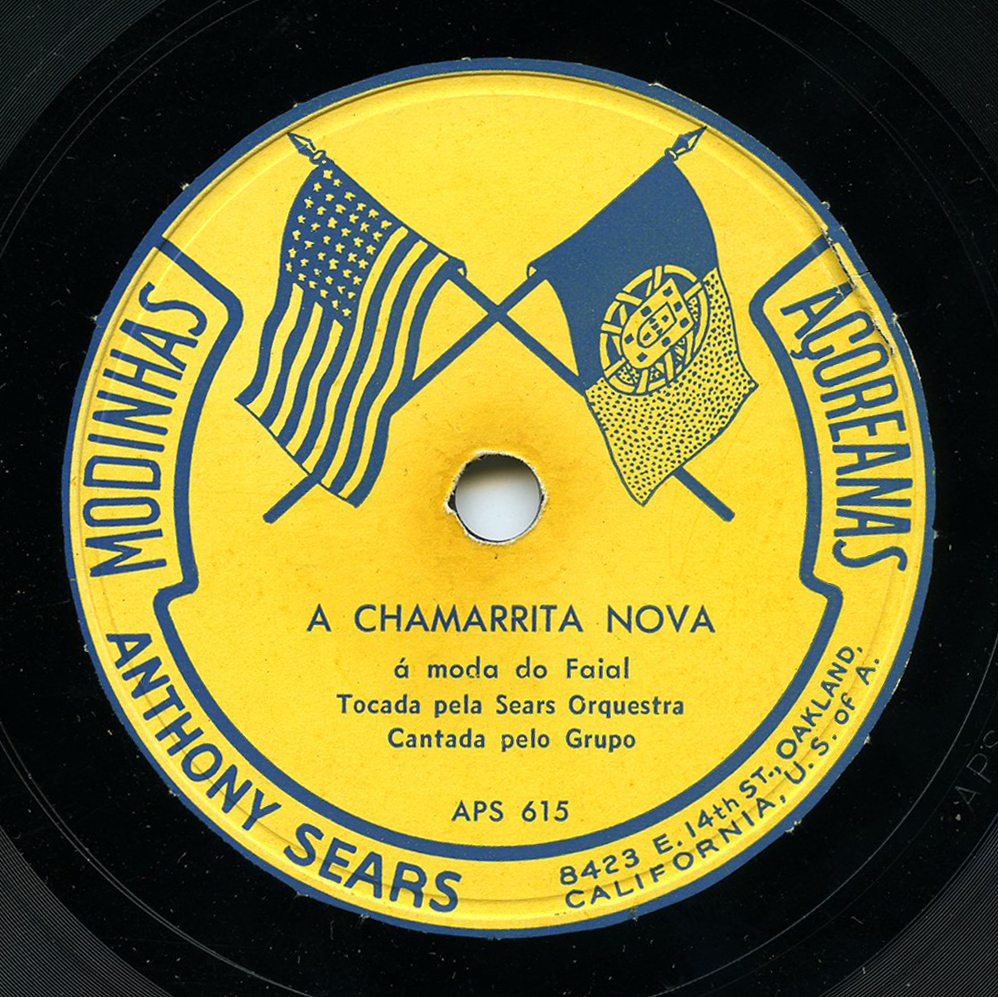
Apart from a group named the Açoriano Quintette that recorded a handful of rare tracks in 1923 for Victor (and which sound to be a studio band performing charts rather than actual Azoreans), I believe that the only other early commercial recordings of Azorean folk music by Azorean musicians were made in Oakland, California, on a vaguely mysterious, independent label named after its proprietor: Anthony Sears. Their pressings were lousy – grainy and noisy, and sometimes with pressing defects such as dents. However, they are wonderfully rootsy, unpolished performances, likely made under non-professional conditions, and possibly recorded by family members and friends. Virtually no information exists on the web about these recordings. Who was Anthony Sears, and what was his story?
Researching a man with a common name like “Anthony Sears” who was active in a large metropolis is not necessarily an easy task. But, we are given one major clue on the front of his record label: the business address, at 8423 E. 14th Street in Oakland. Unfortunately, the present day site of that address is now the Tassafaronga Recreation Center. In other words, it’s a baseball field. All traces of Sears’ place of business and the structures that held it are gone. Check that off of the list.
Searching digitized newspapers by ProQuest and Newspaper Archive does not give us much to go on, either. The San Francisco Chronicle has been digitized only until 1922, and gave me one clue – a man named Anthony Sears of Alameda, California, was arrested for not paying child support in 1897. Same person? I didn’t think so. This Anthony Sears was a grown man in 1897 with multiple children, and likely not making recordings ca. the mid-1940s. Was he a relative? I moved on to the Newspaper Archive and got a hit on the address – by the 1950s, 8423 E. 14th Street was a bar called Gilbert’s. Nothing further, and nothing on Sears. Hm.
In this day and age, it’s hard for some people to wrap their heads around the fact that most of the world’s information is still not online, and not digitized with optical character recognition software. Scholars and researchers know this – but many “digital natives” don’t. If you’re lucky, a newspaper might have a subject or name index. In the case of the San Francisco Chronicle, one does exist, but it only covers major topics. A tidbit about a man named Anthony Sears would never have been indexed by the Chronicle back then (though it might be kept in a clippings file). No, in order to properly research a person like Anthony Sears, you have to actually go to a city library with generous microfilm and microfiche holdings, sit down at a machine, and do real research. I mention this because sometimes people assume this stuff just appears out of thin air. Over the years, I have spent countless hours wrangling microfilm machines for various projects, straining to read out-of-focus articles in long-dead publications. While I didn’t find all that much on Sears or his life, and I wasn’t able to trek up to the Bay Area to pore over the microfilm of local Portuguese newspapers like the “Uniao Portuguesa” not available in Los Angeles (and where I would bet there might be some additional information), just by looking up early phone books, censuses, and my perennial favorite, the Polk City Directory, I was able to identify the Anthony Sears who was behind these recordings.
First off, there were several people named Anthony Sears active in Oakland at that time. There was the Anthony Sears mentioned above, aka “Antone J. Sears,” “Tony J. Sears,” and simply “Tony Sears.” A waiter, barber, and insurance solicitor, he disappears from public records at about 1918. I realized he was not our man. Then there was Anthony Sears the mechanic and utility man, from Portugal, who lived with his wife Helen, and who first appears in public records at about 1940. He seemed like a possibility, but I couldn’t connect him with the address on the record. There was also Anthony Sears the porter, and Anthony E. Sears the “vulcanizer” – not them, either.
The Anthony Sears who created these recordings was Anthony A. Sears, born probably on the island of San Miguel, February 13, 1888 (some sources say February 13, 1887). He first appears in Alameda County in the 1920 census and in 1921 city directories, with his business address located directly next door to his future 78rpm business, at 8425 E. 14th. It’s no surprise that Sears’ home at that time was in nearby San Leandro – that city was the center for Portuguese immigrants in California.
It turns out he, too, was a barber, and remained one for most of his life as far as I can tell, save for a brief period where he was partnered with a man named G. K. Porterfield, and their “Porterfield and Sears” real estate, insurance, and loan business that lasted a brief 2-3 years. Anthony’s wife was named Anna (sometimes “Annie”), and after living in San Leandro, they settled in a small house on 86th Avenue, in Oakland. Anthony dropped the real estate work and went back to working as a barber, now moving his shop one door down to 8427 E. 14th St.
The 1930 census revealed 43-year old Anthony and his wife, age 38, living with their 14 year old son, Albert. Census data can be a trove of helpful information. For example, I found that young Albert was born in Massachusetts, as was Sears’ wife. Anthony also states his date of immigration into the United States as 1908. The closest passenger list record (I checked Boston and Ellis Island records) that matches Sears would be a man named “Antonio Soares” (very likely Sears’ original last name) who arrived in the United States in 1907, at the age of 20, from São Miguel, in the Azores, and who was joining family in New Bedford. Whether this is the same person I can’t prove, as there were literally a few dozen men named “Antonio Soares” who immigrated to the United States from the Azores, but it’s the best match yet. Even without that evidence, it probably means that the Sears family moved out west from Massachusetts, on or before 1920. Also of note, their 86th Avenue neighbors in Oakland were also named Soares…
Fifteen years later, in 1939, Anthony was by then a barber at the record label address, 8423 E. 14th St., and still living at the home on 86th Avenue. Their son Albert, now married to Dorothy (possibly young Dorothy Soares, their neighbor?), was working as a mechanic, and lived with Anthony and Anna for a couple of years before moving out. One thing I could now confirm because of the address: these Azorean recordings were almost certainly made after 1939.
Anthony and Anna had moved to a home on Edes Avenue by 1943. By 1949, there was no trace of Anthony in public records. It turns out he died in 1951 and was buried in St. Mary’s Cemetery in Oakland with a photo on his headstone. His only child Albert appears to have died at the young age of 40, in 1956. Anna Sears continued to live in the Edes Avenue house until at least 1954, but by 1957, she was gone, too. There is no record of an Anna or Annie Sears, with her particular date of birth, in California death records (though there is an intriguing close match). At any rate, after some newly digitized newspapers appeared with issues containing advertisements for his discs, we can now say for certain that the barber Anthony Sears made these recordings at his place of business probably around December 1943 to January 1944. Who were the other musicians? I have no idea.
Despite not knowing much about Sears himself, it’s true that “Anthony Sears” was an interesting homespun label. Sears didn’t just issue Azorean discs (of which there were four discs issued). He mainly issued Portuguese music, especially fado performed by presumably local musicians, also backed by the “Sears Orchestra,” which sometimes consisted of just a fiddle and mandolin. Some of these are a little syrupy, but some of the fado tracks have a real down home quality to them, too. The label itself states that they are “modinhas” – folk songs.
This track, thankfully, is the opposite of syrupy. After a short verbal introduction, Sears and Co. launch into a terrific, fiddle-based dance tune with some terrific vocals. The piece itself is a “chamarrita,” a type of folk dance, and is performed here in the style from the Azorean island of Faial, with its black sand beaches and the large Cabeço Gordo volcano in its center.
Sears Orchestra – A Chamarrita Nova
Notes
Label: Anthony Sears
Catalog Number: APS 615
Matrix Number: same
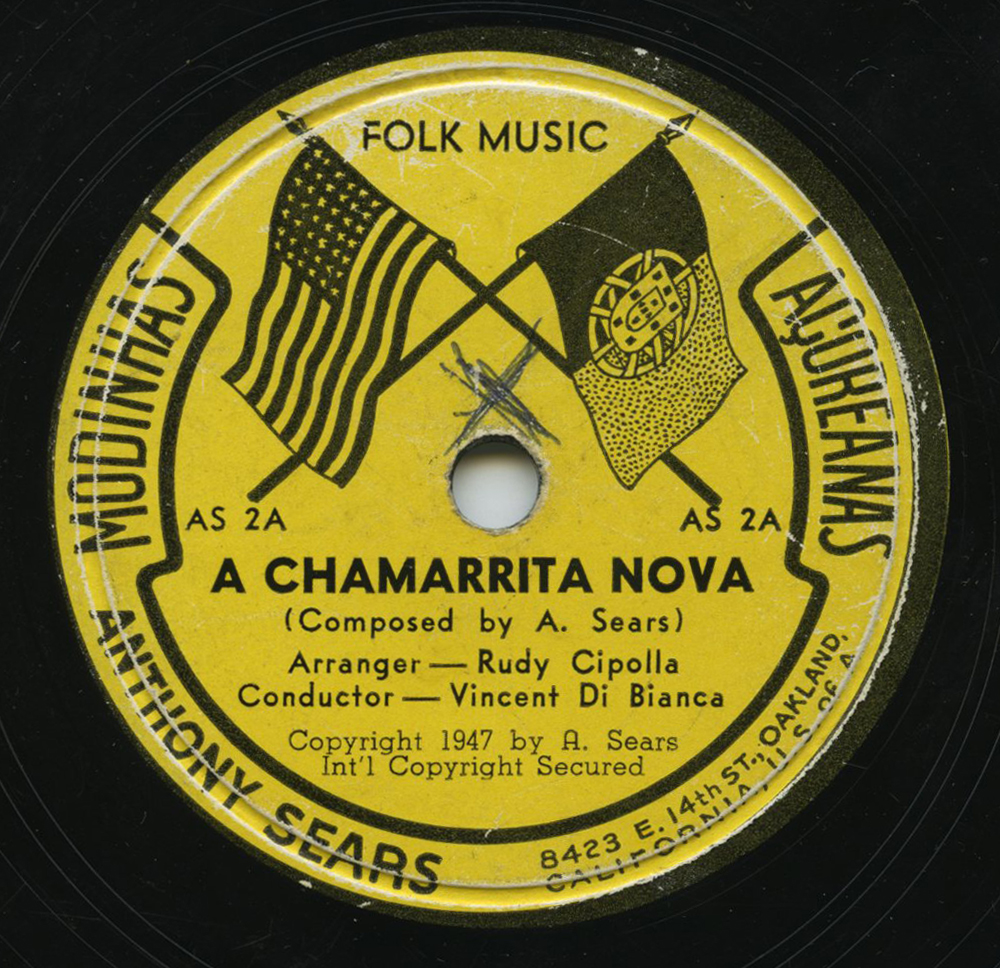 An interesting wrinkle appeared after my original write-up. I discovered that Anthony Sears issued a second series of Azorean 78s on his label. For this series, it appears that he hired professional musicians to accompany him and found a better pressing plant (the pressings on this series don’t have any errors nor are they brittle, as the others are). The musician credited as the arranger of these tunes is none other than Rudy Cipolla, a well-known Bay Area mandolin player with a lengthy career, and who eventually recorded for Rounder Records. A Berkeley-based violinist named Vincent di Bianca is also credited as the conductor. Anthony A. Sears is credited as the composer for these tracks. Most importantly, there’s a date: 1947.
My theory is that Sears perhaps felt that his earlier Azorean discs were a little too homespun, and wanted to give them an up-to-date, professional sheen, with the addition of Cipolla and di Bianca. Unfortunately, in my opinion, the life was sucked out of them. The wonderful, kitchen-table feel of his first run of Azorean discs (featuring possibly his family and friends) is gone, and we’re left with something that’s more akin to “That’s Amoré”-like tourist music. Nevertheless, Sears likely had sound business acumen – this was music that could sell copies. To me, however, the best of the Sears label – wonderful documents of local “Modinhas Açoreanas” by immigrants – was recorded by the still anonymous non-professionals that Sears assembled years earlier, playing in the the example provided here.
Postscript
Without overdoing it or descending into a lame speech, I just wanted to say a couple of things about the elephant in my room, the Grammy Awards, which took place last weekend here in Los Angeles. What the hell – it’s my website, I might as well put a word down on virtual paper. First, and perhaps most obvious, I was naturally happy that we were nominated. It’s the highest honor in the American music industry, for crying out loud – at some point, it doesn’t do anyone any good to be cynical. Second, I am really lucky that Opika Pende was even produced in this day and age much less considered for the award, especially with the relentless onslaught of reissues coming out each year, vying for consumers’ attention. I mean, it could have easily been bypassed in favor of the latest distended Pink Floyd archive release. (The Best Historical Album category allows any release that contains material older than a mere five years.) But it wasn’t bypassed. It was recognized. Like several of the other nominees, we had no corporate or philanthropic monolith’s money behind us. And frankly, like others who work hard at labors of love, I think we all deserved every bit of that nomination, and then some. It took 10 years to accumulate the recordings, 4 years to develop the project, a year to write the book and contact dozens of linguists, musicologists, native speakers, and scholars, 3 months of rapid, 7-day-a-week design work, and 3 months of detailed restoration and mastering. Good people put lots of exceptional work into this thing. All the while I was working my full time job, getting a Master’s at night and on weekends, and periodically traveling back and forth across the country for extended visits on Family and Medical Leave to help take care of my mother who was dying of cancer, watching as she, ravaged by chemotherapy, hung delicate and colorful homemade signs that said “Opika Pende” all over her home in a heartbreaking attempt to stave off the inevitable. And that’s not even the half of it, but at the risk of getting too self-involved, I’ll cap it off with that. Life’s hard, we all know it, and projects like this one take untold hours. No matter we didn’t win – it was a long shot. The project was finished, released, and thankfully, deservedly, recognized. If you purchased and enjoyed the set, I really am happy about that. If you haven’t, there’s something special waiting for you. And if there’s any justice, there are many others who have devoted their lives to releasing some of the most influential early recordings on earth who have never been nominated and should be. (Richard Nevins of Yazoo Records, anyone? Talk about a lifetime achievement award.) So…onward!
Three Early Recordings from Peru
 Here’s a selection of three early and rare traditional music discs from Peru, all recorded and released by the Victor company of the United States, and sold in Peru. These have been on my turntable for months now, as I find them incredibly beautiful pieces of music, each in their own way. I’ll get to the music in a moment, but first, a little context and history, which, while kind of arcane, will maybe help paint the picture of what was happening in the industry at the time.
The Victor Talking Machine Company was extremely active in South America. In fact, they probably had the largest share of the South American 78rpm market through World War II once they and their sister company, the Gramophone Company in England, made a non-competitive agreement between each other in the early part of the 20th century. That agreement dictated that Victor could record in North and South America, Japan, the Philippines, parts of China, and even a little Southeast Asia. The Gramophone Company, alias HMV, could have….everywhere else! The idea of record companies dividing up the world is a little troubling to say the least, but it was such a new technology and a new market, it’s hardly surprising. And, that’s not to say that Victor was the only outfit recording south of the equator. The German companies, such as Odeon, were active in Argentina and Brazil, in particular. However, Victor was among the first companies to record regional music of Peru.
Victor first recorded Peruvian musicians and ensembles in September of 1913. For most of that month, they recorded orchestras, guitar duos, “estudiantinas,” comedians, and military bands. In total 65 discs worth of material was issued of the 128 recordings made, with many different song types represented, and all of them appear to have been recorded in Lima.
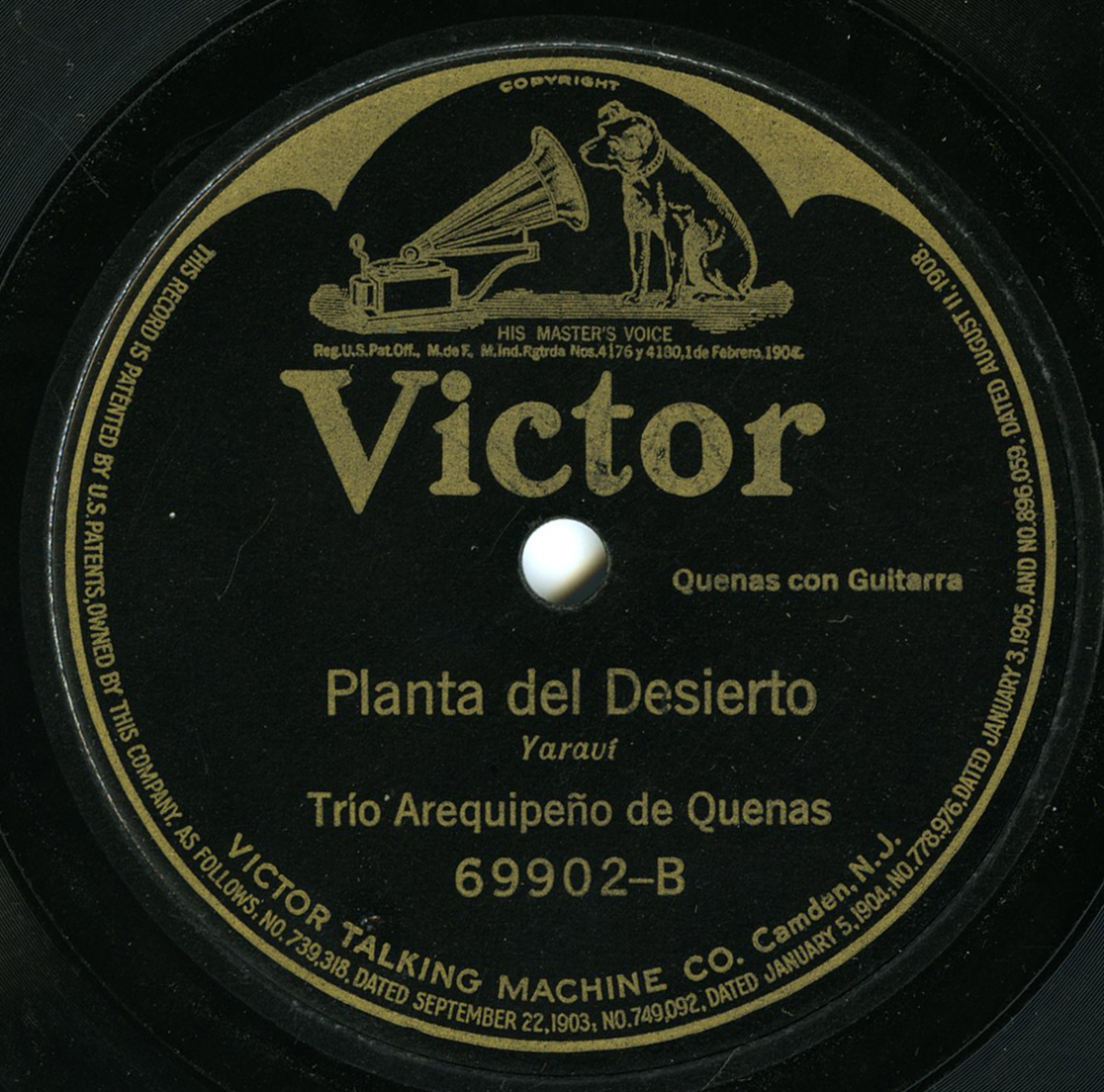
In 1917, Victor once again recorded a significant amount of Peruvian music, but this time, they began recording regionally, starting their sessions in the south of the country, in the city of Arequipa. One of the first groups they recorded in 1917 was a trio, flute players accompanied by a guitar player, credited only as “Trio Arequipeño de Quenas.” The flute known as the quena is probably the most well-known Andean instrument. Usually made from cane or wood, it goes by many different local names in indigenous Peruvian cultures. The most common form of quena has 7 holes (1 in the back), and is about 30-40 cm long. This piece, “Planta del Desierto” (Desert Plant) was recorded on August 8, 1917, and is an example of the yaraví song style. Yaraví is generally common in the mountainous areas of southern Peru, and is usually played slowly, with a wistful mood.
Trio Arequipeño de Quenas – Planta del Desierto
The trio featured here recorded a total of 10 pieces, with 7 of them actually released. Some ancillary information exists for this record. According to notes kept by Victor, this disc sold 3,410 copies, quite a high amount for a regional record of this sort. It’s also interesting that within the Victor ledgers, there’s a reference to a salesman in Peru named Riega (apparently in charge of the sessions) stating that he did not like the discs recorded by the Trio Arequipeño de Quenas, and that he could not sell them! Sales figures need to be taken with a grain of salt, however – they are often misleading or flat-out wrong as some discographers have pointed out, and merely exist as a guide. However, this is a good indication that this was a steady seller for Victor (though I’ve never seen another copy). Also of note – the Victor ledger states that the guitarist broke a string and ruined the previous take. The Trio were at the session for over 12 hours that day, nearly 96 years ago.
After recording in Arequipa, Victor continued their 1917 Peru sessions in Lima, recording from late August through mid-September 1917. These sessions yielded over 221 individual recordings. However, about 68 of them were never issued for one reason or another, so all told, only about 77 Peruvian 78s came out of the 1917 sessions. Within those discs were two versions (the first recorded?) of the famed “El Condor Pasa.”
From 1919-1928, Victor did not record in Peru at all – however, that didn’t stop them from marketing music to Peru. Besides all manner of discs being sold in music stores in Peru, Victor was recording a host of solo musicians and bands in New York, and marketing the music specifically to Peruvian stores and consumers. For example, in 1920 and 1921, American bandleader Nat Shilkret recorded some Andean melodies with harpist Francis J. Lapitino under the name “Victor Orchestra.” A few years later, Shilkret recorded dozens and dozens of tracks pressed for the Peruvian market, including Quechua songs, under the name “Orquesta Internacional,” which may have been an attempt to keep the Peruvian market alive.
H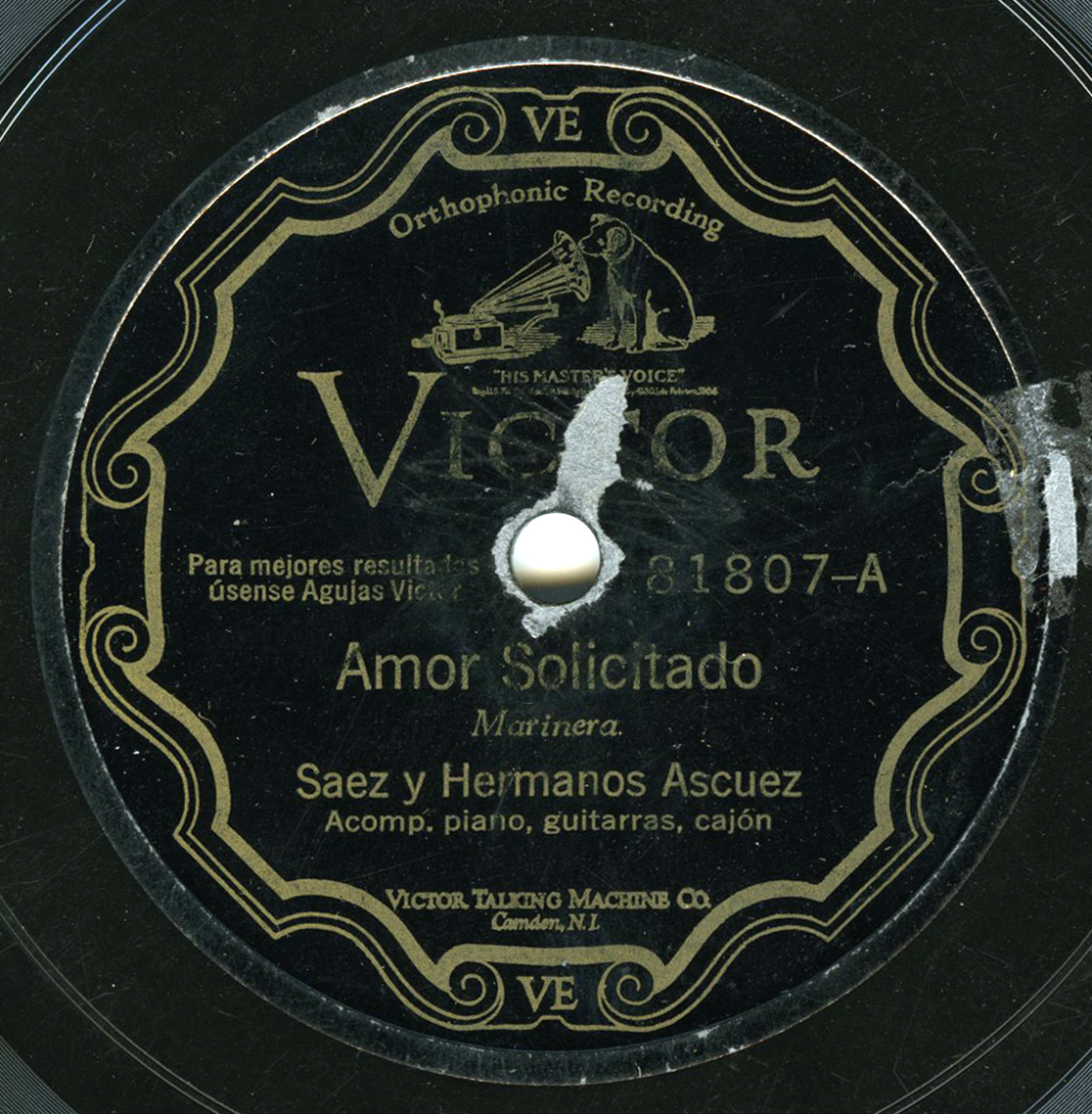 owever, in March and April 1928, additional on-site Peruvian sessions began in earnest once again, and some amazing discs were recorded. Again, Victor chose Lima and Arequipa as the locations for the sessions. The sessions were organized by Victor’s agents in Peru, F. W. Castellano and Brother, and they yielded nearly 40 discs, which were pressed in the United States, shipped back to Peru, and in Peruvian record stores by August of that same year. Starting in Lima, the Castellanos apparently took advantage of several music contests leading up to the annual Day of San Juan festival, which brought a number of then-renowned local artists and ensembles into Lima for work.
One of these groups consisted of Alejandro Sáez along with the brothers Augusto and Elías Ascuez (apparently bricklayers by day, though they were considered popular and respected musicians of the time period, even playing for Peruvian presidents) – they alone recorded the equivalent of 10 discs in 1928 (for some reason, unlike other discs, Peruvian 78s were often artistically split, with a different group featured on each side). This group recorded examples of música criolla, literally “creole music,” which was a kind of coastal, syncretic urban music that developed in Lima due to the gradual movement into the city by various ethnic groups. This piece, recorded in Lima in March 28, 1928, features guitar, piano, and the cajón, aka the “big box,” a wooden box that’s played with the hands and thought to be of Afro-Peruvian origin. The tune is a marinera, a type of música criolla song.
Sáez y Hermanos Ascuez – Amor Solicitado
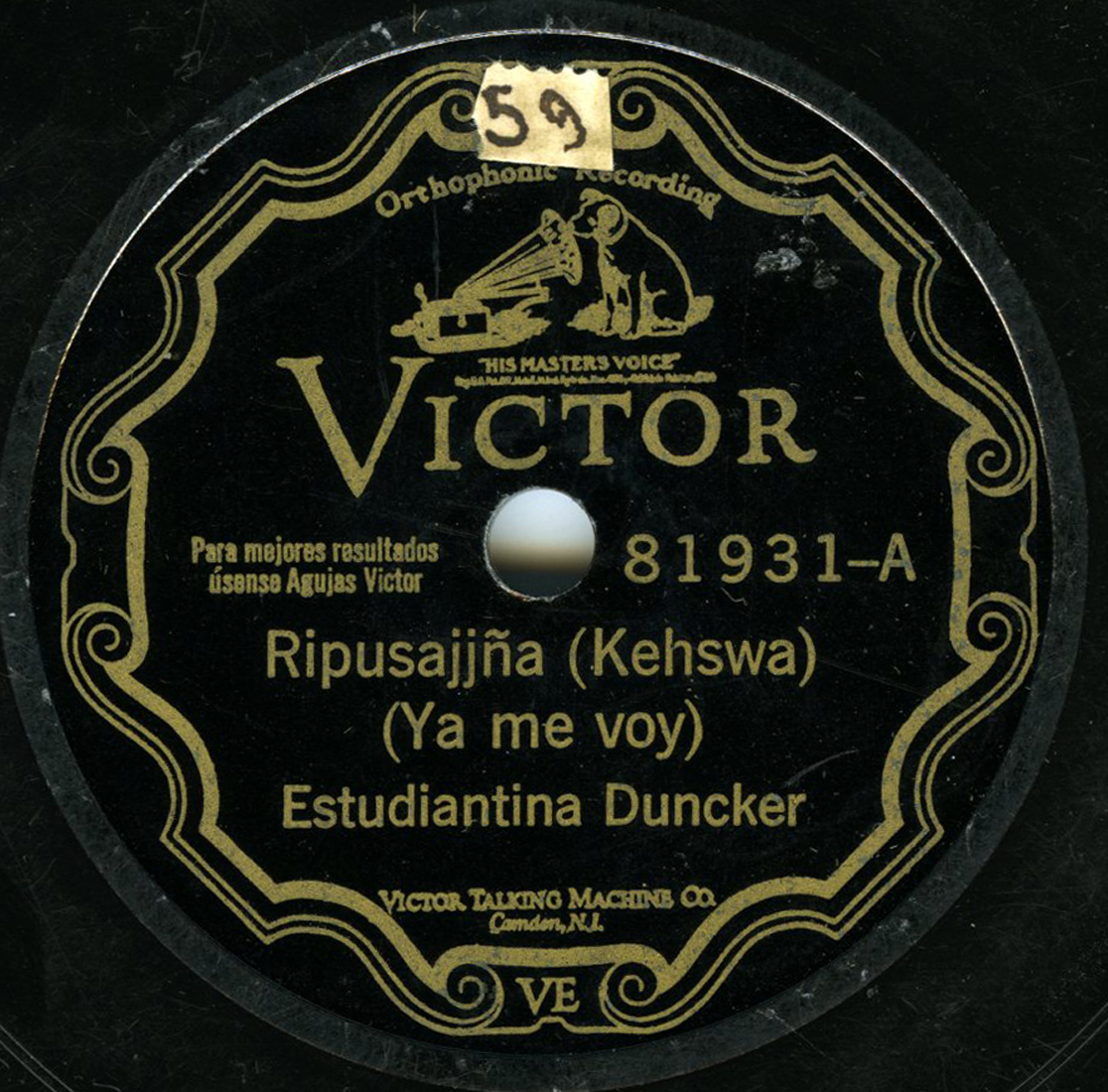 Finally, Victor spent two days in late April 1928 recording artists in Arequipa, including the Estudiantina Duncker, a band originally from Puno, the city on the banks of Lake Titicaca. Estudiantinas in Peru were groups of musicians of mixed heritage, mestizo in nature, which played indigenous music in more formal settings, emphasizing traditional instruments coupled with modern ones (violins, for example). The piece I’ve uploaded is Quechua (or “Kehswa” as it is transliterated on the label). The title in Quechua is “Ripusajjña” and its alternate title in Spanish is “Ya Me Voy” (“I Am Going”). The Estudiantina Duncker recorded 8 sides on April 24, 1928, including four Quechua songs, one Huayno, and one Aymará. It is repetitive, lulling, and terrific music (and in the best condition of the three – Peruvian discs are difficult to find in exceptional condition).
Estudiantina Duncker – Ripusajjña
Victor continued recording in Peru, and in the following years they got around to issuing music from Ayacucho, Cusco, Acomayo, and all manner of regional music. After World War II, independent labels in Peru began appearing, such as Sono Radio, Virrey, and Smith Records. By then, of course, a generation had passed, and the music, while still vibrant and alive, had changed.
Notes
Labels: Victor
Catalog Numbers: 69902-B, 81807-A, 81931-A
Matrix Numbers: G-2228, XVE-42637, XVE-42675
Much information gleaned from the Encyclopedic Discography of Victor Recordings and Luis Gomez’s doctoral dissertation on música criolla for Stony Brook University, 2010.
Diop Sambau Thiam Oumar – Lele Toucouleur, Pt. 2
 There were certain regions in Sub-Saharan Africa where local music was barely recorded – if at all – by commercial companies or ethnographers, until at least after World War II. The result is that commercial recording of Sub-Saharan African music from ca. 1927-1946 is skewed heavily toward certain types of musical styles found in certain cities. This is, I suppose, an important thing to remember whenever one is about to make an attempt to describe what early “African music” sounds like. There are many exceptions to this generalization, of course. Often, rural populations had relocated to cities and companies were able to record musicians there. Sometimes artists were brought to cities, as was the case with the infamous London-based West African recordings on the Zonophone series from ca. 1927-1930, which really can be seen as the starting point for commercial recordings of Sub-Saharan popular music. There were also companies that were, it seems, casting about wildly for as many types of recording artists they could find, in order to develop a market. A good, early example of that are the 23 Ugandan discs issued by the German Odeon company in 1931 – the first time any company had recorded in Uganda. Of this mere 23, there were deeply traditional solo singers, one-string fiddlers, and even a Christian boys’ choir. (These remained the only Ugandan commercial recordings for probably a decade.) But, by and large, because of the recording sites and what we know exists, I don’t think it’s at all a stretch to say that what was captured pre-WWII in Sub-Saharan Africa is merely a nano-sampling of what existed.
The reasons for this are varied. For the most part, record companies simply did not have transportation routes available for them to lug their equipment until industrial expansion in the years following World War II. By the time they were able to do this, however, the advent of cheaper equipment and portable magnetic tape brought a host of local competitors. Independent labels cropped up everywhere, in many major cities – a topic I’ve discussed in numerous posts. These small businesses could record on tape, ship their tapes to various pressing plants in Europe or India, and still make money selling very limited runs of discs. In some cases, for example Congo, large labels like HMV and Columbia merely repressed recordings that had already been made by local labels.
It could be that because of these smaller labels, a few larger companies began venturing deep into various parts of Africa – Western Africa, in particular – to record some of the most intense traditional music on the continent. In the early 1950s, the two labels that did the most of this were Fiesta and Philips. They seem to have made it to Niger, and even to Chad, though primarily they captured traditional and border music in northeast and northern Senegal, Mali, eastern Guinea, Burkina Faso, and northern Côte d’Ivoire.
This disc is the only recorded example on 78 that I’ve come across featuring music of the Haalpulaar’en people of northern Senegal and southern Mauritania, surrounding the River Senegal. They are a subgroup of the Fulani, and speak the Pulaar language. On the disc label there is a clue to their identity – the title listed on the label is “Lele Toucouleur.” “Toucouleur” is an archaic, variant name for the Haalpulaar’en. Thanks to a Haalpulaar friend in the comment section, we know that “Lele” is a type of Pulaar music. The singer accompanies himself on the hoddu, the local plucked lute of the Haalpulaar’en. There are many variations of this instrument all across West Africa – it’s frequently known as the xalam. The derivative in Mauritania is called the tidinit. Some claim it is the origin of the banjo.
There are likely more early recordings featuring the Haalpulaar’en. Fiesta had its origins ca. 1950, and were a subsidiary of French Decca. They lasted well into the 45 era.
Diop Sambau Thiam Oumar – Lele Toucouleur, Pt. 2
Technical Notes
Label: Fiesta
Issue Number: 928
Matrix Number: D 1357-2
Maliot Radio Orchestar Skopje, Macedonia – Macedonski Narodni Ora
“ Near the edge of town I began to hear the heavy booming, in complicated rhythm, of a big drum, accompanied by the droning music of the Macedonian zurla…which told me that some kind of festivity was going on.”
This begins writer Catherine Brown’s 1933 description of a gypsy wedding.
The zurla or surla of Macedonia and southern Serbia is another in a series of wonderfully harsh-sounding double-reed shawms (types of oboes) that I can feature on the site. The zurla is closely related to the zurna of Turkey as well as the mizmar of Egypt, and is also related to the Indian shehnai, among other oboe-like folk instruments. And like many of those instruments, it is historically meant to be played outdoors at festivals and celebrations, very often for dancing. It’s immediately apparent why. The piercing, nasal quality of the zurla at close range can’t be underestimated, and this particular duo of zurle players take their performance to the next level, almost approaching sounds equivalent to harsh, free jazz noise.
Zurle come in small and large sizes – about 14 and 25 inches long, respectively. There is a small, thread-wound disc called a mendik that presses against the player’s lips, and which helps with tuning (or circular breathing, depending on who you ask). The reed is made from a kind of grass known as trska. The zurla is usually played in pairs, with one player holding down a drone, and the other playing the melody. They are accompanied by at least one musician on the tapan (more or less the same as the tupan, which accompanies the zurna in Turkey), the double-headed drum that’s worn around the chest.
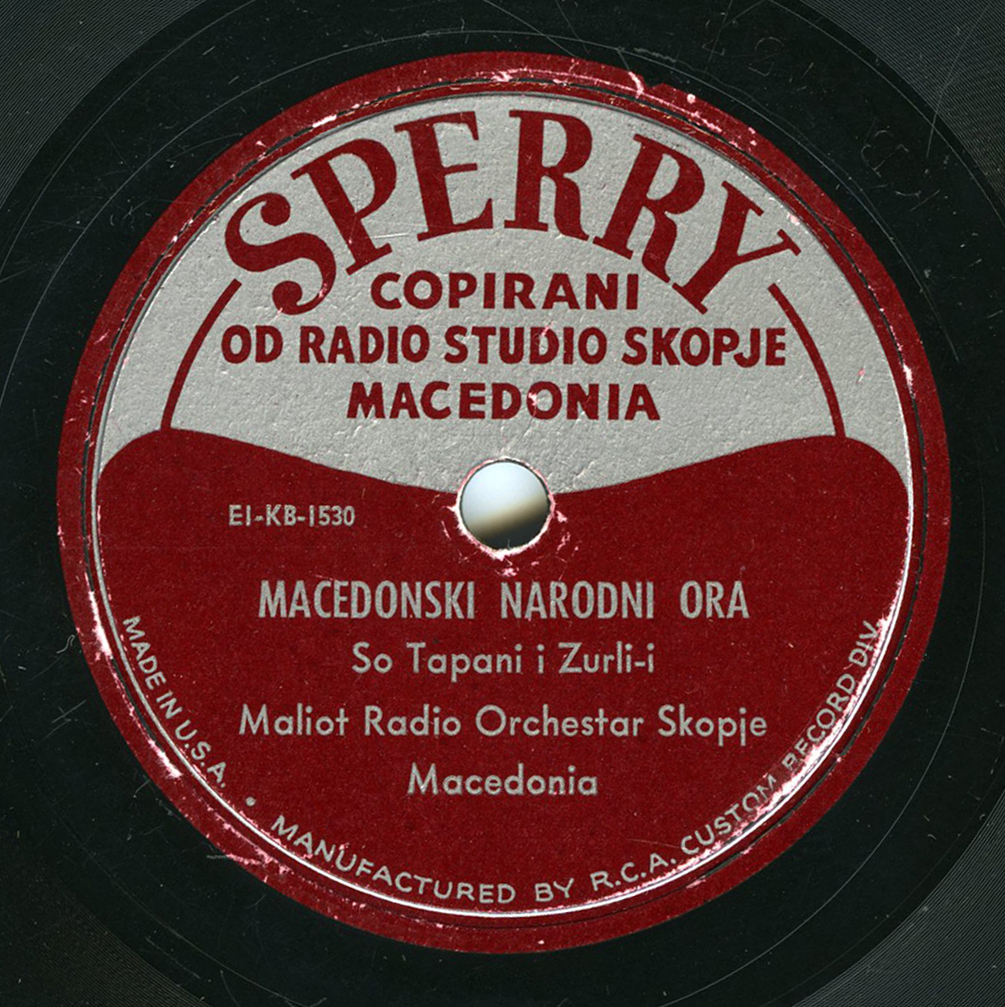
The Sperry label, based at 10625 Shoemaker Street in Detroit, Michigan, was run by Sperry Boge and issued a number of recordings originating from tape, and all from Macedonian groups sponsored by Radio Skopje. Radio Skopje began broadcasting in 1944. I know very little information on Sperry, however, they were in operation for a number of years in the early 1950s, issuing approximately 120 selections on 78 and 33rpm. All of their records were RCA Custom pressings. RCA had three custom pressing plants in the United States including one located in Indianapolis, Indiana, and the pressing number on this disc indicates that this Sperry record was pressed in 1951 – though finding an actual recording date might be more difficult.
Maliot Radio Orchestar Skopje, Macedonia – Macedonski Narodni Ora
Technical Notes
Label: Sperry
Issue Number/Matrix Number: E1-KB-1530
For another example of a group that appeared on Sperry, here’s a video of the Orchestra Čalgii. And for further information on the history of the zurla, check out Timothy Rice’s article in The Galpin Society Journal (March 1982), “The Surla and Tapan Tradition in Yugoslav Macedonia.”
Thanks to Joel Ackerman and Larry Weiner for additional info.
Count Lasher’s Calypso Quintet – Trek to England
 One of the great things about Jamaican mento music – the local, popular music of Jamaica which first began appearing on record in the 1950s – is that, besides being a joy to listen to, it is extremely well documented. Not only are there a number of excellent CD reissues featuring many of the best mento performers that ever cut a record, but Michael Garnice’s Mento Music website is one of the most informative and complete resources on the subject. One can scarcely attempt to understand mento without digging into his site, and I gleaned most of this post directly from information therein.
As Garnice points out on his website, mento was a diverse music, and characteristics of it eventually led to ska and reggae. In essence, however, much of mento had a rural sound to it, with banjo, bamboo saxophones and clarinets, and a particular style of vocal delivery that was direct, even harsh at times. It often gets lumped in with calypso music from Trinidad. Record labels would bill mento bands as calypso bands on their records, and several mento artists had names that sounded like popular calypso artists, such as Lord Power, Lord Composer, and today’s featured artist, Count Lasher. The music, however, was decidedly different than most calypso. Perhaps the most obvious connection was mento’s lyrical content, which was often funny, at times bawdy, and often addressed topical issues of Jamaica that were important during what Garnice calls the “Golden Age” of mento, the 1950s.
Another interesting fact is the majority of early mento records were issued by local Jamaican labels, and were pressed in England (where there also was a Jamaican record-buying public). Kalypso, Chin’s, and Caribou were three popular independent labels, now quite difficult to find. There was also Calypsodisc, Hi-Lite, Times Record, Maracas, and Crystal, among others. The first and arguably the most important Jamaican label was MRS – Motta’s Recording Studio – which, although they issued only about fifty 78s, proved to be popular and influential. “Motta” was Stanley Beresford Brandon Motta, a businessman and shop owner from a family of Sephardic Jews in Kingston. He set up his studio in a woodworking factory in 1951 and began recording and issuing discs, which were pressed by Decca in London. The MRS label was discontinued around 1957, when mento’s popularity was waning.
Terence Parkins aka Count Lasher was a talented and significant mento star, though little biographical information on him has surfaced. He recorded at least 7 discs for MRS, and numerous others for Chin’s and Caribou (sometimes under the name “Count Lasha” or, occasionally, totally uncredited). He continued recording into the 70s and even issued reggae singles before passing away in 1977. This track features some terrific clarinet and guitar, as well as some nice banjo plunking. The lyrics address the issue of immigration by Jamaicans to England. Also important – it has never been reissued.
Count Lasher’s Calypso Quintet – Trek to England
Technical Notes
Label: MRS
Issue Number: DSM.41
Matrix Number: SM-146-1
The Yiwangjik A-Ak Society of Chosun – Ritual Music Botaepyeong (Orchestral) Heemun
 I’m proud to present an extensive and extremely informative guest post written by Mark (Ji-Hoon) Suk, a collector and researcher based in Korea. I was first introduced to Mark a few years ago when I was working for the Encyclopedic Discography of Victor Recordings (EDVR), attempting to create a research paper (completed, and published hopefully soon) which documented all of Victor’s activities in Asia. Mark turned out to be invaluable, providing information on Korean and Japanese recordings that were utterly unknown to any of the collectors in the west that I had contacted. Through that experience, I found that Mark’s passion was collecting early Korean music, and the history of recording on the Korean peninsula. This is a rare opportunity to hear an example! – JW
Mark:
The recording I’m going to share with you today is considered one of the most important traditional Korean recordings ever issued during the 78rpm era. First, I’d like to share some historical details. These will help you understand this recording a little bit better.
A-Ak (Korean: 아악, 雅樂) is a type of Korean court music that was partly modeled on the court music of Song Dynasty China, known as Yayue1. Earliest historical documentation of this type of music dates back as early as 1116, after King Yejong (r. 1105-1122) of the Goryeo dynasty (918-1392 CE) ordered his musicians to play ritual music and other court music with a large quantity of Chinese musical instruments sent from the Song Dynasty Emperor Huizong. A-Ak was apparently played quite regularly in the court until the Mongol invasion of late 13th century, after which interest waned and it was seldom performed. After the dynasty of Joseon (1392-1910 CE) was established, an interest in A-Ak was revived. In 1430, King Sejong the Great (r. 1418-1450), arguably the most influential historical figure in Korean history, ordered his courtiers to reestablish the entire arrangements of old A-Ak pieces with a new musical notation system called “Jeongganbo”2 (Korean: 정간보, 井間譜, literally translated as “Well Notations”). Two A-Ak compositions written in this system, both by King Sejong himself, titled “Botaepyeong” (Korean: 보태평, 保太平), and “Jeongdaeeop” (Korean: 정대업, 定大業), were performed for centuries at important events such as the Royal Ancestral Ritual in the Jongmyo Royal Shrine. Until the late 19th century, A-Ak was performed by the court musicians at Jangakwon (Korean: 장악원, 掌樂院), a government office responsible for court musicians and dancers. The office was dissolved in 1895 under western influences to ‘modernize’ the centuries’ old system. After that, Jangakwon musicians worked for a variety of occasions for more than a decade, but the occasions became fewer with the demise of Joseon Dynasty, which ended in August 1910 with the Japanese colonization of Korea.

Jangakwon musicians, ca. 1905
In 1911, with orders from Japanese government, a special office called “Yiwangjik”3 (Korean: 이왕직, 李王職) was established in Seoul. The main purpose of this office was to take charge of business that involved Royal family members of Joseon dynasty, including King Gojong (r. 1863-1907, d. 1919) and his son King Sunjong (r. 1907-1910, d. 1926), who were still residing in palaces. The Yiwangjik then absorbed most of the officials involved in court activities, including 184 musicians from Jangakwon. These musicians then formed the “Yiwangjik A-Ak Band” in 1912 to perform for the old royal members, but as the Yiwangjik gradually began to reduce the budget for the A-Ak Band (for what were explained as “practical reasons”4), the musicians began to fall out from the band, and by 1917, there were only 54 members present, with most of the musicians in their sixties. Like many centuries-old traditions, it appeared the whole A-Ak genre would bite the dust within a few years, but two notable events occurred which turned out to be turning points in the music’s history.
Ham Hwa-jin, (Korean: 함화진, 咸和鎭, 1884-1948), a master of Gayagum and Geomungo (Korean string instruments), was one of the older Jangakwon musicians and the de facto leader of the band at the time5. He figured that the only way to prevent the eventual group’s disbandment was to create a modern-style school devoted to creating new A-Ak musicians. With help from a few friends and fellow artists including his long time friend Kim Young-je (Korean: 김영제, 金寧濟, 1883-1954), he created the “Yiwangjik A-Ak Academy” (Korean: 이왕직아악전습소, 李王職雅樂傳習所) in September 1917. The curriculum included not only Korean traditional music, but also some basic western music theory including western-style musical notation methods. This certainly created some public interest. Nine students entered the first year, and by 1919, the number of students had tripled. However, even with the increasing public interest, the Yiwangjik still kept reducing the budget, and finally, by late 19206, they started to seriously consider the complete dissolution of the band.


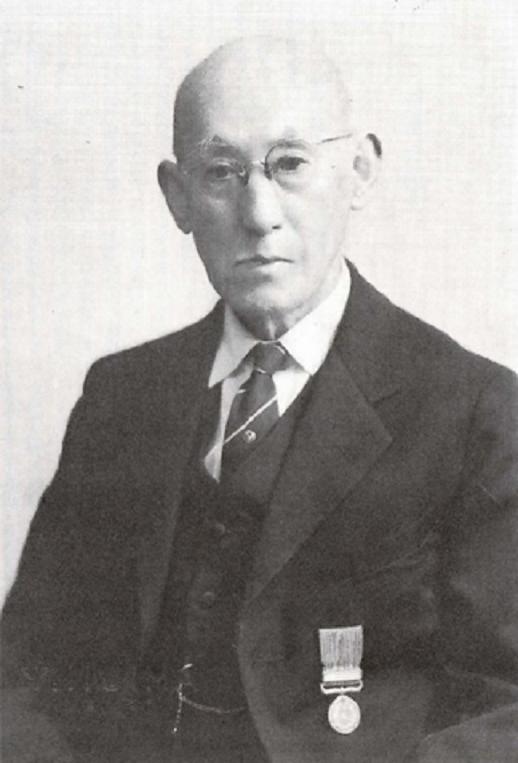
L-R: Master Ham Hwa-jin, Master Kim Young-je, Hisao Tanabe, 1960s.
In April 1921, the famous Japanese musicologist Hisao Tanabe (Japanese: 田邊尙雄, 1883-1984) visited Korea for his first field trip and series of musicology lectures, which drew much attention both in Japan and Korea. Along with Tanabe’s own musical interests, his field trip was deeply involved with the Yiwangjik as Yiwangjik officials, including Zisaku Sinoda (Japanese: 條田治策), the undersecretary of Yiwangjik, asked him to “evaluate” the musical value of A-Ak to find out whether the A-Ak band is worth being supported or not. After going back to Japan in May 1921, Tanabe wrote a special column regarding his Korean field trip in the July 1921 issue of “Music and Gramophone” (Japanese: 音樂と蓄音機) magazine. Contrary to what Japanese officials at the Yiwangjik had expected, he praised A-Ak a great deal, calling it “a great musical treasure trove of Asia” and its musical style “very unique.” He also strongly suggested that the Yiwangjik should give the A-Ak musicians better treatment, including a larger budget, a permanent studio for practice, and additional members. As he put it, “these actions would serve as a part of a more sophisticated, better approach to colonization.” The Yiwangjik relented, and in 1922 officially adopted the band into “The A-Ak Department at the Yiwangjik of Chosun (Korean: 조선이왕직아악부, 朝鮮李王職雅樂部),” and renamed the band “The Yiwangjik A-Ak Society (Korean: 이왕직아악부원, 李王職雅樂部員).”
With this series of turning points, The Yiwangjik A-Ak Society became strong, performing a concert for the public for the first time in September 1922. In January 1926, they received a permanent studio just across from the Changdeok Palace, where King Sunjong and his family still lived. The A-Ak Academy drew 18 new students each year, making the total number of A-Ak society members more than 200 by 1928. The public drew their attention to the A-Ak Society, and even after the death of King Sunjong6/, the Society’s “official” chief patron, the Society saw little effect from the event. After the introduction of radio in Korea on February 16th, 1927, the Yiwangjik A-Ak Society decided to perform on the air. Their first radio performance was on November 3rd, 1927, and they made several additional appearances over the years.
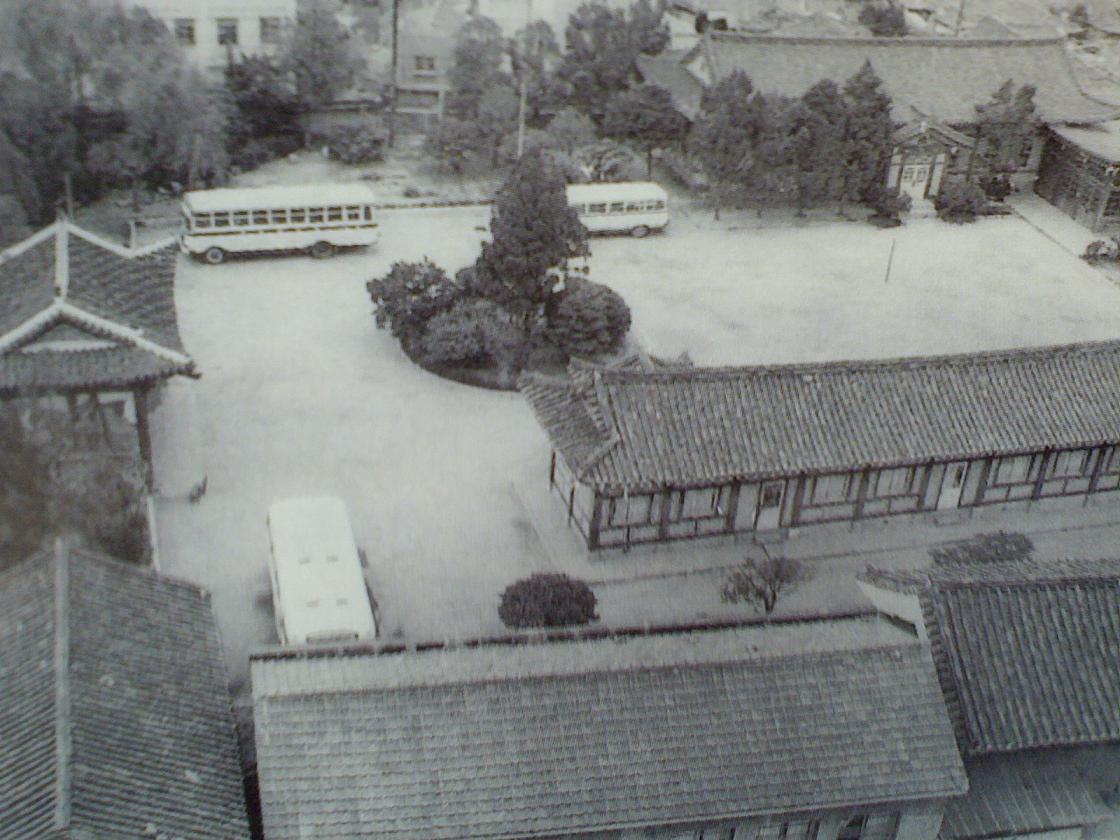

L-R: Yiwangjik A-Ak Society Headquarters (late 1950s), Yiwangjik A-Ak Academy Haegeum Class (1925)

Yiwangjik A-Ak Academy 2nd Graduation Recital (March 15, 1926)
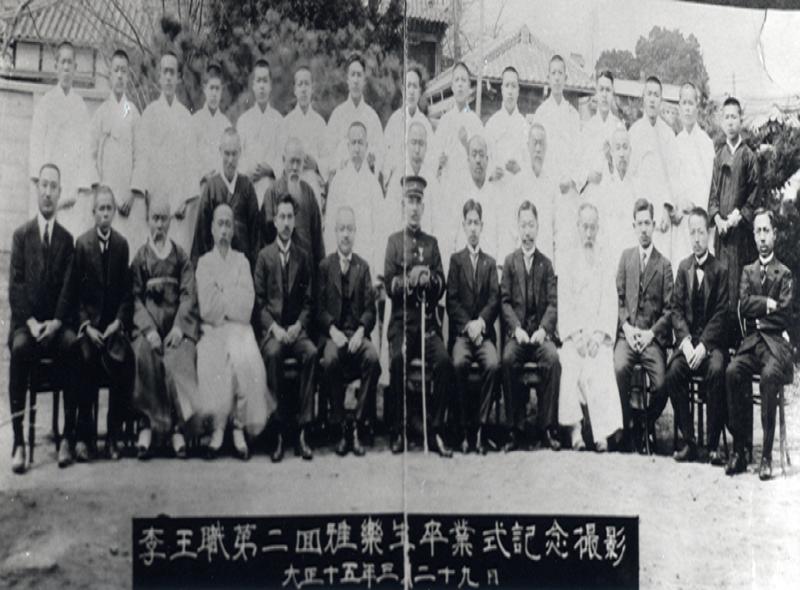

L-R: Yiwangjik A-Ak Academy 2nd Graduation (March 29th, 1926), Yiwangjik A-Ak Academy rehearsal ca. 1928 (Master Kim Cheon-Heung visible in front)
By this time, the Korean public was becoming aware of modern media such as newspapers and magazines, radio broadcasts, and of course, the gramophone and its records. The first commercial recordings of Korean music were issued on a series of Columbia records in 1907, and the US-based Victor Talking Machine company issued around 200 Korean recordings in 1908 and ca. 1915. But the clear winner of the Korean gramophone market7 during the 1910s and most of the 20s was the Nipponophone company of Japan. Nipponophone had their branch office established in Seoul in 1911 and dominated the Korean record market until the late 1920s. With the introduction of electrical recordings, however, things began to change.
In September 1927, Victor established its Japanese subsidiary in Yokohama as “The Victor Talking Machine Company of Japan, Limited,” which later became known as “JVC.” Later that month, they issued the first Japanese electrical recordings, which literally revolutionized the whole record business in Japan. With this success, Victor started to seek other profitable markets, and Korea was considered. Several business arrangements followed, and on May 21st, 1928, Japanese Victor launched its branch office in Seoul, and among the performers they were seeking was the Yiwangjik A-Ak Society. It is not exactly known who came up with the idea of recording A-Ak pieces, but it appears that the renowned Japanese historian and college professor, Shogo Oda (Japanese: 小田省吾, 1871-1953), a close friend of the aforementioned Hisao Tanabe, was a talent scout for this occasion. It is possible that Oda was the one who made the decision under the influence of Tanabe.
On June 8th, 1928, an exclusive contract between Victor and the Yiwangjik A-Ak Society was signed8. The details of this contract were reported on the following day in a short article in the Dong-A Ilbo Daily9 (Korean: 동아일보, 東亞日報), as well as some short notes written in 1947 by one of the leading A-Ak musicians, Master Seong Kyeong-lin (Korean: 성경린, 成慶麟, 1911-2008)10. According to the article and Master Seong’s notes, Han Chang-soo (Korean: 한창수, 韓昌洙), then secretary of the Yiwangjik and the chief representative of its A-Ak department, promised to make 40 “satisfactory” 10-inch A-Ak sides with Victor, while Victor agreed to give the Yiwangjik advance royalties of 1,000 Yen11 per recording. The music selected for these sessions was mostly ritual music that was used at Jongmyo Royal shrine, as well as court music, dance music, and some court Gagok (art songs) with A-Ak accompaniment. If the first recording session turned out to be successful, Victor then would renew this contract, and record additional A-Ak music. There were some discussions about potential future repertoires, which was cited in the Donga Ilbo article as: “71 major A-Ak works, 189 ensemble pieces, and 52 court dance pieces.”
For this occasion, Victor brought two American recording engineers with a recording lathe, and installed it in one of studio buildings of the A-Ak Society called Yooksadang (Korean: 육사당, 六四堂), originally built in the late 17th century as a part of Royal guard headquarters. The building was seldomused by the A-Ak Society musicians, as it had fallen into disrepair and had very bad acoustics, yet it was the only building big enough to install the recording lathe. It is known that at the same time Victor also sent a different group of engineers to a separate studio for recording additional types of Korean music, such as Pansori, folk songs, instrumental ensembles, and even some “modern popular songs.” Judging by this, Victor apparently took the interest of recording A-Ak much more seriously than other styles.


L-R: Korean man listening to Victor phonograph (ca. 1915), Dongo Ilba article (6/9/1928), Yooksadang building (present-day, photo taken by the author 6/9/2012)
There are several eyewitness accounts of this recording session, including aforementioned notes by Master Seong, as well as a 1990 interview of another A-Ak master and court dance virtuoso, Master Kim Cheon-Heung (Korean: 김천흥, 金天興, 1909-2007)12. According to Master Kim, one of the string players at this session, the recording actually took place for about a week, starting June 15th with a total of 54 A-Ak society members participating. Notable personnel included Ham Hwa-jin and Kim Young-je as principal conductors13, Master Kim Kye-seon (Korean: 김계선, 金桂善, 1891-1943) who performed solos with the Daegeum (a type of flute made out of thick bamboo), Master Lee Sook-kyong (Korean: 이숙경, 李肅慶) and Jang In-sik (Korean: 장인식, 張寅湜, 1908-1980) who performed Geomungo solos, and Master Ha Kyu-il (Korean: 하규일, 河圭一, 1868-1937) who performed Gagok solos. All of these performers were considered the greatest virtuosos of each instrument and style at the time.
After the session was completed, the masters were sent to Victor’s pressing plant in Yokohama, and test pressings of all 40 sides were made. It took about three months until the Victor engineers re-visited the Yiwangjik A-Ak Society with test pressings and an Orthophonic machine for playback. Upon hearing the results however, the musicians, including the conductor Master Ham, were very disappointed. One of the most problematic issues, according to Master Kim, was the overall poor sonic resonance of the recordings14, apparently affected by the bad acoustics of the Yooksadang building15. Besides this issue, the recording session, judging from surviving records, was actually full of technical mishaps and faults. The overall volume is low, a few of sides were pressed with wavy surfaces, and on some sides, there are some noticeable speed instabilities, including some rapid speed fluctuation. Last, but not least, all of the sides had varying degrees of high frequency noises at the end known as “cold wax chatter.”
Embarrassed by this reaction, Victor tried to persuade Master Ham to change his mind, but he no longer wanted to be a part of the project. The representatives at Victor feared the worst – losing 40,000 Yen16 without any fruition – so they sent some letters to some “powerful people” involved in the Yiwangjik, to place pressure on Master Ham and other A-Ak society members. After about a month, A-Ak society musicians finally relented to approve the issue of 12 sides, and later another 14 sides, thus approving a total of 26 sides (13 double-sided records) for issue. In order to prevent further problems with unsatisfactory sides, Master Ham requested Victor to give him the metal masters and test pressings of rejected sides. According to Master Seong and Master Kim, these materials were kept in the small room in the A-Ak Academy’s office building, but they were lost by fire during the Korean War, along with the complete first pressings of the issued sides along with the Orthophonic machine later given by Victor to the A-Ak society.
It is not known when these records were first offered to the public, but the earliest known advertisement dates from December 14th, 1928, so it can be assumed that these recordings were issued no later than December 1928. They were given the prestigious Victor Red Seal label, the only Korean recordings ever issued with red seals. They were sold for 2 Yen each or 25 Yen for the whole set17, while ordinary black label Korean music releases were sold for 1 yen or less. They were also assigned a special block of catalogue numbers starting from 49801 through 49813, while other Korean Victor recordings were assigned the 49000 number range18. These records appeared in catalogs until about 1937, after which they were discontinued.
Several of these recordings (12 sides, nos. 49815-49820) were later reissued as a set titled “The Essence of Chosun A-Ak” (Korean: 조선아악정수, 朝鮮雅樂精髓) in 1942. This set featured a 66-page booklet, “Short notes of Chosun Music” (Korean: 조선음악소고, 朝鮮音樂小考), written by none other than Master Ham Hwa-Jin, the conductor of the recordings. The circumstances surrounding this reissue are unknown, but it is true that during the Second World War, Japanese Victor reissued a number of ethnic recordings from Asian countries with the title of “Daitoa Ongaku Shusei (A Greater East Asian Music Compilation),” under the supervision of musicologist Hisao Tanabe19. So, it is possible that these A-Ak reissues were related to these ethnic music reissues as well. While these 1942 reissued discs, together with their fancy-looking original album, occasionally show up in good condition on the collectors’ market20, the first pressings rarely show up anywhere in any condition, possibly the direct evidence of their poor sales.


L-R: Victor Records advertisement (Donga Ilbo, 12/14/1928) with A-Ak records inside red square, Yiwangjik A-Ak Society performing (1929)
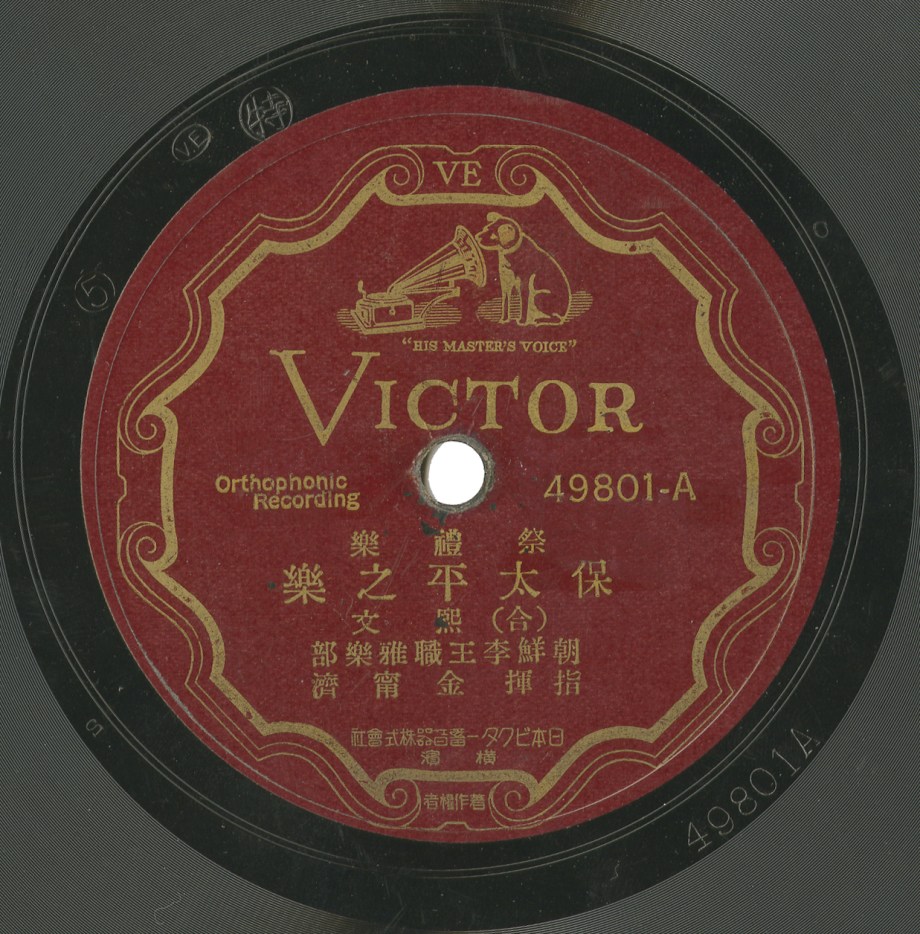
The piece I’m going to share with you is from this original set of 1928 A-Ak recordings and is titled “Heemun” (Korean: 희문, 熙文, literally “Glorious Writings”), the first part of a larger scale A-Ak work, the aforementioned “Botaepyeong” (Korean: 보태평, 保太平, literally “Conserving the Peacefulness”). Botaepyeong has been performed at the Jongmyo Royal shrine during the memorial rituals which pay respects to the deceased Kings of the dynasty, and “Heemun” is performed to signal the opening of the entire ritual as well as during the first dedication of offerings to the spirits of the deceased. It has lyrics sung by Gagok singers, which are mostly about praising the dynasty and its descendants. The lyrics are only performed during actual services21, not during rehearsals or any other events, which is why they are not audible in this recording.
These A-Ak recordings, even with the below-the-average sonic quality, are still considered to be some of the most important recordings of Korean traditional music ever captured during the 78rpm era. They feature a glimpse of A-Ak pieces performed in their “authentic” way – that is, as they were performed by the court musicians of the Joseon dynasty throughout the centuries. The performances in these recordings, compared to the modern recordings of A-Ak, sounds much higher in pitch and faster in rhythm22, with lots of prominent improvisations on strings. This sort of performance style is hardly seen today, as present day A-Ak performers tend to strictly rely on modern notations.
After the issue of this recording, even with the poor sales of the records, the Yiwangjik A-Ak Society and its musical legacy became arguably known as one of the most cherished legacies of Korean culture. Several publications and media reports concerning various aspects of A-Ak and its performers followed, and Korean intellectuals and scholars began to conduct serious research about its origin and development. The A-Ak Society building and its concerts became one of the major tourist attractions, which not only attracted Korean or Japanese audiences but also notable foreigners, including violinist Mischa Elman and film director Josef von Sternberg. After attending a performance of the A-Ak Society, Sternberg said to a reporter in an interview: “I was surprised Koreans have such a rich musical legacy. This is something that should be shared, studied, and enjoyed with the whole world.”23
Competitions followed. Nippon (Japan) Columbia, established in January 1928 by merger of Nipponophone and British-based Columbia’s branch office in Japan, started issuing Korean recordings in February 1929. Among its first issues were a few recordings by the “Jeong-Ak Club” (Korean: 정악구락부, 正樂俱樂部), a small private performing and teaching group24 of A-Ak and other traditional ensembles. These were recorded considerably better than their Victor counterparts, but in terms of musical values, most of these recordings were popular pieces arranged in A-Ak style, so they are not in the same league as the Victor recordings.
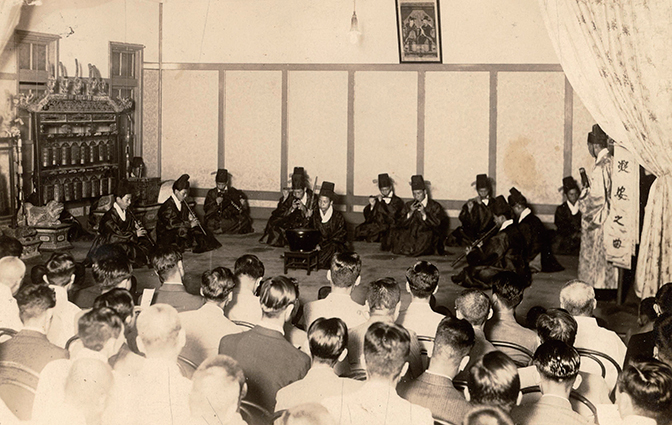
A-Ak Society Recital at Seoul City Theater, October 7, 1938
The Yiwangjik A-Ak Society continued to perform for the public. A notable performance was at the Seoul City Theater on October 7th, 1938, which drew thousands of people. Even during the Second World War and the political repressions against Koreans, the society continued to perform. After Korea was liberated in 1945, the Yiwangjik was dissolved, but the A-Ak Society still survived as “Old Royal Court A-Ak Society” (Korean: 구왕궁아악부, 舊王宮雅樂部), and in 1951, under the special laws passed by the President and the National Assembly of Korea, it officially became The National Gugak25 Center of Korea26. They are still performing and teaching A-Ak and other traditional Korean music styles to the Korean public to this day.
The Yiwangjik A-Ak Society of Chosun – Ritual Music Botaepyeong (Orchestral) Heemun


Top (L-R): Master Kim Cheong-Heung teaching traditional Korean dance (1990), Jongmyo Shrine Ritual Music Recital at the National Gugak Theater (2005)
Bottom: A modern day A-Ak performance
Technical Notes / Discographic Information
Victor (Japan) Red Seal Record 49801-A
祭禮樂 保太平之樂 (合) 熙文 朝鮮李王職雅樂部 指揮 金寧濟
Conducted by Kim Young-je.
Recorded electrically on location in Seoul, ca. June 15th, 1928.
Issued ca. December 1928.
Reissued on Victor (Japan) Red Seal Record 49815-B as a part of “The Essence of Chosun A-Ak” in November 1942.
Reissue coupled with a side originally issued as 49808-A.

L-R: Front cover of “The Essence of Chosun A-Ak” (1942)
Footnotes
1“Yayue (Chinese),” “A-Ak (Korean),” and “Gagaku (Japanese),” are the local pronounciation of the same Chinese characters “雅樂.” Even though all three of them have the same origins from Tang China, all three of them are usually considered as totally different types of music.
2See one example of this here, a manuscript from the Sejong Silok (世宗實錄); The Chronicles of King Sejong (from 1454), http://pds22.egloos.com/pds/201108/19/29/e0062529_4e4e3817bfad9.jpg
3“Yiwang (Korean: 이왕, 李王)“ means “House of Yi (Lee)” – which was the clan of Royal family of the Joseon Dynasty.
4The Yiwangjik also took charge of a marching band and other western style musicians for entertaining the old Royal family, and apparently these “new” style musicians were considered more important than the “centuries-old tradition.”
5His father, Master Ham Jae-Woon (Korean; 함재운, 咸在韻, 1853-1916), was also a Gayageum player and the leader of A-Ak band from 1912 until his death. The official leader of the band was Master Myeong Wan-Byeok (Korean: 명완벽, 明完璧, 1842-1929), but because of old age and ill-health, he could not perform regularly at this point.
6Even after this, which occurred on April 25th, 1926, Yiwangjik was not dissolved, as the deceased King’s half-brother Prince Yeongchin, succeeded the position as the head of Yi household. The Yiwangjik A-Ak Society continued to play for Prince Yeongchin and his family members as late as 1943.
7Until the introduction of few Korean recordings by Nitto Records in October 1926, Nipponophone was the only record company active in Korea.
8It appears the A-Ak society (at least some of the members) recorded a number of recordings for Nitto Records in 1926, although not a single copy of these recordings hasn’t been found.
9Anonymous. Ancient A-Ak Music of Chosun Goes Worldwide (朝鮮古代雅樂世界的으로前進), article from The Donga Ilbo (東亞日報), June 9th, 1928, p. 2. c. 4.
10Seong, Kyeong-lin, The A-Ak Records (아악레코–드), from the book, A-Ak of Korea (朝鮮의雅樂), Bakmun Publishing (博文出版社), Seoul, 1947. pp. 169 -173.
11Statistics shows that a middle-class Korean white-collar worker earned about 150 Yen a year in 1929, so the whole royalty was quite a big sum of money.
12Kim, Cheon-Heung, Reminiscence of Making 78rpm records (유성기음반취입회고) from, Korean Discography Journal (한국음반학), Vol.1, No.1. Korean Discography Research Society (한국고음반연구회), Seoul, 1991. pp. 267 – 268.
13Master Kim conducted all of the ritual music sides, while Master Ham conducted everything else.
14It appears that these technicians from Victor had not yet mastered proper microphone settings. Most of the other Korean Victor recordings from 1928 also suffers from hollow acoustics, which shows the distance between the performers and the microphone was too distant. Afterwards, Victor chose to record Korean artists in their own studio in Yokohama, Japan. The second Korean recordings sessions occurred around May 1929 and lasted until the final Korean Victor recordings of December 1941.
15Much of the A-Ak Society’s buildings were demolished in 1967 when the whole complex was sold to a private company, The Yooksadang building, however, somehow survived as a part of private property, albeit in a serious state of negligence. This writer actually trespassed (!) on to the private property to confirm the details regarding this building. The building, as you can see in the photo, is mostly built with wood with tiled roof. Inside the building there is a relatively big open space (72 x 40 x 9 feet, respectively) with wooden floors. This room gives enough space to gather 54 musicians, but there’s not much room to consider the sonic balance. There’s a small room at the Northeast corner of the building which is obviously the room where the recording lathe was installed.
16Ironically, according to Master Kim, after these tense situations were settled, the Yiwangjik used this money to build a sonically better studio for the A-Ak society in late 1929.
17It apparently could be bought as a whole set within a special album, although there’s no reported example of the album.
18Victor’s regular Korean issues on black label started from 49000 and went through 49491. Although there are several surviving Victor metal parts that carry the number after 49491 (the highest is 49508, reassigned to Victor Junior number), it is doubtful that the ones after 49491 actually carried the number when they were issued. 49491 was issued on November 1937. Afterwards, Korean recordings were only issued on Victor’s budget label called “Victor Junior,” which started with the number KJ-1001 (issued on February 1935) and ended with KJ-1386 (issued sometime in 1941). There are separate recordings appearing in the 49500 range (49500-49514), special recordings of operatic recordings sung by Korean opera singers, issued between December 1941 and November 1943.
19More information about “Daitoa Ongaku Shusei” and examples can be found on Haji Maji, here.
20The quality of shellac was more inferior than the 1928 pressings because of wartime shortages, but usually most of the examples appearing on the market tend to have less wear or scratches on them.
21According to some insider knowledge, this ‘common law’ was kept among the A-Ak musicians until the mid-1950s, but after Jongmyo Royal shrine rituals temporarily ceased to be performed during the Korean war and afterwards, nobody took this seriously, and as a result, modern day performances and recordings feature the lyrics most of the time.
22Here’s a field trip recording of the same piece (plus vocal Gagok parts) from 1966, recorded by Dr. Robert Garfias.
23Kim, Dong-hwan (김동환 金東煥), Na, Woon-Kyu (나운규 羅雲奎), etc. Impressions on Mr. Sternberg – Interviews and Discussions with an international artiste and leading Korean film stars. (스탄–벅印象, 世界的巨匠과朝鮮映畵人間座談會), Samchullee (“3,000 Leagues”, 三千里) Magazine, Vol, 8, No. 11., 1st November, 1936. Seoul, Samchullee Publishing (三千里社), pp. 164-165.
24Master Kim Kye-Seon, the Daegeum virtuoso who participated in Victor’s A-Ak Society recordings, was also a member of this Jeong-ak Club, and it is interesting to compare his recordings on Victor and Columbia.
25Gugak (Korean: 국악, 國樂) is the term that applies to all sorts of traditional Korean music.
26The National Gugak Center of Korea issued a special private CD in 1991, commemorating the 40th anniversary of its creation. It contains the whole 1942 Victor reissue set, as well as few other 78rpm recordings containing A-Ak or other folk ensembles. The CD actually tarnished the reputation of these legendary recordings, however, as all of the recordings featured in this CD were re-recorded by playing the original discs on a cheap portable gramophone, therefore badly distorting further the sound of the originals.
Brazil and South Africa (Two for the Summer)
 It’s summer where I am – the French doors have opened and in comes the breeze. And I’m probably in one of the few places in North America that isn’t melting under a spate of equatorial heat and humidity right now. It’s true that I turn to specific musics in different seasons. These two tracks have nothing ostensibly similar about them at all – except I find them irresistible at the moment. They appear to be (deceptively) effortless in their execution. They’re catchy, smooth even…though original copies aren’t exactly growing on trees.
“A Tua Vida É Um Segredo” (Your Life Is A Secret) is a classic, easy-going Brazilian samba, recorded February 1933 in Brazil by the Victor company. Victor was extremely active in South America particularly Argentia, but didn’t become active in Brazil until later, establishing recording hubs and pressing plants in São Paulo and Rio de Janeiro in 1929. Columbia had been recording in Brazil periodically from ca. 1910-12, and before them were the Germans: Odeon, Favorite, and Jumbo, pressing loads of 10.5″ discs. What was recorded in the early days in Brazil, by and large, was not folkloric – it was military bands and operettas, and other music of elites. That said, there were incredible exceptions, such as the string band Grupo Bahianinho, featured on the excellent, now sadly out of print Portuguese String Music: 1908-31 CD on Heritage.
By the late 1920s, the Brazilian repertoire on 78 was beginning to change. Some of the leading artists who bridged the gap between traditional and popular music were just beginning to record. A number of renowned talents were involved in the production of this song, early in their careers. First, the lead vocal is by Mário Reis (1907-1981), the smooth-voiced samba pioneer who made his name performing with Carmen Miranda and Francesco Alves, among others. His soft-spoken vocal style was later an influence on João Gilberto. Second is the composer of the song, Lamartine Babo (1904-1963). Babo, originally from Rio, became one of the most important composers of Carnival music. Eventually, he became popular in radio and television production. Finally, there’s the man behind the Grupo da Guarda Velha (“The Old Guard”), Alfredo da Rocha Vianna, Jr., aka “Pixinguinha.” Pixinguinha, besides being a top choro musician (flute and saxophone were his specialties), was also a house conductor and arranger for RCA Victor during this period. His “Old Guard” at times featured guitarist and cavaquinho player Donga, Bonfiglio de Oliveira on trumpet, Luis Americano on clarinet, Vantuil de Carvalho on trombone, and João da Baiana on the pandeiro.
A mea culpa – this track also appears on an imported 3-CD, eponymous collection of Mário Reis’ work, although I have not heard the transfer or seen the set. I am accompanying it with a separate piece of music that’s all but disappeared…
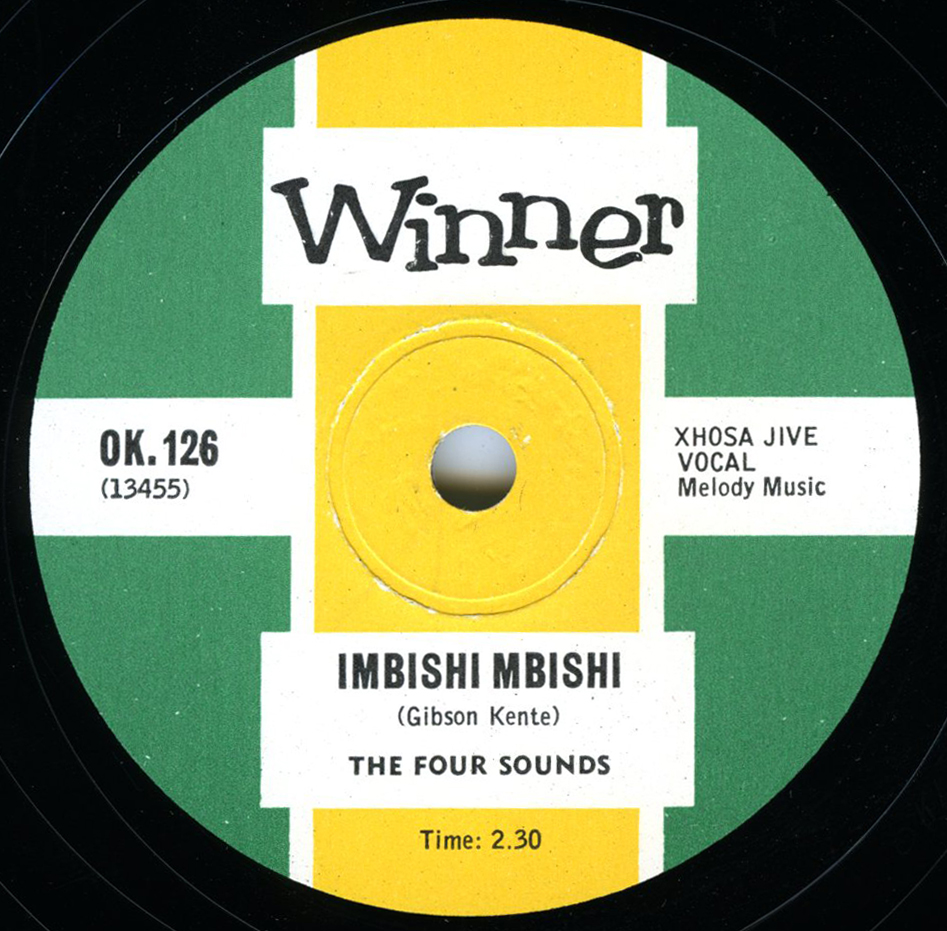 The Winner label was one of many small, South African labels operating in the early 1960s, issuing all manner of popular styles of music across southern Africa – jive, jazz, guitar folk, concertina music, Malawian music, Mozambican music, etc. Winner had an impressive roster and beautifully clean pressings. This track, recorded ca. 1962, features an excellent vocal jive quartet and an acoustic backing band typical of jive bands before most had gone electric in the mid-1960s. I was introduced to the A- side of this record (titled “Vuka Lova”) some years ago by collector and friend Michael Kieffer, and instantly recognized an above-average jive band. When I had the chance to pick up my own copy, I jumped – lo and behold, I was equally enamored of this, the flip side. “Imbishi Mbishi” in Xhosa apparently is a nickname that means “the corpulent one”…though I believe the term is used metaphorically. The lyricist is a man named Gibson Kente (1934-2004), who was just on the cusp of becoming one of South Africa’s most revered writers of musical theater in the townships. Throughout his career, Kente was criticized as being overly saccharine in the face of the violence of apartheid, but various scholars consider his works important examples of township drama, and his works in the 1970s focus on the injustice of apartheid. This sweet number is an example of his early beginnings…
Grupo da Guarda Velha – A Tua Vida É Um Segredo
Technical Notes
Label: Victor
Issue Number: 33614-B
Matrix Number: n/a
Label: Winner
Issue Number: OK.126
Matrix Number: 13455
Sara de Ortega y Manuel Sierra – A San Cipriano
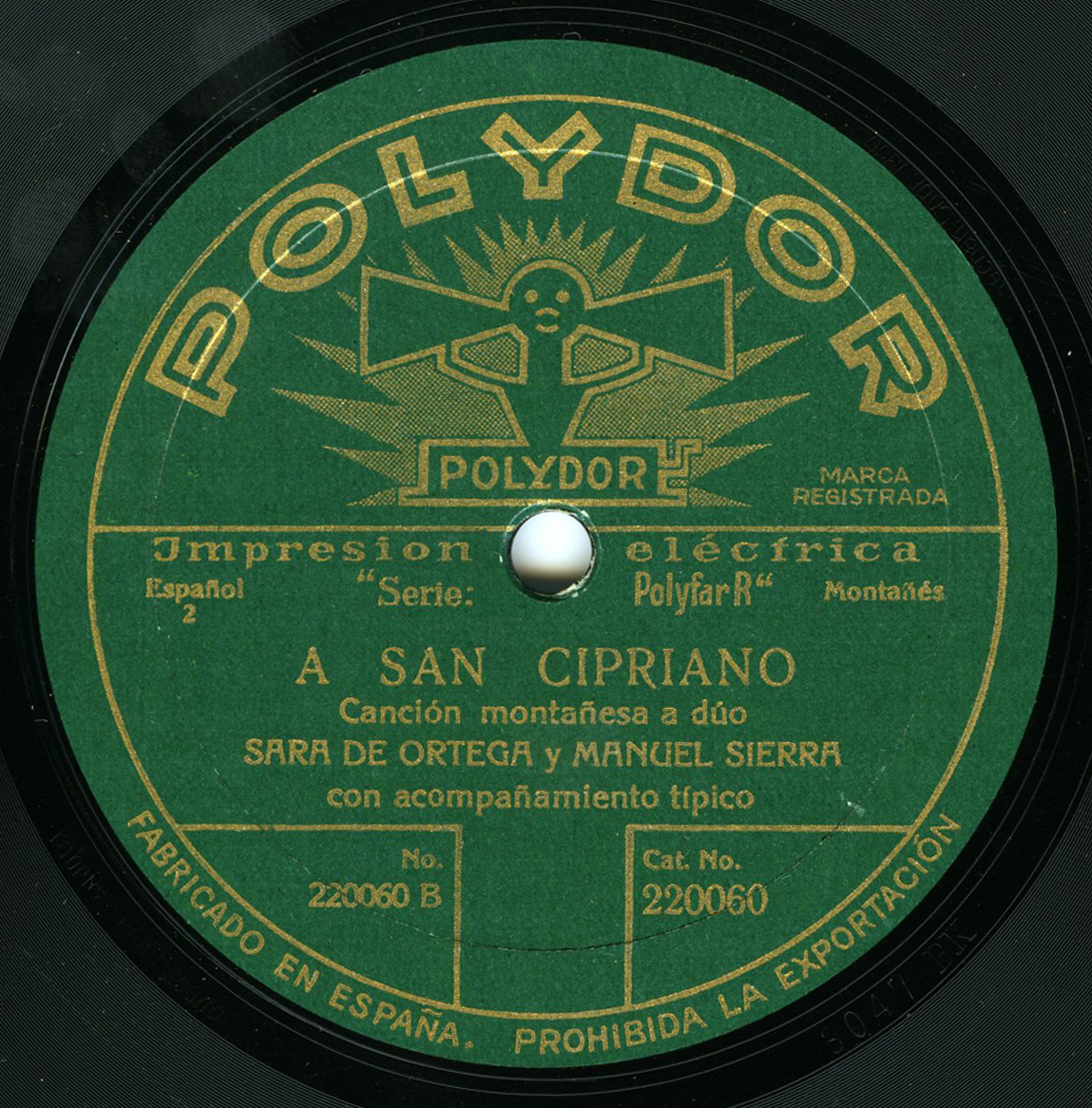 It’s been a while since I’ve revisted the wildly diverse folk music of Spain. Today’s example is from the autonomous community now known as Cantabria, and in the past known as Santander (after its port city) as well as the more lyrical La Montaña.
Cantabria is indeed, mountainous. A small, coastal, and green region, it is bordered by Asturias to the left and the Basque Autonomous Community to the right. Because of it’s geographic location, it’s no surprise that its music has much in common with the music of its neighbors. And yet, it retains its own uniqueness. This piece is introduced with the classic pitu and tambor duet – the pitu being the small reed instrument of the north of Spain, and the tambor, its accompanying drum. However, after a short introduction, all stops, and the classic, acapella singing of Cantabria begins. Journalist Rodney Gallop somewhat improbably wrote about these two particular artists when they recorded a few sides for HMV in 1928 and 1930, and distinctly noted what he called the “tragic intensity” of their brand of Cantabrian singing. It’s also forceful and strident at times. What still, for some reason, shocks me, is the fact that it’s unaccompanied, until the pitu and tambor return for a brief refrain at the end of the piece. It shouldn’t shock me, I suppose – although it’s less common on commercial discs, unaccompanied folk singing was recorded all around the world. Even Asturian tonadas, right next door to Cantabria, were often completely unaccompanied (when not accompanied by the gaita bagpipe). And on a crisp recording like this one, made in 1930 by the German Polydor company, you can really experience the acoustics of the room, something that is often buried under layers of hiss and decades of groove wear. The sound of the singers’ brief pauses are almost as interesting as their voices themselves.
Because, perhaps, of the region’s size, the cancion montañesa of Cantabria wasn’t recorded nearly as much as the coros of Galicia, let alone the flamenco superstars of Andalusia. As far as I can tell, Manuel Sierra and Sara de Ortega made a handful of records for several labels from the late 1920s to the early 1930s, after which I have no idea where their careers went. Sierra was popular enough to perform at a large exposition in Barcelona in 1928. Any success they would have had outside of Spain would probably be due to the intrepid Rodney Gallop, probably the only person writing about commercial “ethnic” 78s for the English speaking world at the time. He was specifically fond of Sierra and Ortega’s duets. The song itself is a sweet interplay between a boy and a girl on the way to the festival and pilgrimage honoring Saint Cyprian, which dates from the XV century and still occurs yearly in Cantabria on September 16th. Thanks to reader isoldevila, we have a full transcription of the song, a slightly different version than the one documented on this site.
Vístete pronto mozuca
que vamos a San Cipriano
no te apures por las cuestas
que yo te daré la mano
y en brazos, nena, te llevaría
A San Cipriano a la romería.
Dices que me quieres mucho
y a la romería iré,
y al pasar el regatuco en
tus brazos me pondré
pero no te resbales
que no quiero caer.
No tengas miedo
que yo resbale
con una carga
que tanto vale
con gran cuidado
iré, preciosuca, como
llevando a la virgenzuca
Y si caemos nos levantamos
y le decimos a San Cipriano
que fuimos juntos al regatuco
y nos caímos apretaducos.
Sube, sube las cuestas arriba,
que por ti suspira tu moza querida,
y subimos arriba a los llanos,
a tomar la sombra de los avellanos
Manuel Sierra y Sara de Ortega – A San Cipriano
Technical Notes
Label: Polydor
Issue Number: 220060
Matrix Number: 3047 BK
And yet another shout out to Heritage’s Voices of Spain CD, which contains 3 songs by Sara de Ortega and Manuel Sierra. One duet, and two solo pieces.
Muhyiddin Ba’yun – Taxim Alal Wahidat
 Muhyiddin Ba’yun (1868-1934) was from Beirut, and became a popular recording artist for the Baidaphon company, based out of that same city, from the early 1920s until around the time of his death. He became well-known as both a singer and as a talented instrumentalist, having studied under a lute player from Baghdad named Ibrabim Adham. It appears he recorded sessions in 1924, 1926, 1929, and sometime in the early 1930s, most likely, when this terrific improvisation was made – a wahida, similar to the Turkish ciftetelli, accompanied by an oud playing on the pulse throughout the piece.
Part of the problem of piecing together an overall picture of Ba’yun’s career for me, anyway, is access to documentation. I could trace about 35 individual releases by Ba’yun, most of which are vocal pieces, though I am almost certain there are more. Typically, his name is often transliterated in multiple ways: Mohieddine Effendi Bayoun, Mohiddine Baayoun, and the spelling I’ve used above, culled from an out-of-print Ocora CD (Archives de la Musique Arabe, Vol. 1).
One of the most interesting wrinkles when considering Ba’yun’s output has appeared when trying to determine precisely what instrument he’s playing. On some records he is credited as playing the buzuq. On others, he is credited as playing the tanbur. Tony Klein first brought this artist to my attention, and the instrument he was playing. We listened to Ba’yun tracks which were labeled buzuq and others labeled as tanbur, and he posited that there appeared to be very little sonic difference, if any, between the sound of either instrument.
Definitions can be hazy, however. The buzuq is usually a two-course instrument with 24 frets and a body similar to the oud. “Tanbur” is a term that can refer to a number of different long-necked lutes from Turkey to Central Asia. Complicating things further, Grove Dictionary of Musical Instruments states in their tanbur section that “Buzuq is the term known in Arab urban music and is used in Baghdad, Damascus, and Beirut.” So tanbur = buzuq in this instance. Or does it? Or, as Tony asked rhetorically in an e-mail: “When is a tanbur a buzuq, and/or when is a buzuq not a tanbur?”
At the risk of plummeting down a semantic rabbit hole, it’s probably best to get right to the music. Those who’d like to augment our musical instrument discussion are welcome. Enjoy!
Muhyiddin Ba’yun – Taxim Alal Wahidat
Technical Notes
Label: Baidaphon
Issue Number: B 090887
Matrix Number: same
Thanks to Tony Klein!
Updates
I am wrapping up the notes to Excavated Shellac: Reeds, the next LP in the Parlortone series, which hopefully will be finished soon. I can definitely say that it’s the most intense little mix I’ve put together, with virtually all 14 tracks stone rarities. Opika Pende, on the other hand, sold out its first printing recently, and a second printing arrives very soon. I’ve been way behind on posting, as usual, but there’s lots afoot.
 Excavated Shellac
