
Comic songs were the bread-and-butter repertoire for so many early entertainers, whether they were well-known popular American songsters like Billy Murray, or obscure, often forgotten immigrant performers in the United States. Thousands were recorded, without question. A few have caught my ear over the years, such as those by Finnish fiddle player Erik Kivi. Recently I was delighted by the rustic voice of Russian-Ukrainian accordionist Nikolay Dontzoff.
Nikolay, or “Nicholas” as he was often credited, was born in 1881 in Kharkiv, Ukraine. He immigrated to the United States in 1922, getting onboard in Constantinople on the ocean liner Braga, which ran a route from Beirut to New York. With him was his wife, Lucy Dontzoff, who was twenty years his junior. They lived mostly in what is now West Harlem in Manhattan, and both worked the vaudeville circuit.
So far as we know, Dontzoff’s career on record was brief, and separated by extensive lags. He first stepped into a recording studio in New York in late 1922, almost as soon as he was settled, accompanying baritone Mikel Wavitch on a session for Victor. Those recordings, however, were never issued. Five years later, in October 1927, he was back – this time for Columbia, where he would record two records under his own name, including this one featured today.
Dontzoff accompanied his wife Lucy on four discs in 1929, and one disc accompanying Lucy and then-famed Russian “gypsy” singer Vera Smirnova. Then things go dark. He and Lucy were divorced by 1935. Nikolay moved downtown to the Eastern European neighborhood in the East Village. He was still performing both as a solo act, and with Russian music and dance troupes, often touring the country. He performed in the Russian revue Chauve Souris on Broadway, which ran for twelve performances in 1943.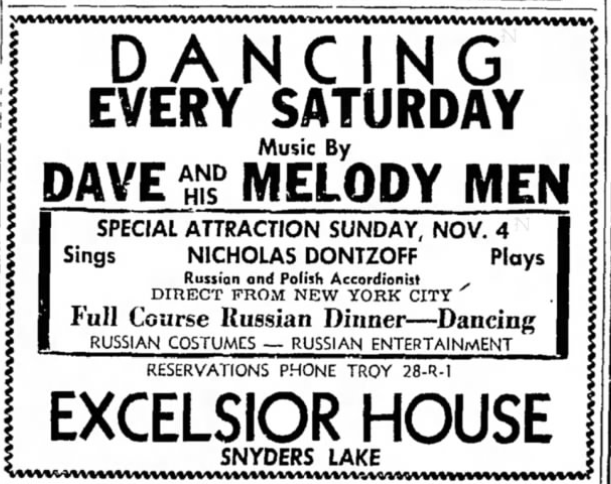
At some point, probably in the late 1940s, Dontzoff issued a 78 on his own imprint, “Nicholas Dontzoff” – but there seems to have only been one issue. It was likely an offshoot of the Argee label, which was a small, Russian-language label based out of a music shop on Lexington Avenue and owned by a Latvian immigrant named Jack Raymond. That record, and the two discs he made in 1927, appear to be Dontzoff’s only moments on record as a solo performer. By 1953, he was working at the Tompkins Square Tavern on 7th Street. He died that year.
“Serenkiy Kozlik,” or “The Little Grey Goat,” is a well-known Russian children’s song about a goat that is loved so much by a grandma that she naturally ends up cooking the dear goat in her homemade soup. The earliest recording of the song I could locate was one made in Saint Petersburg in 1908 by the Gramophone Company, and performed by G.L. Lebedev’s accordion troupe. In September 1910, another version was recorded in Vilnius, Lithuania, also for the Gramophone Company, and performed by a group listed as “Detskiy Khor Vilenskago Pervago Nachalnago Uchilisha.” Another was recorded one year later by Maria Emskaya for the Syrena label of Poland. I suspect there are many other versions, both earlier and later.
This version, however, is not standard – Dontzoff’s version of this song is a parody of the original. Here, he makes it an ironic song for adults.
Listen/Download:
Nikolay Dontzoff – Kozlik
Kozlik
(translated and transliterated by Diana Tarnavska and reader ‘andretges’)
Once upon a time there was an old lonely babushka
And she was very bored, alone
That’s right, that’s right, she was alone
Babushka went along the bazaar
She looked but there were no products
That’s right, that’s right, any products
But it was her lucky day
‘Cause she met a shaggy cute goat
That’s right, that’s right, a shaggy cute goat
She noticed the goat
And brought it right home
That’s right, that’s right, she brought it home
The goat was dirty, besides, and unshaven
And apparently had not washed at least for ten years
That’s right, that’s right, at least for ten years
Babushka took the goat to the bath
Babushka washed it with soda
That’s right, that’s right, she washed it with soda
Goat was for sure all native Russian
But sported a little French beard
That’s right, that’s right, a little French beard
Babushka didn’t like the beard at all
She shaved off the beard at the hairdresser
That’s right, that’s right, she shaved the beard
Babushka called the goat “Dusya”
They were living together, the goat and babusya
That’s right, that’s right, goat and babusya
In the morning as soon as the dawn breaks
Our goat hits the coffee with a bun
That’s right, that’s right, coffee with a bun
Our goat was horrifically comic
He registered her house in his name
That’s right, that’s right, registered in his name
Having taken almost everything from babusya
He left his babushka with horns and hooves [without a damn thing]
That’s right, that’s right, just horns and hooves
Dear babushkas, don’t lose yourself
Falling in love with some young goats
That’s right, that’s right, with some young goats
They will disappear at the first occasion
And you will sit lordly in a galosh
That’s right, that’s right, sit in a galosh
Original Russian
Как-то старушка одна проживала
И в одиночестве очень скучала
Вот как ведь как, очень скучала
Отправилась бабушка вдоль по базару
Глянуть там, нет ли какого товару
Вот как ведь как, какого товару
Значит счастливый денёк ей задался
(На)встречу лохматый ей козлик попался
Вот как ведь как, козлик попался
Бабушка козлика вмиг залучила
И на квартиру к себе притащила
Вот как ведь как, к себе притащила
Козлик был грязный, к тому же небритый
И уж лет десять, как видно, немытый
Вот как ведь как, как видно немытый
Бабушка козлика в баню сводила
Бабушка козлика содой помыла
Вот как ведь как, содой помыла
Козлик конечно был нашенский, русский
Но щеголял он с бородкой французской
Вот как ведь как, с бородкой французской
Бабушка бороду страх не взлюбила
У парикмахера бороду сбрила
Вот как ведь как, бороду сбрила
Бабушка козлика звала всё “Дуся”
Зажили в мире козёл и бабуся
Вот как ведь как, козёл и бабуся
Утро(м) едва только зорька займётся
Козлик наш “кофэ” уж с булкой напьётся
Вот как ведь как, с булкой напьётся
Козлик наш был преужаснейший комик
Взял перевёл на себя бабкин домик
Вот как ведь как, бабкин уж домик
Взяв у бабуси почти все до крошки
Оставил он бабушке рожки да ножки
Вот как ведь как, рожки да ножки
Милые бабушки не увлекайтесь
И в молодых козелков не влюбляйтесь
Вот как ведь как, вы не влюбляйтесь
Козлик исчезнет по первой пороше
Вы же усядетесь важно в калоше
Вот как ведь как, важно в калоше
Notes
Label: Columbia
Issue Number: 20119-F
Matrix Number: 108381 (A-1)
 Excavated Shellac
I had no idea that Mr. Mikhail Ivanovich Vavich sung with this man. He is one of my favourite Russian singers of that time period, and his beautiful baritone (almost basso) voice is enchanting
You can hear (and download!) the 1940s sides by Nikolay and a couple of duets by Vera Smirnova and Lucy, accompanied by Nikolay on: https://www.russian-records.com/search.php
Search for ‘Dontzoff”
Thanks, Mark – yes, I’ve included a link directly to that page in the text.
Thank you for the story of Nikolay Dontzoff, really interesting things to know!
I’m writing to note that the Russian transliteration is not quite right (and the translated version as well), so I’ve made a couple of edits to it:
Transliteration:
https://gist.github.com/andretges/3610cb51939a47fb24beedb3dec9347f
https://gist.github.com/andretges/3610cb51939a47fb24beedb3dec9347f/revisions
– here you can see what was changed in red and green color.
A few notes on this:
As I’m not a native English speaker, I did my best for the translation in the meaningful parts, although it may feel weird stylistically. I leave it for anyone more advanced in English than me 🙂
Translated version:
https://gist.github.com/andretges/e89e6d033bac479377984cb4ccd37ce5
https://gist.github.com/andretges/e89e6d033bac479377984cb4ccd37ce5/revisions
Hope you find this helpful.
Thanks again!
Thanks very much! I will edit the entry soon, based on your suggestions.