Author: Jonathan Ward

Trutone Dolls – Kudala Ngikutshela

winner.jpgI couldn’t resist heading back to Africa this week. And not only that, I’m taking a brief break from the really early material I’ve been posting and moving ahead to the 1960s for this release.

And why not? South Africa (as well as other countries, such as India) kept pressing 78s up until the late 60s, at least. There were a slew of local labels churning out hundreds of fantastic jive singles throughout that decade – labels like Troubadour, Tempo, Stokvel, Tee Vee, F.M., Gallo New Sound, and Winner, which is where this nice jive track comes from. The pressings were great, too. A mint copy sounds like a mint copy with little to no surface noise. For you folks who prefer the older stuff, give this a try!

I have no idea what happened to the Trutone Dolls, although I have another great record by the group on the Stokvel label. It’s titled “Jo Jo In School.” If any of you out there are familiar with the late-60s, South African jive compilation on Mercury Records titled “Ice Cream and Suckers,” you might remember that title track’s melody. The Dolls used that same backing track for their “Jo Jo” song. It was written by Strike Vilakazi and I guess he tended to reuse backing tracks for other artists as he saw fit!

Enjoy!

Trutone Dolls – Kudala Ngikutshela

Technical Notes
Label: Winner
Issue Number: OK.263
Matrix Number: 15055

Phước Cương troupe – Xử án Bàng Quí Phi (excerpt)

bekavietnam.jpgThanks to reader Linh and Jason Gibbs, we know know that this is a piece featuring the famed Phước Cương troupe. They are performing an example of cải lương, a “classical” type of Vietnamese theater music played on traditional instruments, and it is an excerpt of a piece known in English as “Sentencing the Precious Consort Pang.” The record dates from the mid- to late 20s. According to Linh’s description, cải lương sets lyrics over older, classical Vietnamese songs. The songs that are played in this excerpt are Khoc huang thien, Ngu Diem, and Thien Tuong.

Beka was sold to Columbia in 1926, although the Beka imprint seemed to last well into the 1930s. The company made at least 140 recordings in Vietnam, and had a considerable presence in Asia throughout the early part of the century, having begun to record there since ca. 1906, when they first landed in Hong Kong.

The singers are accompanied by a bamboo flute (either the sao, or the tieu), a bowed instrument (probably a dan gao or dan nhi), and a plucked lute of some kind.

Khoc Hoang Thien – unknown

Technical Notes
Label: Beka
Issue Number: B 20107
Matrix Number: 92380

Peara Saheb – Gazal

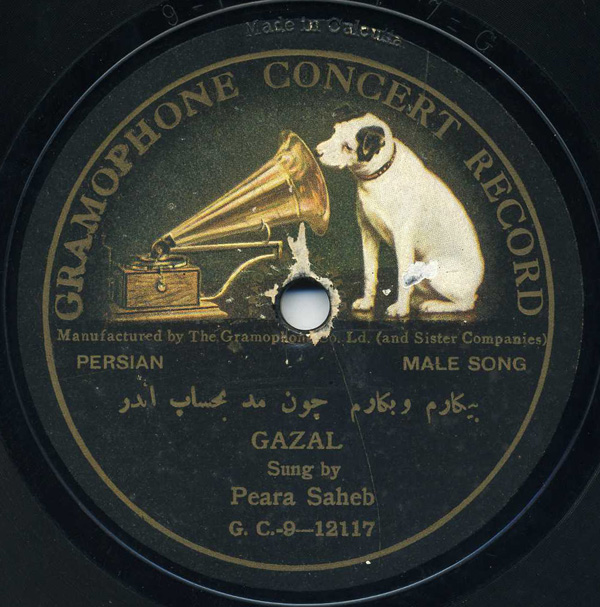
peara.jpgSome “light classical” music from India, for this week’s post.

This record was recorded in India on October 20, 1910 (thanks to reader Howard Friedman for the sleuthing). In 1908, the Gramophone Company opened a pressing plant in Calcutta, and this record was pressed there for local distribution.

Mr. Saheb was a contemporary of this singer featured in this article, and was also credited on other recordings as “Peara Sahib.” For a more detailed biography on Peara Saheb, I am indebted to Suresh Chandvankar of the Society of Indian Record Collectors in Mumbai, who has graciously allowed me to distribute a recent edition of their newsletter. The newsletter can be downloaded in .pdf format here, and the biography on Peara Saheb appears on pages 14-15.

Saheb’s lilting voice is accompanied here by harmonium and percussion, and he sings a ghazal, an ancient poetic form originally from Persia. Listen closely at the very end of the track for a common occurance in early Indian music: the singer announcing himself in English. It’s a beautiful piece of work.

Peara Saheb – Gazal

If you’re interested in more information on early recording in India, there’s this article. There is also the fine article by Gerry Farrell in the British Journal of Ethnomusicology (Vol. 2, 1993), titled The Early Days of the Gramophone Industry in India: Historical, Social and Musical Perspectives. There is also yeoman’s research by Michael Kinnear in his book The Gramophone Company’s First Indian Recordings (1899-1908).

Technical Notes
Label: Gramophone Concert Record
Issue Number: G.C. 9-12117
Matrix Number: 13469

Athanasia Atraidou – Sti Raxi Stin Kriovrisi

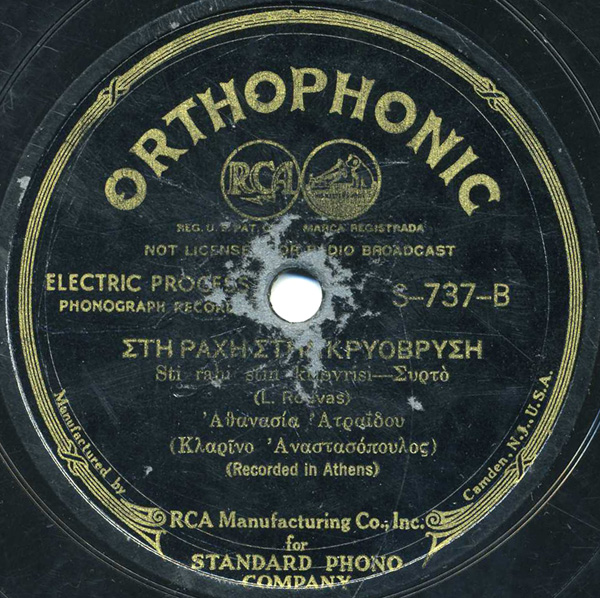
orthophonic.jpgThis week, I offer a nice example of Greek dimotika from the mid-1930s.

Dimotika refers to folk songs traditionally from the Greek countryside, as opposed to rebetika, which is an urban song type that I’m sure most listeners/viewers out there are doubtlessly familiar. This dimotika track is a syrto, a folkdance and song generally in 2/4 time, usually danced in a circle. The title roughly translates to “Up on the Ridge at Kriovrisi.” The transliterated name “Kriovrisi” is actually a reference to the municipality of Kria Vrisi, located in the Macedonia region of Greece.

Alas, I could find scant information on the vocalist, Ms. Atraidou. However, the clarinetist, also credited on the record, is Yiorgo Anestopoulos, a master player and an accompanist on hundreds of classic recordings. A collection of his recordings can be found here. The “L. Rouvas” listed as composer is most likely Lazaros Rouvas, who was also a lute player.

The Orthophonic label was a Victor subsidiary, run out of the United States by Tetos Demetriades. Throughout the 1930s, they released countless fine examples of Greek and Turkish music (much of which was originally recorded in those countries).

Athanasia Atraidou – Sti Raxi Stin Kriovrisi

A big thanks to Dave at Spectacular Opticals for help with translation, as well as musical info and insight.

Technical Notes
Label: Orthophonic
Issue Number: S-737
Matrix Number: n/a

A. Kevorkian – Gigo

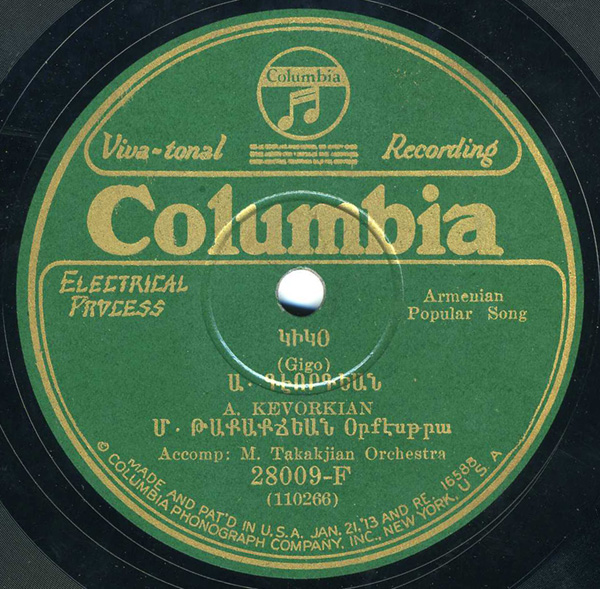
columbia-kevorkian.jpgAnother one of my personal favorites, thanks to the folks with foresight working for Columbia Records in the late 1920s, who managed to capture some of the greatest folk music by American immigrants (Ukrainian, Polish, Albanian, Armenian, Irish, etc.).

Mr. Kevorkian sang this track in January of 1929 in Los Angeles, and is accompanied by violin, oud, and Mesrob Takakjian on clarinet. Takakjian must have been well-known in the 1920s, as I’ve found his presence on several Armenian, New York City-based labels around that time. (Pharos records, in particular. Sohag was another short-lived label associated with Pharos.) Other recordings from this session were released by Columbia.

For more by A. Kevorkian and Mesrob Takakjian, again try The Secret Museum of Mankind, Vol. 5.

A. Kevorkian – Gigo

Technical Notes
Label: Columbia
Issue Number: 28009-F
Matrix Number: 110266

Tefanake, Reia, and Moratai – Ute

mareva.jpgFirst, a thank-you to Matt at Benn loxo and Matt at Matsuli Music for their comments and links – welcome to all who have found your way via their fine sites. I hope you enjoy your time spent here.

The beautifully designed Mareva was a painfully short-lived label maintained by amateur French ethnographers Adolphe Sylvain and Marc Darnois, and sold on the waterfront in Tahiti ca. 1949-1950, and likely in France. Super scarce. The records feature authentic folk music of Tahiti as well as music from neighboring Tahitian islands. From what I can deduce, fewer than 30 discs were issued on Mareva. They were pressed in France and sold both separately, and in a box with photographs by Sylvain. From the sound of this recording, it seems to me as if they were dubbed from original acetates which Sylvain and Darnois recorded in the field.

I seem to be stuck on accordion music lately too, so I thought I’d pass this rarity along. I find the singing a real treat.

(If you’d like to hear more from the Sylvain and Darnois archives, a different track exists on Yazoo’s Secret Museum of Mankind, Volume 5 CD.)

Tefanake, Reia, and Moratai – Ute

Technical Notes
Label: Mareva
Issue Number: 115
Matrix Number: Part 13485-1PD

Pradal & Cayla – La Crouzado

lesoleil.jpgI’m back, and will be on schedule for the forseeable future.

This track hails from the Auvergne region of France, and is an authentic bourée – a folkdance usually in double-time whose origins date back to the 17th century. Performing here are Jean Pradal on accordion, and Martin Cayla on the cabrette, the Auvergne bagpipe traditionally made of goatskin. (There are other types of bagpipes from different regions in France I’ve been able to find examples of on 78, such as the binioú kozh from Brittany, which are more reedy and high-pitched.)

Cayla was a popular folk musician of the time and the man behind the short-lived Le Soleil record label, which, as far as I can tell, was in existence from the late 20s to the early 30s. Despite the sometimes cruddy pressing quality, there’s great music on this label – besides fantastic accordion and cabrette jams, there are excellent examples of banjo and hurdy-gurdy playing as well. I’ve been lucky enough to find a bunch of them, several of which came from the collection of a certain cartoonist residing in the south of France. Even his cast-offs are great! I’m not worthy!

If you’re interested in more vintage music from France, try digging up this CD. (This one might be decent, too.)

Pradal & Cayla – La Crouzado

Technical Notes
Label: Le Soleil
Issue Number: 221
Matrix Number: C 221

Edouard & Oliveira – Ngai Abuyi

African acoustic guitar music is, for me, some of the more sublime music in the world. And certainly some of the greatest examples came from what was then the Belgian Congo, right around the mid-century mark.

Ngoma remains the most important Congolese record label, as well as one of the most important labels in all of Africa. It was started by two Greek brothers, Nico and Alexandros Jéronimidis, around 1948. Not only did they record well over a thousand discs, the first to capture all manner of Congolese musical styles (the rumba, cha-cha, and solo acoustic guitar picking of course), but they encouraged experimentation by their musicians. Ngoma records were pressed in France and distributed primarily in Central Africa – Congo and Cameroon especially – and as such are, well, impossible to find. Not only that, but all the Ngoma masters were long ago lost in a warehouse fire. As if that wasn’t enough, the company then donated all of its file copies to the Congolese government, only to have those destroyed during political strife.

Here’s a nice guitar duet by Georges Edouard and Manuel D’Oliveira, released sometime in the late 40s-early 50s.

Edouard & Oliveira – Ngai Abuyi

Absolutely worth searching out are two collections of Ngoma material, released on CD in the late 90s. The first contains all 78rpm material and is titled “Ngoma: The Early Years.” The second is mostly 45rpm Ngoma records, and is titled “Ngoma: Souvenir ya l’Independence.” I’m not sure if they’re even technically in print anymore, but they’re definitely worth digging up.

And the next two weeks are crazy for me – next post after the 18th.

I hope you enjoy this one.

Technical Notes
Label: Ngoma
Issue Number: 380
Matrix Number: J-764-2

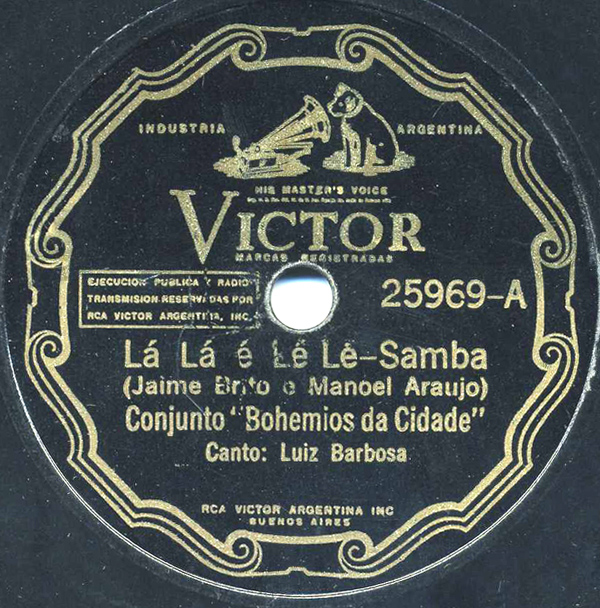
Bohemios da Cidade – Lá Lá é Lé Lé

bohemios.jpgI thought it might be fun to start the week off with an authentic samba, recorded in Brazil in the early to mid-1930s by Victor’s productive Argentine division.

In terms of geography, the Victor company handled all of North and South America at that time, with divisions in Canada, Mexico, and Argentina – while His Master’s Voice (HMV), Victor’s larger sister company (for lack of a better descriptor), handled the rest of the world. Interestingly, Brazilian recordings were released by HMV as well, but I don’t know the exact reasons behind this. By 1933, all record companies that were still lucky enough to exist in one form or another were doing whatever it took to stay afloat, which in many cases meant merging, consolidating, or just plain selling off their catalog. Victor was the only American record company to make it out of the Depression. Surely, sales in the southern hemisphere had something to do with that, but again, this is conjecture on my part.

The lead singer of this track seems to be a well-known samba pioneer in Brazil, Luiz Barbosa. Barbosa recorded throughout the 1930s and appeared in some of the earliest films to feature Carmen Miranda. He died in 1938, at the young age of 28.

Some Barbosa material appears to be available on this CD, but as usual, I can’t vouch for the quality of the transfers.

Bohemios da Cidade – Lá Lá é Lé Lé

Technical Notes
Label: Victor (Argentina)
Issue Number: 25969
Matrix Number: 80377-1