Jeannette, Hélène, and Rasamy Guitare – Mpanjakan’ny Ny Lisy

Some readers of Excavated Shellac are undoubtedly familiar with the CDs “The Music of Madagascar” on Yazoo, and “Madagascar: Musique de la côte et des hauts plateaux” on Fremeaux. Both contain a wealth of utterly stunning historic recordings made from ca. 1929 to the late 1930s*. Many of the performances on these CDs contain the unforgettable sound of the valiha, the traditional Malagasy plucked tube zither (and pronounced vahLEE). I highly recommend them both.

What’s also interesting about those CDs – which represent the only full CD-length collections of 78s from Madagascar – is that the bulk of those recordings were made in Paris for the Colonial Exposition of 1931, and not in Madagascar. For these Parisian recordings, some of which were issued by HMV and Pathé, it seems that a clear effort was made to primarily record a varied collection of music featuring the valiha, and similar vocal troupes with fiddle and accordion. The Musée de l’Homme was involved in these recordings as well, cutting their own versions of dozens of songs, while the groups were in town. The primary troupes which recorded in Paris were Hiran’ny Tanoran’ny Ntao Lo (called “Mpililao de Fenoarivo” by Fremeaux, and written as such under the Hiran’ny name on their 78s), Hiran-d Razafimahefa (called “Troupe Razafimahefa” by Fremeaux) and a group called the Choeur Malagache, which is most likely one of the two groups, or a combination of the two, under a generic pseudonym. (Hiran-d Razafimahefa leader, named Razafimahefa, was also a member of Hiran’ny Tanoran’ny Ntao Lo.)

Yet, there were recordings being made in the country of Madagascar at approximately the same time – in 1931, by Odeon, on site. While their catalog was diverse, the Malagasy Odeon series contains numerous examples of a style of music that was quite prevalent by 1931, and which virtually overtook the Malagasy 78rpm market from the 1930s onward. It’s called kalon’ny fahiny, or “songs of the past” – and is a song type deriving from theatrical Malagasy operetta.

Malagasy music varies across the island nation, and has been influenced from so many sources – East Africa, Europe, Indonesia, and even Yemen. Compared to other traditional music from Africa, it is often described as more melodic, or “lyrical,” because of some of these influences. Kalon’ny fahiny songs certainly fit that description. The style is primarily from the high plains of the country, and the theatrical tradition is still practiced today in major cities of Madagascar. Some have said that, during the mid-20th century, 78s themselves were seen as symbols of modernity in Madagascar, and helped to encourage a marginalization of traditional representations on record.  However, that’s not to say that the kalon’ny fahiny songs were not unique in their own way. While the style was clearly influenced by western sources, it still retained the unique Malagasy singing (called angola). It featured piano, yet the piano playing was often sharp and staccato, sometimes sounding like an imitation of the valiha.

The 78rpm industry in Madagascar blossomed after those initial Parisian recordings in the 1930s, which, I believe, were marketed mainly to the French. Besides Odeon, the Polyphon label also recorded traditional groups in Madagascar. HMV soon began again, recording on-site, as did Decca – and from what I can tell, those two held a large share of the market and mainly recorded kalon’ny fahiny tunes. Soon, there were independent labels in Madagascar, such as Decco, Decaphone, Tiana, Discomad, Rova, Ossian, Colombe, and others. 78s were still being pressed in the 60s in Madagascar – Discomad, for instance, was launched as late as 1959, in the run-up to the country’s independence.

One of the most popular early theatrical groups was N Tropy Jeannette, or “Troupe Jeannette.” Their lead singer was the very same Jeannette on this recording.  She is considered a national treasure. N Tropy Jeannette recorded for everyone, even touring France in 1929.

Jeannette, Hélène, and Rasamy Guitare – Mpanjakan’ny Ny Lisy

Technical Notes
Label: Decca
Issue Number: 155043
Matrix Number: MAD 119-2

* Fremeaux’s collection lists 1929-1931 as recording dates, although the discs contain 6 tracks from the Clérisse expedition. Fremeaux states this expedition was in 1930, although I believe this is in error, and the expedition was in fact in 1938 or 1939 (one of my sources states 1939, while two others list 1938 as the date). At any rate, those Clérisse recordings were not issued on shellac until 1946, and apparently only in a run of 50 copies. Yazoo’s collection does not contain exact dates for the tracks, but from what I can tell they were from HMV, Pathé, and Polydor recordings (and possibly more), dating from ca. 1931 to the mid- to late 1930s.

Raïs Mohamed Ben Bihi – Caïd Mokhtar

Whenever I listen to early music from North Africa, even the classical pieces with piano by Algerian singer Mahieddine Bachtarzi, I find myself reminded how different North African music is from classical Arabic music. To my amateur ears, it comes with an entirely different set of influences, though there are similarities at the same time. One of the most obvious influences on North African music is indigenous Amazigh culture, and this piece is a prime example of Amazigh music captured in Morocco in the early days of the recording industry. Though they are still used interchangeably, I am using the term “Amazigh” as opposed to the frequently used “Berber,” as many Amazigh believe the term “Berber” to not only be pejorative, but also a name foisted upon them by other cultures. Morocco gained independence in 1956, after having been a French and Spanish protectorate.

In the Souss Valley, and in the Atlas Mountains of southern and southwestern Morocco, live the Shilha Amazigh (also known as Chleuh, and Ishlhin). Their native language is tashlhit, an Amazigh dialect. The musical traditions of the Shilha are rich. Small groups of professional Shilha musicians are known as rwais. The singular of the term rwais is raïs, and raïs refers to the leader and person in charge of the repertoire and poetry used in the group’s material. Hence our group’s leader: Raïs Mohamed Ben Bihi.

Generally, there is a repetitive, call-and-response quality to all the early rwais music that I’ve found, or have heard. The primary instruments used in a rwais ensemble are the rribab, the one stringed fiddle from the region made of walnut and olive wood, the lotar, which is a four-stringed lute with an enamel soup bowl as a resonator, and the naqus, which is a percussive bell that is played with a metal rod. The raïs sings his poetry line by line, and very often the chorus repeats it, line by line. I chose this piece, however, because it’s an instrumental, and it features another instrument used by the rwais ensembles which is not as often featured on early recordings: the haha, a flute used in the Essaouira region (thanks to reader ‘asklu’). Accompanying the flutes are two types of drums, though I’m not sure which ones – possibly the tallunt frame drum.

Polyphon, the French-run label related to Polydor, recorded this piece in 1936, probably in Marrakech. The first rwais recordings were made by Pathé only about 10 years earlier, and featured the artists Raïs Abdallah Enaïr and Raïs Elmokhtar Ben Saïd. The Gramophone Company followed suit, recording rwais troupes in 1929. In 1938, the Baidaphon company’s Paris outfit recorded the famed El-Hadj Belaïd, who even recorded a song about his travels there: “The Trip to Paris.” On the one hand, it’s interesting that recording of such a large cultural group that was easily accessible in major Moroccan cities did not begin until the mid- to late 1920s. We know that companies such as Polyphon and other European multinational recording companies were driven to find new markets, if they existed. In the late 1920s, Sub-Saharan recording began in vigor, and previously that was a recordist’s no man’s land. Perhaps the same feeling existed with regard to the non-urban music of Morocco. I suppose we can only be thankful that they began recording rwais groups when they did.

Rwais performances are, like so many other local styles of music, traditionally long-form styles. The 78rpm record can only capture a snapshot of the reality of a live performance, so we are left with mere snippets. The Polyphon label has remained an idiosyncratic favorite of mine, when it comes to the recording of small troupes across North Africa and elsewhere. For some reason, they chose to record in some of the most sonorous, gigantic recording spaces that must have been available. In some cases, particularly with large ensembles, this was a terrible choice, with the result sounding like mud. But for small troupes (including the Arab-Andalusian and raï music from Algeria recorded during the period), it worked magically – even with a little over-modulation.

Raïs Mohamed Ben Biak – Caïd Mokhtar

Technical Notes
Label: Polyphon
Issue Number: 46016
Matrix Number: 8033 WPM

Much info gleaned from the articles and dissertation by Philip Daniel Schuyler.

Maurizio Carta – La Disisperata di Tempiese

The early recorded folk music of Mediterranean islands is diverse and, with the possible exception of the islands of Greece, generally unexplored on reissue CDs. The European multinational record companies that readers of this website are by now very familiar with, were vigorous in their pursuit of any available market, and this included then far-flung and relatively isolated communities of the Balearic Islands, Malta, Corsica, Crete and the Greek islands, Cyprus, and Sardinia. Most of these markets – again, with the exception of the Greek islands – were miniscule when compared to, say, the classical music recordings of Russian tenors! The sales of Mallorcan 78s couldn’t even come close. It’s no surprise that comparatively few discs of these musical types were produced, and sales were, of course, smaller.

For instance, take the island of Malta, with its guitar-based ballads in the unique, Arabic-based Maltese language which dates from about the 9th century. Major recording labels of the early 20th century – Odeon, Polydor, HMV – only recorded Maltese music on 78s during a short period between the wars in the early 1930s. Those labels did not even record in Malta – Maltese musicians traveled either to Tunis or Milan to be recorded. On Malta, there were just one or two shops that sold those fine records. And that appears to have been beginning and the end of early commercial recording in Malta until the LP era.* In Spain, the Gramophone Company recorded music of Mallorca as early as September of 1924, and later in 1932 – just a handful of tracks as far as I can tell, although some appear to have been popular enough to have been reissued on their Spanish subsidiary imprints later in the 1930s. These examples can provoke two feelings that I’ve mentioned numerous times: fascination that such regional music was captured by these companies who were, of course, out for capital, yet at the same time, disappointment that they did not record more.

Sardinia has always remained independent from Italy in numerous ways, not the least of which is its local, non-Italian language, or its status as an autonomous community. There are no freeways. Cattle and sheep farming are a major source of the economy. Sardinia is also one of the least populated regions of Italy, therefore it’s not surprising that recording of Sardinian music was spotty. However, the musical traditions are rich, indeed. In Nuoro, the center of the island, there is the sonettu accordion dance music, and powerful, secular, vocal polyphony music called a tenore. In the south of the island, there is the folk dance music on the launeddas single-reed pipes, and the fisarmonica, a local accordion. The north of the island, particularly the regions of Logudoro and Gallura, is known for its mutos, or canto a chiterra songs – essentially voice and guitar music which developed in the early part of the 20th century, which allows the both singer and guitarist plenty of room for interplay. This is the type of music featured today.

At least in terms of the Gramophone Company, the 78rpm-era music of Sardinia, as with Malta, was primarily recorded in the early 1930s, with a spate of tremendous discs featuring singers such as Gavino de Lunas, Antioco Marras, and launeddas player Efisio Melis. However, other companies along with Gramophone, such as Odeon and Pathé, had been sporadically recording Sardinian music throughout the 20s, beginning at least as early as 1922.

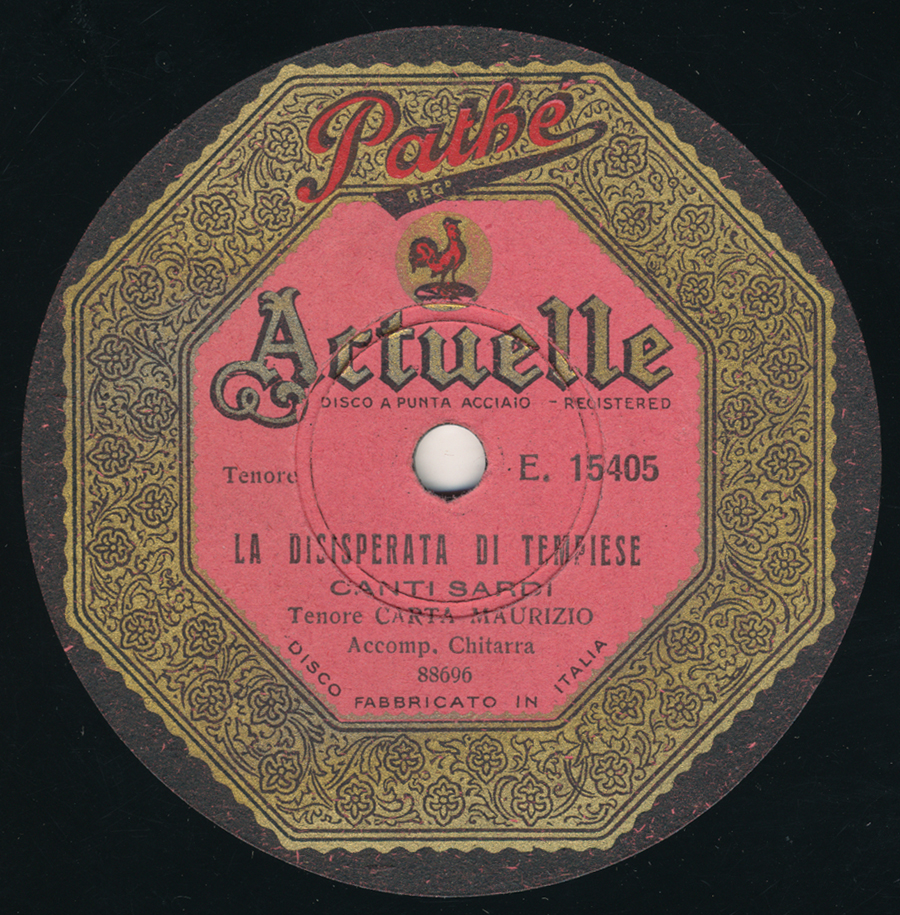
The story goes that in 1928, an executive from the French Pathé company heard the voice of Maurizio Carta, and immediately signed him to a record for the label. This record was probably made not long after. Carta was born in 1904 to a middle-class family in Mogoro, a town in the Sardinian province of Oristano. He later gained fame with his recordings on Pathé. He is, in fact, not forgotten, as a choir named for him, the “Coro Maurizio Carta,” is active today. The term “disisperata” is used on both sides of this disc. Canto e chiterra songs have been divided into 12 different types, and the “disisperata” is usually the 12th and final song. “Tempiese” could be referring to a type of canto a chiterra singing known as La Tempiesina, which comes from the town of Tempio Pausania in the Gallura region. As always, I await your contributions and knowledge. For now, a Sardinian bagatelle…

Maurizio Carta – La Disisperata di Tempiese

Technical Notes
Label: Pathé Actuelle
Issue Number: E. 15405
Matrix Number: N88696

For more early Sardinian music, please see the fine In Dialetto Sardo CD, on the Heritage label. And for a beautiful launeddas workout, see the Secret Museum Volume 1 (of course!). For more on Maltese music on 78rpm, keep checking this site.

Special thanks to Rod Stradling, James Cheney and Tony Klein.

* Apart from what appear to be later re-pressings of the earlier material on the local Dischi Maltin label.

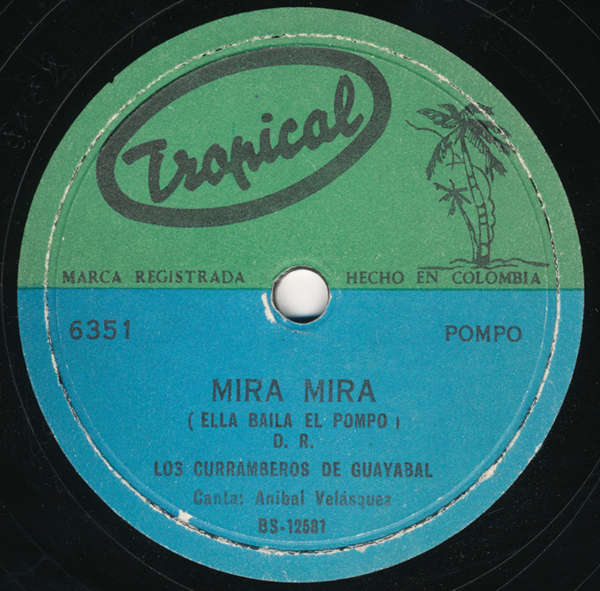
Los Curramberos de Guayabal – Mira Mira (Ella Baila de Pompo)

Many apologies for being slow to update. Believe me, there is more, and there will be more – I’ve been busier than ever. However, here’s a quick post to tide us over until the next!

Whenever we hit 100°F/38°C temperatures in the Los Angeles area, with weird, unseasonable humidity, lightning flashes, and brush fires, I inevitably turn to the popular and dance music from places even warmer. This time, I turned to Colombia – a country I’ve never posted a 78 from, until now, but whose music I’ve always found irresistible.

Colombian music began appearing on 78rpm quite early. American labels, such as Victor (who had perhaps the largest presence in South America in part due to an early agreement with the British Gramophone Company, which effectively split the world’s markets between them, acting as independently operated sister companies), Brunswick, and Vocalion, all released Colombian musical styles. In my mind, however, it wasn’t until the independent labels of Bogotá began cropping up that intense Colombian dance music began its true heyday. Labels like Lyra, Tropical, and of course, the famous Discos Fuentes, released thousands of both urban and more rural cumbias, porros, and vallenatos, well into the 33/45 rpm era and beyond (in fact, it’s probably far more common to find these songs on 45s rather than 78s these days). With cumbia seeing such a massive and well-deserved resurgence in the past few years, I thought it would be fun to post a a different genre, a pompo, instead. It is well-played, simple, repetitive, and fun.

The accordionist from Barranquilla, Anibal Velasquez Hurtado, is one of the most well-known musicians of Colombia. Born in 1936, Velasquez began recording in 1952. Los Curramberos de Guayabal recorded in the early to mid-1960s, I believe – there are several of their LPs (collections of singles) floating around the internet if you dig hard enough. If you’d like to know more about Velasquez, the fine folks over at Analog Africa have an interview and a CD available – see here.

Los Curramberos de Guayabal – Mira Mira (Ella Baila de Pompo)

Technical Notes
Label: Tropical
Issue Number: 6351
Matrix Number: BS-12681

Kankolongo Alidor – Kalenda wa muchombela

“Thirty years ago I heard my first African song on a farm in Southern Rhodesia. I still know that song by heart, together with dozens of others I learnt from the farm labourers and musicians of the neighborhood. The vitality and genuineness of this Karanga folk music made a deep impression on me and it was not until many years later when I realised that little or nothing was being done to study and encourage the work of these simple musicians that I turned to the making of gramophone records as the best method of doing so.” – Hugh Tracey, July 1951.

The renowned recordist and ethnomusicologist Hugh Tracey (1903-1977) spent decades capturing traditional music across Sub-Saharan Africa. I’ve written about Tracey in previous posts, and have avoided attempting to sum up his extensive and dedicated career in a few pat sentences – it’s really impossible to do. However, it’s certainly worth touching on a few points. First, Tracey separated himself from other ethnomusicologists of the day because he recorded both for commercial recording companies, and for his own organizations. Although actively recording across Africa beforehand, in 1946, Eric Gallo, the head of Gallotone Records of South Africa, gave Tracey the budget to travel far and wide across Central and Southern Africa, recording all manner of music. Tracey truly captured musicians and styles that most likely would never have been captured on shellac (or tape, which Tracey moved to, probably because of its portability). Over time, Tracey released hundreds of 78rpm recordings on Gallotone and on a subsidiary of Gallotone named Trek. These disc recordings were available commercially and marketed to educational institutions, “industrial and municipal organisations,” and adventurous listeners. The records would come with a set of library index cards with cross-reference information. Tracey called this service his African Music Transcription Library, which fell under his larger organization, African Music Research. (As I’ve mentioned previously, if you stumble across a Gallotone record and it says “African Music Research” on it, as this one does, you can be sure that this was recorded by Tracey himself, on one of his excursions.) However, Tracey made separate acetate recordings from these sessions, too. In 1954, Tracey began the International Library of African Music, and began releasing LPs of his recordings (he even had a cross-marketing deal with Folkways). Some of these ILAM recordings had already been released commercially, but they drew primarily from Tracey’s own acetates and tape recordings from those same sessions. Some 210 LPs of his recordings were released.

A second aspect of Tracey’s work that separates him from the crowd is that he recorded popular music as well as traditional. As far as I can tell, Tracey was quite skeptical about African music that had absorbed elements of western culture, particularly those elements that came from religion. In 1951, Tracey wrote, “Foreign intrusion into African arts would not matter if it did not break the continuity and so prefer imitation to originality.” At the International Folk Music Conference of 1958, held in Liège, Belgium, Tracey railed against missionaries, jazz, and other commercial music as examples of how traditional African music had been undermined throughout history. A Reverend from Uganda, in the conference audience, took issue with Tracey’s negative perceptions, and claimed that the relationship between Africans, religion, and invading forces, was more complex. Tracey replied that indeed, nothing in Africa was simple, and that in fact there were many missionaries on the board of the African Music Society, of which Tracey was the Honorary Secretary. Regardless, Tracey’s recordings of popular African bands of the day were exceptional. It would appear that despite his misgivings, his ear was still golden.

Today’s piece falls into the traditional category, and comes from February 10, 1952, when Tracey was recording in what was then the southern part of the Belgian Congo, recording examples of music by the Luba people, such as this artist, Kankolongo Alidor. The Luba are found primarily in the Southern Congo, and today there are over 7 million speakers of Luba languages. Many of the Luba men, at the time of this recording, were miners in Belgian and English copper mines. Historically, many Luba miners had been slaves, forced to work in the mines by the Belgians after a series of Luba uprisings in response to Belgian colonialism. I could find little information about Mr. Alidor, though Tracey recorded about a dozen tracks by him on that day. A few made it to his ILAM records, though only four songs made it to the Gallotone label.

My reasons for choosing this track have less to do with history, and more to do with the lovely instrumentation. This track features an instrument that is considered unique to Africa (though other similar examples have turned up in the world): the mbira, known colloquially in the west as the thumb-piano, and an instrument close to Hugh Tracey’s heart. If anyone knew how to record the mbira, it was Tracey, who always recorded hand-held, without a microphone stand. The quality of this recording is stunning. In terms of strict, technical classification, the mbira is in the idiophone family. Idiophones are instruments that create sounds from vibrations without the use of strings or membranes. Plucked idiophones are the branch of idiophones that have a tongue or tongues that vibrate when plucked. Lamellophones are the type of plucked idiophones which have a series of tongues or plates which are fixed in place at one end, and free on the other. Hence: the mbira. The mbira is found in a multitude of variations, in a multitude of local names, across the continent. Tracey calls Alidor’s mbira the chisanzhi mbira. In Tracey’s 1961 article for African Music, “A Case for the Mbira,” he lists no fewer than 8 variations of chisanzhi mbira. Two have 12 notes, three have 10 notes, one has 8, one has 11, and one has 18! Some are tuned in a hexatonic scale, some pentatonic, some heptatonic. Some have a box soundboard, some have a fan. My point is….I don’t know exactly which type of chisanzhi mbira Alidor is using, but Tracey would be able to identify it! As far as I’m concerned, it’s yet another example of Tracey’s impeccable taste.

Kankolongo Alidor – Kalenda wa muchombela

Technical Notes

Label: Gallotone
Issue Number: GB.1593
Matrix Number: XYZ.7174T

For more recordings by Hugh Tracey (including more by Alidor), please see the Sharp Wood label, who reissued many classic Hugh Tracey recordings in a CD series. It appears that some of these are now out of print but still findable, so try and snag them if you can. The notes are terrific. John Storm Roberts, in many of his early LP and CD releases on Original Music, also licensed and released Hugh Tracey tracks.

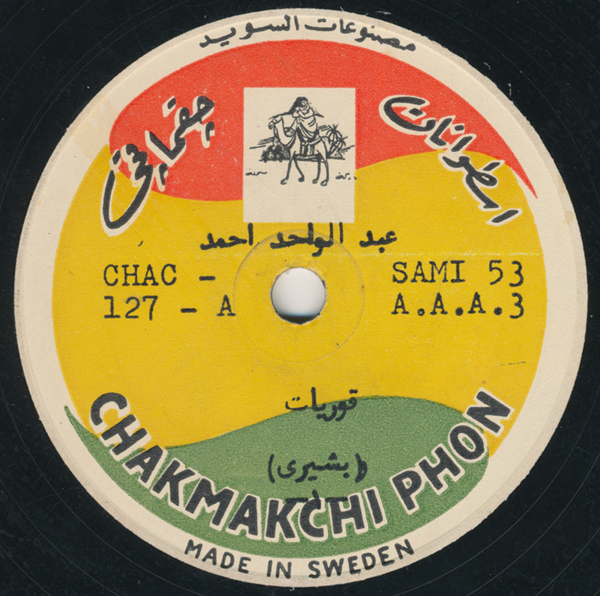
Abdul-Wahad Ahmad – Qoyrat (Beshiri)

Every once in a while, I like to post a true scarcity – a record which not only has considerable cultural import, but which is also nearly impossible to locate. I feel I can mention my personal feelings at the start, and in this direct manner, as an outsider: today’s post is not my own record. It is a generous loan from a friend and musicologist, which I transferred and repaired. The original – possibly the only known copy – is considerably damaged, but with a new transfer we were able to make it shine once again.

Early recordings of the stunning classical Arabic and traditional music from Iraq are quite difficult to find. What’s more, the few early recordings of ethnic minority music from Iraq on any of the large, European labels, have nearly vanished without a trace. Further, the infinitesimal amount of early recordings of ethnic minority music from Iraq on local, independently-pressed labels, are truly gifts to behold. This record falls into that last category. It is one of the few, extant examples on 78rpm of the traditional music of Iraqi Turkmen.

At least a half-million Turkmen live in Iraq and they are the third largest ethnic community in that country (behind Arabs and Kurds), representing 5% of the population (printed statistics state the half-million figure, although various Turkmen groups in Iraq claim a population of anywhere between 1-5 million, thus increasing their percentage of the general populus). Iraqi Turkmen primarily live in a central stretch of land from the Turkish and Syrian borders in the north of the country, to the Iranian border in the center of the country. This region is known colloquially as Türkmeneli. Descendents of Muslim Oghuz Turks, Turkmen first entered Iraq from Central Asia. Though there seems to be disagreement as to when Turkmen settlements in Iraq began appearing, one date that is mentioned is 650 CE.

There is very little scholarly information in English on the traditional music of Iraqi Turkmen, as it is different from Turkmen music of other regions. This is hardly surprising, when a multi-volume book such as the Encyclopedia of World Cultures (1991-1996) does not even list Turkmen as a being a cultural population in the country of Iraq. Major texts ignore Iraqi Turkmen music, such as Grove or the Garland Encyclopedia of World Music, or the Rough Guide (scoff if you must, but the Rough Guide to World Music provides at least a passing mention of some extremely obscure traditional musical styles).  Kurdish music, equally as beautiful and also ridiculously rare on 78rpm, has, by comparison, been generously studied.

This piece is an example of a particular type of long-form song of Iraqi Turkmen, called qoyrat (also commonly spelled hoyrat, but pronounced khoyrat). The qoyrats are formed around a 4-line quatrain and defined by their style. This one is in the beshiri (beşiri) style. Qoyrats are also sung by Turkmen in Southern and Southeastern Anatolia – it’s a style similar to the bozlak, another epic folk song type from the region. In Turkish musical parlance qoyrat could be described as uzun hava – a free-rhythm song that could also be a lament, a poem, a play on words, or a wail. The term qoyrat in Turkish actually means “vulgar” or “boorish” – though this piece is anything but. Beginning with the strains of a typical sounding Middle Eastern ensemble, with qanun, violin, flute, and percussion, the vocals soon take over. It is a powerful love song and lament – sung in Turkish, albeit in a Turkish that might sound strange, or indecipherable, to a Turkish-speaking teenager of today. There are universally recognizable moments, however – for instance, when the singer, Ahmad, exclaims “aman aman” mid-way through the song…”aman” being understood from the Balkans to the Indian Ocean as an exclamation of grief and suffering. Abdul-Wahad Ahmad was known as “Abdülvahit Küzecioğlu” in Turkey. Born in 1924 in Kirkuk, Ahmad had a lengthy recording career, even recording for the BBC. He died in 2007.

The Chakmakchi Company had offices and a showroom on the prestigious and bustling Rashid Street in Baghdad, along with a satellite office in Mosul. If we are to take the name literally, “chakmakchi” in standard Turkish means “maker of lighters” or “flint stone maker.” However, this is simply the surname of the proprietors, one of whom we know was named Arif Chakmakchi. At any rate, this small company got into the 78rpm business in the early 50s and only released at most about 200-300 recordings on their Chakmakchi Phon label. What distinguished them was that they catered to the local – local artists sold in local stores. What further distinguished them was their repertoire – not only did they record Iraqi classical maqam (by artists such as Nazim El-Ghazali and Mohammed El-Qabbandji), but they recorded music of the minorities. Chakmakchi Phon recorded some of the finest Kurdish singers in all their rawness – from the well-known, such as Mohammed Arif Jezrawi and Hassan Jezrawi (not necessarily related), to the lesser-known, such as Mahmud Kourouri, Khalil Aqrawi or Rasul Gardi. These records would, in some instances, due to the political situation, have to be smuggled in order to be sold in some regions. Since the Persian Gulf region did not have a 78rpm pressing plant at the time, Chakmakchi outsourced their early pressings to Sweden of all places (see the label photo), and their later pressings to Greece. It is strange that neither India nor Pakistan were considered, as both had thriving pressing plants – although both were run by the Gramophone Company, based in the UK. No matter what the case, Chakmakchi Phon did not last long in the 78rpm record business. They soon ceased producing 78s and moved into pressing 45s. Their musical legacy is only just beginning to come to light.

Abdul-Wahad Ahmad – Qoyrat (Beshiri)

Technical Notes
Label: Chakmakchi Phon
Issue Number: CHAC 127
Matrix Number: SAMI 53

Many thanks to our generous donor! And to Volkan, for providing further information.

Addendum

I resist using this blog as a platform for too much self-promotion, but it’s been a busy month or two, so I figured I’d get it over with at once. First, my first LP with Dust-to-Digital, Excavated Shellac: Strings, is now available from all manner of outlets. Aquarius Records gave it a nice write-up. Sasha Frere-Jones of the New Yorker added it to his Best of 2010 list. Thanks to Liz Berg and others for playing it on the radio. We hope to do more, and have other projects in the works, too. Also, I am indebted to writer and designer Meara O’Reilly who gave Excavated Shellac a nice write-up on BoingBoing. Thanks to Susanna Bolle, I had the chance to play records on her radio show Rare Frequency a few weeks ago. The show is now a podcast and you can listen here.

It’s also officially our 3-year anniversary here at Excavated Shellac. I thought it was high time to finally register the domain, so you’re now on excavatedshellac.com. Why did I resist doing this for so long? For one, I wanted to remain under the radar. There seems little point to that now, so here we are. I’ll keep the rhapsodic ruminations to a minimum, but thanks to everyone who keeps coming back here to read text and listen to music. I obviously don’t have as much time to spend on the site as I used to, when I was posting weekly, but it’s still a pleasure for me.

I want to emphasize again that this site is participatory. More and more people are using it as an information resource. Though it has a long way to go in that regard, I do think this is positive – but the site can only be as rich as the people who contribute. Unlike CDs or LPs, we always have the chance, with a website, to correct errors, contribute better translations, and in general, make the information more and more robust. The site, text, and music all have the potential to last longer than any hard copy because of this very fact. Some might be unaware that I edit the text on the site all the time if new information comes to light or someone sends a contribution. Sometimes, comments sections on posts from long ago suddenly spring to life (witness the family reunion that took place in the comments section of the Urbano Zafra post). The phrase “permanent beta” comes to mind – existing in a continuing state of upgrade. This, in a sense, is a more realistic view towards an information resource, if we want to take it to the next level. I can only do so much, and besides, there are records to find!

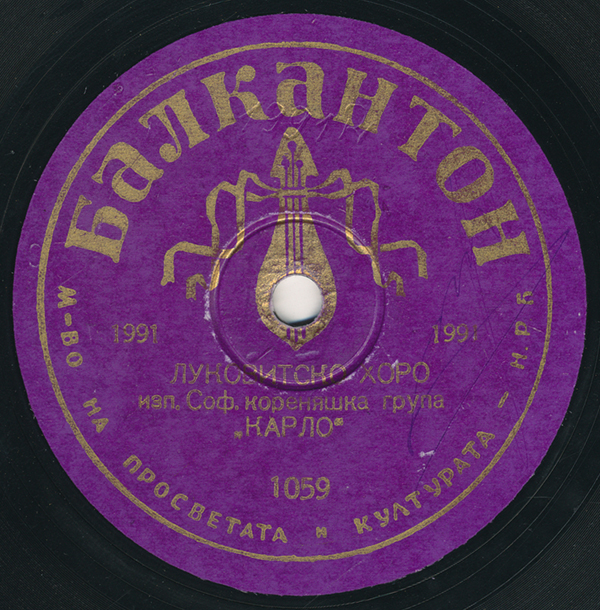
Karlo Ensemble – Lukovitsko Horo

It’s hard to refrain from tapping out the driving, complex rhythm to this lively piece of Bulgarian urban folk music – the Lukovitsko Horo, a dance originating from northern Bulgaria. This performance stems from the mid-20th century sometime, though it’s a little hard to pin down an exact date of release or recording. As I mentioned in a previous post featuring Bulgarian music, in 1947-1948, all the numerous Bulgarian independent labels (a vibrant bunch!) were nationalized by the Communist government and folded into the state-run label known as Radioprom. After a few years, Radioprom became Balkanton – the label featured here. However, both Radioprom AND Balkanton reissued earlier folkloric performances that had been originally issued on those independent labels (as well as a host of nationalistic performances – folk soloists were rare). I know that this record previously appeared on the Radioprom label – I suppose it’s conceivable that it originally appeared, earlier, on one of those lovely independent labels of 1930s Bulgaria: London, Balkan, Mikrophon, Orfei, Arfa…we have not forgotten you!

But, enough about label minutiae. Karlo Aliev’s brass band is performing this horo in 9/8 (or daičovo), and he was an important musician in Bulgaria. He was Romani, and was part of a lineage of musicians. Primarily, he was a trumpet player, and his ensemble recorded for numerous Bulgarian labels throughout the 1930s, recording tracks for Orfei, London, and Radioprom. His son, Boris Karlov (1924-1964) was a famed accordion player who began his career playing tambura in his father’s orchestra on Radio Sofia. In fact, Boris was known to later play the flip side of this record by his father, the song Eleno Mome. Boris’ son, Kalcho Karlov, played drums in his grandfather’s band – perhaps even on this track. I was unable to track down the names of the performers, but for other, similar recordings, Karlo’s ensemble featured Demir Cholakov on clarinet, Assen Radenov on violin, and Kalcho Karlov on drums. However, one can distinctly hear the sound of other brass instruments as well (a flugelhorn, maybe? tuba?) on this recording.

Bulgarian urban folk featured rhythms and melodies of traditional Bulgarian music, played on non-folkloric instruments. As Lauren Brody points out in her notes to her CD Song of the Crooked Dance (the essential CD collection of Bulgarian 78s available on Yazoo), folk musicians were “quite conversant with non-traditional instruments” and used them frequently in recordings. This is an all-out romp – with some shouts near the end!

Karlo Ensemble – Lukovitsko Horo

Technical Notes
Label: Balkanton
Issue Number: 1059
Matrix Number: 1991

Much information gleaned from Lauren Brody’s notes, Larry Weiner, David Murray and Peter Jaques.

Excavated Shellac Live – March 28th in Los Angeles

I will be performing a live Excavated Shellac show on Sunday, March 28th, 3PM, at the Los Angeles Municipal Art Gallery, Barnsdall Art Park, as part of Edith Abeyta’s ongoing exhibit “Actions, Conversations, and Intersections.” I only come out of hibernation maybe once a year to do a live show, so this should be fun. Join me in listening to some beautiful, rare music on 78s from Kurdistan to Madagascar – none of which are featured on the website.

I will also have available a small cache of advance copies of the “Strings” LP. Stop by to say hello!

For more on the show:
http://www.actionsconversationsintersections.com/

Ajdin Asllan – Valle Devollice

“Muzike Shqiptare e Drejtuar Prej Ajdin Asllan (Leskoviku)” reads the label to this slightly mysterious and certainly scarce 12″ 78rpm record on the American Mi-Re Rekord label. The sentence means, “Albanian Music Directed by Ajdin Asllan, of Leskoviku,” and from there we can begin to delve into the music, and the record’s origins.

The piece, a duet featuring clarinet and lute (quite probably the Albanian llaute) is “Valle Devollice Me Gérneté” which translates in English to “Dance from Devoll, with clarinet.” The Devoll River runs through southeastern Albania, very close to the Greek border, and through the Devoll District. The style of clarinet playing you’ll hear on this piece, played by Mr. Asllan, is very similar to the style of playing in Epirus, the mountainous, sparsely populated, northern region of Greece which borders Albania. The boundaries of classical Epirus originally contained parts of southern Albania, so therefore it’s no surprise to hear a direct similarity. In fact, the primary instrument in Epirotic folk music is the clarinet. In Greek Epirus, in turn, there’s a strong history of vocal polyphony, similar to the kind associated with Albania. This is further proof, if we needed any, that political boundaries are so often meaningless when it comes to folkloric, musical traditions. In the case of “Valle Devollice,” the interesting rhythms played on the llaute by an uncredited musician sound distinctly Albanian, not Greek-Epirotic. It’s a jam, plain and simple.

Ajdin Asllan (1895-1976) had a long history as a multi-instrumentalist (clarinet, oud, llaute/lauto), an instructor, and an independent label owner in the US. As the label indicates, he was originally from the town of Leskovik, in southeastern Albania, just to the west of the Greek border (“Leskoviku” may also have been his nickname). He was most well-known for being part of the Turkish, Greek, Armenian, and Albanian nightclub scene on 8th Avenue in New York City in the mid-20th century, through the 1960s. However, this release, and other releases on the short-lived Mi-Re label appear to be among his earliest recordings. When this recording was made is difficult to say. The origins of the label are unknown. Asllan may have owned or co-owned it, but perhaps not. Only 4 or 5 releases on this label are known to exist. A prominent discography lists it being recorded ca. 1930. Robert Crumb has posited online that the label may have been pressed by the famous Marsh Laboratories of Chicago – the very first record company to make electric recordings with microphones. However, there is no outward indication that it was pressed by Marsh (a logo or number, for instance). Whatever the case, this record is yet another example of how immigrants in the New York area created and independently marketed music for their communities.

In the early 1940s, Asllan started the popular Balkan record label, which released music by oud virtuoso Marko Melkon, Sephardic singer Victoria Hazan, and a host of fine musicians and singers. His Balkan Phonograph Record Store was at 42 Rivington Street in the Lower East Side, and eventually moved to 27th Street, between 7th and 8th Avenues. While simultaneously offering Greek, Turkish, Armenian, and Sephardic music on the Balkan label, Asllan was behind at least one Albanian-American record label during the mid-20th century (Me-Re, with an ‘e’ – and possibly a label called Rekorde Shqiptare). His career lasted well into the LP era.

As a side note: this record is not in pristine shape, despite my valiant attempts at cleanup – it’s in average to poor condition with a pretty rough first 10 seconds. I’ve made a point to choose records in terrific condition for Excavated Shellac, so this is a good chance to hear what most 78s sound like! Put your ears on – the noise will fade into the background. When it comes to some records, one can’t be too picky.

Ajdin Asllan – Valle Devollice

Thanks to Joel Ackerman and Steve Shapiro, for help.

Technical Notes
Label: Mi-Re Rekord
Issue Number: 502
Matrix Number: 502 (504-3 crossed out in dead wax)