Kosta Šarćanski-Koča – Bačvansko Kolo

We’re starting 2010 off with a scorcher: a fine example of rural bagpipe music of the Balkans.

Preconceived, negative notions about bagpipe music abound, I believe, mainly because the instrument is primarily associated in the mainstream media with British Military processions. This, of course, is a frustratingly narrow view. Not only are there wonderful musicians and folk performances on the Great Highland Bagpipe of Scotland, but the bagpipe itself is a positively ancient folk instrument with varying types and styles stretching from Ireland and the UK, to Spain, across Europe, to Tunisia, and as far east as India. Urban and rural cultures all over the globe have used the instrument to accompany vocalists and dancers since the 12th century, at least. Chaucer famously referenced the pipes in The Canterbury Tales. Bosch, Breughel, and Dürer depicted them in paintings and drawings.

For the uninitiated, the bagpipe in its most basic form (which visually seems to reference the human stomach) is comprised of a few simple parts: a blowpipe, the bag (made of animal skin), the melody pipe (known as the chanter), and the drone pipe. Wood and animal skin – and that’s it. These basic ingredients are expanded upon (or not) depending on the culture and geographical location. There are numerous varieties of Italian zampogna with several variations on the numbers of chanters and drone pipes – the Hungarian duda often has a double chanter and one drone. The Tunisian mizwad and the Maltese zaqq have double chanters and no drone pipes. There’s the German dudelsack, the Bahraini jirba, the Cretan askomandoura, the Swedish säckpipa, and hundreds more variations. On Excavated Shellac, we’ve featured music performed on the Galician gaita and the binioù of Brittany.

Another bagpipe variation is the Serbian gajde, the bagpipe played here by Kosta Šarćanski. His particular gajde is the Banat gajde of Northern Serbia, which is similar to Carpathian models of bagpipes as opposed to other Balkan styles (like the Bulgarian gaita). It has a double chanter and is bellows blown. Here he plays a kolo, a traditional, upbeat folk dance more or less comparable to the horo in Bulgaria. The title, “Bačvansko Kolo,” might be a reference to the region known as Bačka, currently divided between southern Hungary and northern Serbia.

Kosta Šarćanski’s powerful performance was recorded September 18th, 1930, in Vienna, by Gramophone Company engineer Douglas Ewen Larter. Larter was known for his recordings of European classical music. It would be fascinating to know the circumstances of how he came to record a few dozen Serbian folk records in mid- to late September of 1930. Šarćanski performed numerous solos that day along with Stevan Bačić-Trnda, a musician from Sombor, Serbia. Šarćanski has been documented performing earlier gajde solos on the Edison Bell label, as well – as “Koča Šasćarnski” and “Koča Šašćanski.” (“Koča” is his nickname, and it’s separated with a dash from his last name on the record label. The term “Izvodi” on the label simply means “performed by.”)

Enjoy!

Kosta Šarćanski-Koča – Bačvansko Kolo

Technical Notes
Label: Victor (from HMV masters)
Issue Number: V-3096
Matrix Number: BL-6507

Many thanks to Steven Kozobarich. Also thanks to Ferenc Tobak and Mark Gilston for information on the bagpipes!

For more of the same, another Kosta Šarćanski performance can be found on the out-of-print Heritage CD The Ace and Deuce of Pipering.

“It is a well-attested fact that the bagpipes, when heard by persons who are not accustomed to them, give rise to violent griping pains in the stomach which closely resemble the pains of Asiatic cholera.” – New York Times, April 24, 1885.

Carl-Eric Berndt & Richard Isacson – Svingedans; Polska

One country I have not posted any traditional music from is Sweden, and now that the northern hemisphere has passed into winter, and that seemingly unending series of all manner of holidays is upon us, I thought I’d head back to Scandinavia for some authentic folk music from a local 78 label. Additionally, I’ve added a little bonus record this week, but more on that below.

Radiotjänst is the name of the state-run Swedish radio network which began broadcasting in 1925, and began releasing 78s in the late 1930s, many of them folkloric. Today’s selection is a medley of two traditional fiddle pieces for two performers from Sweden’s southernmost region, Skåne (or Scania). Carl-Eric Berndt, on the fiddle (fiol), was from Lund, and began collecting folk songs and melodies from Skåne in the 1920s, with several being published in Sweden in the late 1960s. Accompanying Berndt is Richard Isacson, who is apparently playing the local Skåne fiddle known as the träskofiol, or the clog fiddle. The clog fiddle is a fiddle actually made from a worn wooden shoe (see a photo here). The two tracks here, “Svingedans” (literally “swing dance,” after Mårten Sjöbeck) and the “Polska” (not to be confused with a polka, which is in 2/4) are part of the continuing tradition of folk dance music in southern Sweden. They were recorded January 21, 1950.

Carl-Eric Berndt & Richard Isacson – Svingedans; Polska

In addition, I’ve added a piece from Finland this week. Now, I think you could imagine that it might take considerable convincing for me to post a classic Christmas song. These songs are relentlessly played in virtually every store that opens its doors during this season. At least in my part of the world, they are played at every event, they are used to sell meaningless products, they hammer and hammer and hammer away at you until your wallet is drained and you cease to recognize that you’re supposed to be celebrating. Heaven help you if you don’t happen to be Christian – the pervasive nature of these songs must seem positively bizarre.

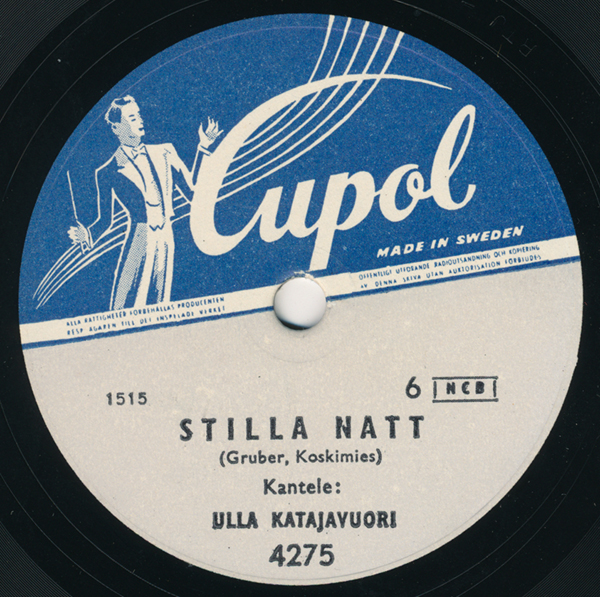
Yet, as much as I try to resist, I am struck by how beautiful the well-worn melody of “Silent Night” can sound when played by Ulla Katajavuori, a virtuoso of the Finnish zither, the kantele. The kantele is Finland’s national instrument, and prototypes date back approximately 2,000 years. Traditionally, it is played on the lap.

Ulla Katajavuori was born in 1909 in the coastal town of Rauma and studied kantele under Paul Salminen at the Helsinki Conservatory. She always recorded as a soloist, never as an accompanist, believing that an orchestra would drown the kantele’s intimate qualities. The arrangement for this piece was by her husband, Eero Koskimies. Katajavuori died in 2001. This piece was recorded March 24, 1949.

Ulla Katajavuori – Stilla Natt

Thanks to everyone who has continued to visit Excavated Shellac in 2009. Here’s to 2010 – there will be more. Just you wait!

Technical Notes
Label: Radiotjänst
Issue Number: RA 174
Matrix Number: Rtj 3248

Label: Cupol
Issue Number: 4275
Matrix Number: 1515

Thanks, as always, to TK.
To hear more Ulla Katajavuori, check Volume 5 of the Secret Museum series.

Palu Vava’u Tupou & Veiongo Fakaua – Taio; Vanavana; Fakapo Oka To E Takapu

I hadn’t posted a record from Oceania in nearly a year, so I thought I’d post both sides of this little gem (totaling three little gems) from the Kingdom of Tonga. Although similar to the majority of the music of Polynesia, much (though not all) Tongan music has been influenced by the presence of visiting and colonizing Europeans, who first arrived in Tongan waters in the early 17th century. Over time, Tongans adapted some aspects of their folk songs and lyrical poems to these outside influences, while strongly preserving other types of their traditional music. Interestingly, Tonga is the only Polynesian nation that was not formally colonized by a European country. Part of the British Western Pacific Territories until 1952 (and occupied by the United States from 1942-1945), it remains a constitutional monarchy, and has been continually governed by indigenous Tongans. Deeply rooted traditions still thrive, such as the faikava, the traditional kava drinking party where men drink kava for hours, talking and singing.

These three short tracks were sung by the female duet of Tupou and Fakaua, two ladies-in-waiting of the Tongan queen Sālote Mafile‘o Pilolevu Tupou III, who reigned from 1918 to 1965. The young duo were invited to the UK in 1954 and stayed sixteen days. They performed traditional songs for Queen Elizabeth, and recorded six sides for the company on their trip. These feature simple ukelele and guitar accompaniment, the two most common musical instruments used throughout Polynesia. What I enjoy about these pieces, besides the sweet melodies themselves, is the hushed style of vocals. It’s as if someone snuck the duo into a recording studio late at night, and they were trying to keep their voices down, and as close to the microphone as possible.

Palu Vava’u Tupou & Veiongo Fakaua – Taio
Palu Vava’u Tupou & Veiongo Fakaua – Vanavana
Palu Vava’u Tupou & Veiongo Fakaua – Fakopo Oka To E Takapu

Technical Notes
Label: HMV
Issue Number: JO. 411
Matrix Number: OEF.273-1A/OEF.274-1A

Expect another post in the next week or two!

Tyson’s Autoharp Band – Mnamkuruane

TysonsThere’s much to discuss with this very interesting record, though you wouldn’t necessarily know it from its simply stated printed information. Neither the language, culture, or country is listed, unlike most Sub-Saharan African 78s. Usually, at the very least, a culture is printed on the record label, but we are left with only a few visual clues. Before looking at those, however, we can listen.

What immediately sets this piece of music apart from other Sub-Saharan styles is the ethereal sound of the European autoharp. The simple, plucked melody accompanies an otherwise completely traditional band with percussion and vocals. This particular style of music comes from the Pedi people of Northern Transvaal, specifically the present-day Limpopo province. The Pedi people are thought to have migrated to Southern Africa from Central Africa about 500 years ago. They established a territory known as Bopedi (“the place of the Pedi”), and resisted colonial Afrikaners numerous times throughout the 19th century, until 1879, when they were defeated by the British. In the 19th century, proselytizing Lutheran ministers introduced the Pedi to the German zither or autoharp. By the 1920s, the instrument had become fully assimilated by the Pedi into their culture and music, and was known as the harepa. They used the autoharp to replace their own plucked mbira (known as the dipela), and adapted the instrument to their own 5-note scale – there was no European embellishment whatsoever. Though, interestingly, the Pedi apparently preferred to have their autoharps tuned by Europeans. According to Deborah James in her book Songs of the Women Migrants, mission elites felt that the use of the autoharp in the Pedi’s traditional music was completely distasteful, most likely because the instrument completely reinvigorated the Pedi’s traditional repertoire.

Since the label states “African Music Research,” we know without doubt that this is a Hugh Tracey recording, and this is a good thing. There’s little that can be said about Tracey (1903-1977) that hasn’t been said numerous times by people far more close to his work than I. The fact remains that Tracey’s recorded legacy of Sub-Saharan music is unparalleled. He had the foresight to travel across the continent not just recording the music of rural cultures, but dance bands, guitarists, and urban pop. He recorded for Gallotone records, the first Sub-Saharan independent label. He recorded for Trek, a separate 78 label. Some of his recorded music came out on Columbia and other labels, as well. And of course, he built the ILAM (International Library of African Music) from the ground up, releasing 210 LPs over approximately 30 years. Today, a vast swath of Tracey recordings, lovingly presented, are available on the Sharp Wood label.

This recording, according to the ILAM, was made in 1948. However, the South African Music Archive states it’s from 1945. Tyson’s Autoharp Band were recorded throughout the late 1940s, cutting 11 tracks. The leader, Tyson, also recorded 7 tracks with a women’s choir, under the name “Tyson and company.”

Tyson’s Autoharp Band – Mnamkuruane

Technical Notes
Label: Trek
Issue Number: DC. 292
Matrix Number: ABC.3693

Shekar Hanim – Tchakidji

hanoumI’m happy to once again have another fantastic guest post from Ian Nagoski, a fellow collector who has been a supporter of (and contributor to) Excavated Shellac since its inception. Today, Ian edits Canary Records, a vinyl label manufactured and distributed by Mississippi Records. The label’s second release, a 2LP issue of Tony Klein’s Mortika: Rare Recordings from a Greek Underground is out this month. For more details click here. – JW

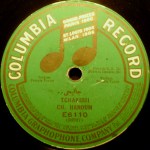
These few minutes were recorded by a now-obscure, independent German record company called Favorite which operated from 1904-1914.  Favorite were giving the Gramophone Company and Odeon a run for their money by recording and selling exceptional performances in the cosmopolitan cities of the Agean coast by the middle of the first decade of the 20th century (as well sessions in East Asia, South America, Egypt, the independent Balkan states and throughout Europe). According to Professor Hugo Strotbaum, it was recorded by Shekar Hanim (“Hanim” being an honorific meaning, simply, “Lady” or “Ms.”) with an unidentified fiddler and second singer in Constantinople between the 16th and 19th of July, 1910 and originally issued in the US in 1910 or ’11 as part of Columbia’s E6000 series, which, Dick Spottswood reports, ran 1909-11 using Favorite Records masters as source material (although some titles in that series  remained in the Columbia catalog for a decade thereafter). Because the singers are female, and we know that religious propriety kept the overwhelming majority of Turkish Muslim women from singing on records until after the formation of the Turkish republic in the mid-20s, we can guess that singers are likely ethnic Greeks, but also maybe Armenians or Jews.

The subject of the song is certain: Çakırcalı Mehmet Efe who was born in 1871 in the village of Ayasurat, near Odemis, a little over 100km south of Smyrna, and was shot down by government brigands on September 17, 1911, fourteen months after this performance was recorded. Çakırcalı was, and is, a folk hero of Turkey, a Robin Hood or a Pretty Boy Floyd as Woody Guthrie sang of him. And like Guthrie’s Pretty Boy, he has been romanticized beyond human recognizability. Ozkul Cobanoglu’s 1992 doctoral dissertation for the University of Indiana on the transmission of Çakırcalı’s story into folklore counts three movies and three novels about him as well as many plays, and eleven folk songs. (Another performance of same song, recorded in Constantinople in 1908 by the Jewish singer Haim Effendi is included on Charles Howard’s Rembetika 2: More of the Secret History of Greece’s Underground Music 4CD box on JSP Records.) Contemporary newspaper accounts of him were as often false as true, because the public was so hungry to hear about him that the papers would run any hearsay. Today, his name brings up more than 12,000 hits on Google, nearly all of them in Turkish, and there’s a Facebook fan page for him with over 2,500 fans and counting.

I won’t try to be the first to attempt to unpack his heroism to the non-Turkish-speaking world. In overview, he is said to have been: a coldly and evenly just man, generous toward his hosts; a skilled marksman and warrior; a pious and devout Muslim; a man haunted by wounded familial pride; a defender of his own honor; a powerful and charismatic leader of his cohort of over 100 rebels; a flamboyant outsider; a man who reacted to cruelty by becoming an unstoppable killing machine; a protector of serfs and a kind, and meaningfully loving man toward women.  The time and place of his exploits was one of unjust taxes, regulations, and bureaucracy, exploitative landlords and paranoid, scoundrel rulers, the waning years of the Ottoman Empire under the reign of Abdulhamid II, who Lord Kinross succinctly described in his 1977 volume The Ottoman Centuries: The Rise and Fall of the Turkish Empire as “an unhappy man and an inhuman sultan.”  In 2003 Dr. H.B. Paskoy gave a lecture in Texas drawing comparisons between Çakırcalı and the American ideal of the righteous Old West outlaw. It would be easy enough to draw comparisons to innumerable other archetypes that fulfill any culture’s revenge fantasies.

As a young man, he was a bootleg tobacco trader because of unjust regulations on the plant. Persecuted by the authorities, he fled to the mountains and rose through the ranks of nomadic militiamen called zeybeks to the stature of efe, top dog.  Here’s where it gets complicated, musically and culturally. Zeybeks were nomadic and independent professional fighters of western Anatolia for several centuries. Over the generations, their allegiances were changable. Historically, some were seen as helpful to the proletariat, some as a neutral if chaotic force, and some were rapist cretins. Well after the time of Çakırcalı, the zeybeks fought against the Greeks in the Greco-Turkish War of 1919-22 that resulted in the Smyna tragedy. Had Çakırcalı lived, we can only guess what side he would have taken and what difference his leadership might have meant to the state of Greco-Turkish relations today. But the Greeks identified with the zeybeks enough to make a tradition of zeybek-style dancing, which they called zembekiko. Gail Holst-Warhaft described her exposure to the dance in late-60s Greek taverns beautifully in her book The Road to Rembetika as her point of entry into Greek folk music:

“…unlike any dancing I’d ever seen – not exuberant, not being done for the joy of movement, not even sensual. It reminded me almost of a Quaker meeting, where only if the spirit moves does the man speak. The music would begin, the rhythm insistent, the voice harsh and metallic, and the dancer would rise [alone] as if compelled to make his statement. Eyes half-closed, in trance-like absorption, cigarette hanging from his lips, arms outstretched as if to keep his balance, he would begin to slowly circle. As the dance progressed, the movements would become more complex; there would be sudden feats of agility, swoops to the ground, leaps and twists, but the dancer seemed to be feeling his way, searching for something, unsteady on his feet.”

Meanwhile, the wild ways and outlandish, cutthroat mountain dignity and rough-and-ready attire of the zeybeks symbolize for Turks a nostalgic, golden image of Turkishness, just as the John Wayne-type cowboy serves as an image for American-ness. There continues to be a traditional zeybek dance in Turkey, performed in groups of men and with upright nobility, “in imitation of a hawk,” according to a Wikipedia writer. Probably neither the urban cafe zembekeiko of Greece nor the folklorically-enshrined  zeybek dance of Turkey are exact reenactments of the real dances of Çakırcalı and his brethren, but they are, instead, both variants patterned on what is believed about the mountain bandits and what they mean to men in more recent times.

But back to Columbia E6110 and these anonymous women of unclear ethnic derivation singing about a great man who still walked among them. What are they singing? They, like the dancers who imitate the zeybeks, are singing a variant on something older and deeper.  Of the eleven songs on Çakırcalı accounted for by Cobanoglu’s paper, two of them, both of similar length to the one of this record, begin with the image of the Poplar trees in the region of Smyrna with their leaves falling (foretelling onset of a difficult winter, Turkish folklore says). In 1962 the Turkish communist poet Nazim Hikmet (born in 1902 in present-day Greece, then Ottoman territory) quoted a full verse of a poem into his own poem about his journey into political exile “Things I  Didn’t Know I Loved;” “The poplars of Smyrna / losing their leaves…”  Was he quoting, in fact, this very song or quoting something from which this song came or referring to it to draw out its “underneath”?

Apart from the poplars, several other themes run among the variations of Çakırcalı songs. Several versions begin with the image of the hero descending the mountain, announcing his presence to us, here below. Several mention his purple fez, his horse or his supply of bullets. Most refer to him as tall as a cypress, a tree used  over and over from the old Persian poets including Rumi and Hafez to Turkish folk rug-weaving patterns to symbolize correct application of the faith of the Prophet, submission to God’s will, the true meaning of Islam.

The target audience for this release were the tens, maybe hundreds of thousands of Turkish-speaking Christians and Jews in New York, New Jersey, Massachusetts, Michigan, Florida, Rhode Island, etc. Dr. Sedat Dişçi of Ege University points out that between 1860 (about four decades after Greece’s independence from the Ottoman Empire) and 1920, one and a half million Ottomans emigrated to the U.S., although 85% of them were Christian and Jewish ethnic minorities, just as we suppose the singers on this record are. By virtue of the fact of this record’s existence, a century-old mass-produced document of Anatolian lore intended for consumption by immigrants from the waning Ottoman state, we have evidence of a significant story of the late Ottoman Empire in circulation within American Empire as well. This song of revenge against the unfair Turkish overlords by a still-living hero was sold here, in the land of Freedom and Opportunity, to Turkish-speaking Americans, three decades before Guthrie’s “Pretty Boy Floyd.” But beneath the clothing of language, it’s the same damn song.

Ian Nagoski

Shekar Hanim – Tchakidji

Technical Notes
Label: Columbia
Issue Number: E6110
Matrix Number: 4051-f

Success!

Excavated Shellac’s files have now moved to a new host and are once again available (thanks to Jim Stephenson for the tip). It took a few hours of wrangling, but everything should be a-ok. Please let me know if there is a problem.

You will still not see any ads – this is an ad-free zone! (Except if it’s a plug for something 78rpm-friendly.) The only minor difference will be that Windows users will no longer be able to right click the file to download. Just click on it normally and you should be fine from there!

Also – I re-established links for all the tracks in the archive that are now part of WFMU’s Free Music Archive. So, track links will take you directly to the page on WFMU’s site where you can listen and download.

Thanks for your patience and for continuing to stop by. There’s lot of great music on the way. Coming up in a few days, a killer guest post from Ian Nagoski. See you soon —

JW

Vieira e Vieirinha – Transporte de Boiada

VieiraI thought I’d head back to Brazil for an example of mid-20th century song performed by a dupla sertaneja: the Brazilian country music duo.

Música sertaneja essentially is Brazilian country music whose influences stem from the rural regions of the São Paulo and Minas Gerais states. The duos (duplas) perform on 10-string viola caipira guitars, and usually sing in parallel thirds and sixths, in a rural dialect and in a somewhat nasal tone. From the 1940s on, the duplas became hugely popular, particularly with working class Brazilians. There were dozens of duplas groups that recorded for Brazilian labels – apparently, the style even threatened to eclipse samba in popularity, causing a bit of a backlash. Some duplas performed virtually all types of songs and dances, often mixing folk idioms with urban or international influences. Some performers wore felt hats or had wild pompadours. While it may not sound as raw and unsophisticated as Dock Boggs or any “country” artist from the United States, it can be truly enjoyable, effective music. For such a popular, ingrained genre, similar to postwar “Country and Western” in the US, I find it interesting that there seems to be few if any early examples of this music on CD on US labels, though there are loads of Brazilian CDs that feature the style.

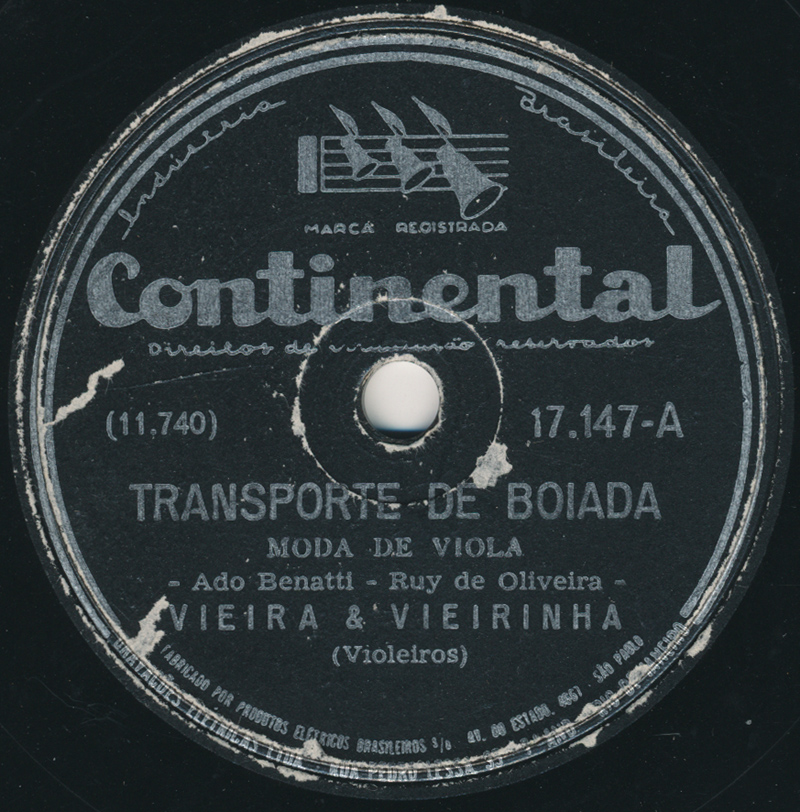
Many duplas had simple names, more or less like nicknames: Tonico e Tinoco, Zico e Zeca, Lourenço e Lourival, and the performers of today’s piece, Vieira e Vieirinha, one of Brazil’s most beloved duos. Brothers born in a rural part of the Itajobi municipality in the interior of Brazil, Vieira’s given name was Rubens Vieira Marques (1926-2001), and Vieirinha’s was Rubiao Vieira (1928-1991). Their career began in the late 40s performing on Brazilian radio. They began recording approximately 32 78s in 1952-1953, and their first LP was released in 1958, for Continental. This piece is one of their most famous, and one of their earliest, dating from 1953. The title translates to “Transporting Cattle” or perhaps “Cattle Drive.” It eventually appeared on a 1971 LP by the duo, which can be found on the web, if you dig enough. The song is unabashedly romantic, with over-the-top sound effects, yet it does evoke a time and place, and one that we haven’t explored here.

Vieira e Vieirinha – Transporte de Boiada

Technical Notes
Label: Continental
Issue Number: 17-147
Matrix Number: 11740

Van Shipley – Guitar Filmi Tune “You Have to Love Me”

VanShipley78_AIt’s a busy time for me, and while I’ll have some great music and special announcements coming soon, I am happy to know that there are some fine curators jumping into the game at Excavated Shellac this autumn. For the first of two guest posts, we have a selection from Stuart Ellis, the man behind the phenomenal Radiodiffusion Internasionaal blog. If you haven’t combed through the archives of international 45s at Radiodiffusion, you must do so. The sounds are varied, thought-provoking, and rare. Stuart is also behind the terrific Sublime Frequences release Bollywood Steel Guitar. That fact alone should be a perfect introduction to his post… – JW

The earliest known report of anyone playing slide guitar was of Gabriel Davion, a native of India who had been kidnapped by Portuguese sailors and was brought to Hawaii in 1876. Of course, Indian string instruments, like the gottuvadhyam and the vichitra veena use a slide and are known to have existed since the 11th century. But it was not until Ernest Ka’ai and his Royal Hawaiian Troubadours toured in 1919 that the slide guitar was introduced to India.

Most people agree that Van Shipley was the first electric guitarist in India and the first to record instrumental versions of film songs, beginning sometime in the early 1950s. Van was born in the city of Lucknow in Indian state of Uttar Pradesh. When most people hear his name, they say “But that’s not an Indian name!” Well, that’s because not everyone in India is Hindu. Shipley was Methodist.

Inspired by his mother, who played the sitar, Shipley took to music at a young age. His first instrument was the violin. He attended Saharanpur to study Indian Classical music. There, he studied under Ustad Bande Hassan Khan and his son Ustad Zinda Hassan Khan, who were both famous Khyal singers from Northern India. At the same time, he took lessons in western music from an American identified as Dr. Wizer.

Shipley then returned to Lucknow to attend college, where he became involved with All India Radio. After college, he went to the city of Pune to work for the Prabhat Film Company before moving to the center of India’s film industry, Bombay (Mumbai). It was there that he caught the attention of producer and director Raj Kapoor, who spotted him performing a stage. Kapoor enlisted Shipley to play violin on the soundtrack for “Barsaat” (Rain) in 1949. The following year, Shipley added his electric guitar to a dream sequence in “Awaara” (The Tramp), which brought him to the attention of The Gramophone Co. of India. In 1955, Shipley teamed up with accordionist Enoch Daniels, whom he had met while working for the Prabhat Film Company in Pune. This musical partnership ultimately lasted for many years.

Shipley set off the steel guitar craze in India. Other steel guitar players from the 78 era include Batuk Nandy, Brij Bhushan Kabra, Kazi Aniruddha, Mohon Bhattacharya, Nalin Mazumdar, Robin Paul, S. Hazarasingh, Sujit Nath and Sunil Ganguly. But most of these guitarists only recorded Tagore songs, with only a few (Kazi Aniruddha and S. Hazarasingh) recording Filmi tunes (Sunil Ganguly and Batuk Nandy would start doing film songs in the 60s and the 70s, respectively).

One distinction that set Shipley apart was that he played an eight string guitar, which he had designed and built to give him the drone sound that was more common in Indian classical music than in the Film songs. Almost all of the other Indian steel guitarists played a National Dual Six Console guitar. Shipley also designed his own electric violin as well, which he dubbed the ‘Gypsy Violin’ and used on many of his later records.

Shipley’s first album, The Man with The Golden Guitar, a title that stuck with him the rest of his career, was released in 1962. He would go on to release an album every year until 1982, as well as a dozen or so EPs. He also toured the world, playing shows in Europe, the Middle East, the Caribbean Islands, Suriname, Guyana and the U.S., including the cities of New York, Washington D.C., Los Angeles, San Francisco, Chicago, Buffalo, and Detroit. Besides recording, Shipley acted in a few films as well, including 1964s “Cha Cha Cha.”

Shipley died on March 8, 2008 of a heart attack at his home in Mumbai. His daughter Ingrid is an artist and musician who lives in New York, and his nephew Valentine is a singer/songwriter in India.

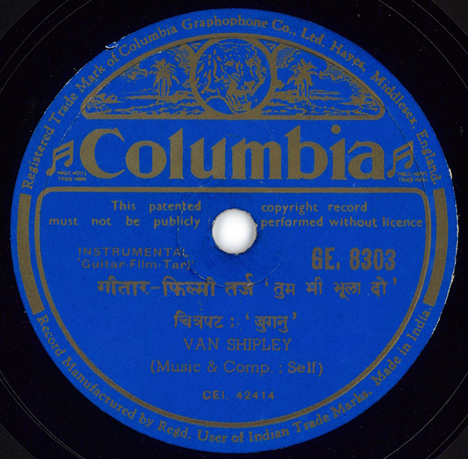
Van Shipley – Guitar Filmi Tune from “You Have to Love Me”

Technical Notes
Label: Columbia
Issue Number: GE. 8303
Matrix Number: CEI 42414-IC

Thanks to Derek Taylor at Bagatellen for the information.

William Kamel & Naim Karakand – Ayn Allaty, Pts. 1 & 2

kamelFinally, I’m coming up for air and presenting a long-overdue, two-sided post. Unfortunately, being a Los Angeles resident at the moment, this means the air I’m coming up from is thick and sooty, with flakes of ash swirling around, wherever you’d care to look. People like to say, “Well, they should be used to it – it happens every year!” But, this is now the 10th largest in California’s history with no sign of letting up, and it looms…man, does it loom. The sky has been punched.

But let’s move on to loftier subjects. Today, we present both sides of a recording made ca. July 1916, by two Arab-Americans: the singer William Kamel, and the enduring Syrian-American violinist, Naim Karakand. There is an oud player as well, which may or may not be Kamel. They perform an aching love song, transliterated here as “Ayn Allaty.” When translated into English, it looks like sort of a strange phrase: “Where is she, the one who…?” This is the fragment of a question Mr. Kamel asks repeatedly. He and Karakand engage in interplay between singer and violinist that is made more delicate by the age and acoustics of the recording. Both musicians give each other plenty of room to perform, but there is no need for flagrant theatrics on either side. For a recording that was made 93 years ago, it still has subtlety.

Kamel recorded 12 sides that day in 1916, these two included. As far as I can tell, he did not record for any other company, though it’s possible he recorded for one of the several Arab-American independent labels of the time (Maloof and Macksoud, for example). Naim Karakand, on the other hand, recorded for multiple labels, both as an accompanist and as a virtuoso soloist, from about March of 1915 through the 1940s (under a multitude of name spellings). His talent makes one wonder about his history – in Anne K. Rasmussen’s excellent CD The Music of the Arab Americans on Rounder (where there are several pieces which feature Karakand), she supposes that Karakand arrived in the US sometime “during the second decade” of the 20th century. In fact, Karakand was born in 1891, and arrived in New York City in October of 1909, and is listed as “Nourim Karakan” in Ellis Island records. He passed away in 1973. Now, who was his teacher? Perhaps someone who knew the giant of violin, Aleppan Sami El Chawa? This is simply a fantasy for the time being…

The Columbia E-series began around 1908 and ended around 1923, and featured hundreds if not thousands of recordings made by US immigrants. Armenian, Norwegian, Icelandic, Polish – you name it. There are two things about this series that are worth mentioning from a collector’s standpoint: first, the majority of releases displayed one of the most irksome color schemes in record label history, with its gold on green, making artists and song titles almost impossible to read. Second, their pressings were often godawful, filled with noise even with a clean recording…making those distant, pre-electricity recordings extra difficult for the novice. This one is actually quite clean, believe it or not – thankfully, although the disparity in volume between Kamel’s voice and Karakand’s violin is wide, you can still sink into it. And I hope you do!

William Kamel & Naim Karakand – Ayn Allaty, Pts. 1 & 2

Technical Notes
Label: Columbia
Issue Number: E3430
Matrix Number: 44179/44180

Thanks to Ian Nagoski for dates and info! Besides the aforementioned Music of the Arab Americans CD, definitely check out the blistering Karakand solo on Black Mirror, if you haven’t already.

Fyre James and Lewis Borges – Sezari Muje Sogle Poule

youngindia-1I’m very happy to present another guest post on Excavated Shellac. This time, from renowned jazz and blues collector Russ Shor. Russ, for many years, has been the US editor of VJM (Vintage Jazz Mart), now in its 56th year. VJM is famous not only for its rare jazz and blues auctions, often filled with top rarities, but also its grading chart, which is used (or should be) by all the professionals in this esoteric world of old records. For those who keep track of the hardcore jazz and blues 78s out there, Russ is all over the infamous journal 78 Quarterly, as a regular contributor to their “Rarest 78s” column, called by 78 Quarterly-proprietor Pete Whelan as “a spiritual journey into the realm of greed.” A fellow California resident, Russ and I caught up recently and he graciously offered to tell his story about this very peculiar recording – one that I think that listeners will definitely appreciate, as it covers much ground. – JW

This disc on the Young India label is something of a mystery. Recorded in Bombay in the late 1930s, by (apparently) a Goanese duo, it illustrates what an international crossroads that city was during the Raj era – especially when it came to recording.

The side by Lewis Borges borrows (amazingly) the tune of “Little Log Cabin in the Lane,” a song published in the US in 1871, which, by the 1920s, had become a staple of country music recorded by Fiddling John Carson, Riley Puckett, and others.  In fact, Puckett’s 1926 wide-selling recording of that song seemed to have been the model for this recording because the guitarist attempts his accompaniment style.  Unfortunately, I don’t know the language so I cannot tell whether the original lyrics had been translated or whether the performers simply adapted the melody to entirely new lyrics. In fact, I don’t even recognize the language in which they are singing.

Bombay, until recently, was a 78 RPM wonderland. The first time I went there for business was in 1984.  Sneaking a side trip to the Chor Bazaar, I stumbled on an entire block of shops with huge stacks of records – uncountable thousands – piled every which way, inside and out. I made for a stand actually built from 78s stacks and began flipping through discs on his counter. Actually, the discs WERE the counter. The proprietor (I wish I could find the photo I took of him and his wares) quickly informed me that all non-Indian discs were “English records,” even if they were Congolese choirs. At least that helped narrow my search somewhat.

The multitudes of Indian 78s was no longer a surprise after I learned of the history of the country’s recording industry.  Recording began in India around 1902 and developed quickly and prolifically immediately after. With some 50 princely states with their own languages, the opportunities for European companies were limitless and they took full advantage. Before long, however, the British Raj authorities gathered in all of the recording (and importing of records) to British companies, dominated of course by HMV and (later) Columbia. Young India, named after Gandhi’s independence organization, was one of the very few pre-war locally-run operations and, because it was closed out of most of the burgeoning Bollywood business, tended to record classical pieces and oddities like this example.

Indeed, in the 25-plus years of traveling to Bombay (now Mumbai) I’ve encountered a number of such cross-cultural mysteries – a singer who billed himself as the “Jimmy Rodgers Blue Yodeler of Ceylon” and a 1930s disc by (I assume) an African group called the Rhino Boys (accordion, banjo, maybe 2 guitars) doing “Down in Honolulu Looking Them Over,” a 1916 Irving Berlin tune recorded by Al Jolson.

By the 1920s, India was a major record manufacturing center, pressing discs for British rights holders throughout the Southern hemisphere. This explains why a fair number of African records turn up there. Plus, they pressed a huge amount of American material for sale in the region, which spawned the cross-cultural oddity I mentioned above. 

Indeed, while jazz writers have, for many years, written about the spread of jazz around the world from 1919 onwards, Hawaiian music and American country music also enjoyed wide dissemination. Judging by the number of Jimmie Rodgers 78s I’ve found in India and Africa (at least in the former English-speaking colonies), his discs were certainly quite popular – at least sufficient to spawn an imitator in Ceylon.  I’ve also found seen a number of sides by the Carter Family, Puckett, the inevitable Bud Billings-Carson Robison and various string bands (Columbia gave them the blanket pseudonym The Alabama Barnstormers during the ‘20s). In the Hawaiian field, recordings by Frank Ferera & Anthony Franchini sold all over the world – again I have seen them in Indian bazaars, African markets, Turkish, Chinese and Japanese junk shops, and European record fairs. Given their popularity (and the popularity of the Hawaiian troupes that worked the tropical hotel circuits around the globe), it was inevitable that local ensembles would pick up the sound record their own material. There was also a fair amount of Caribbean music to be had in India (Lecuona Cuban Boys and Rico’s Creole Band were big sellers), particularly during the rhumba craze of the mid-to-late ‘30s.

The end of the 1930s saw the end of these types of ensembles. By then, Bollywood was producing 300 or more films each year – the sheer numbers of songs from these productions pretty much overwhelmed most other material, especially these local groups who borrowed songs from everywhere and made them their own.

As a post-script, the 1994 riots in Bombay were centered in the bazaars, which brought the destruction of many of the shops offering 78s. Several survived and now offer their goods on Ebay, but there’s an occasional nugget left in the stacks for an in-person visitor.

 – Russ Shor

Fyre James and Lewis Borges – Sezari Muje Sogle Poule

Technical Notes
Label: Young India
Issue Number: DA 5121
Matrix Number: NG 322