Unknown Laotian Group – Lao-tenh

laosIt’s time to visit another region we’ve not been to yet on Excavated Shellac: the mountainous country of Laos, once known as the Kingdom of a Million Elephants, and at least at one time, was one of the least explored countries in the world in terms of its music. I cannot fully grasp how much or little Laotian music was recorded during the 78rpm era, to be honest. Certainly the French were in the region, recording in Vietnam and Cambodia, as was Columbia and Odeon. Burmese music was being recorded mainly by the Gramophone Company and their subsidiaries, which made sense as they had large control over the Indian market, and Burma was a part of British India until 1937. There was an obscure series of Laotian discs released around the late 1920s by Victor on their 40000 series, and one can hear a cut from that series on Black Mirror. And then there’s the French series where today’s track stems from – but more on that in a minute. First, the music…

In Laos, the central instrument of traditional folk music is the khene. The khene (also spelled kaen, khéne, khène, khaen, etc.) is a free-reed mouth organ made of bamboo, in double rows, sometimes measuring as large as 2 metres long, and is used generally to accompany vocalists. The khene traditionally has 7 notes per octave, and there are several different types, usually associated by name with different Laotian ethnic groups. I’m not sure which type of khene is being played on today’s track, but there is definitely accompaniment by the traditional so or so-ou fiddle, made from a coconut shell. After the khene fades away, the so player continues and a vocalist joins in, and all are accompanied by a small flute, which is probably the khui, or bamboo flute. The piece is apparently an “old dance” or “danse ancienne” as the label states.

In 1931, Paris hosted the Exposition Coloniale Internationale. Twenty-five years in the making and hosted on 500 acres, the Paris Colonial Exposition was meant to be a monument to French imperial policies, an effort “to promote a French identity as a colonial people, a people whose genius lay in assimilating peoples so that they both kept their petit pays and yet partook of the universal identity of a French-defined and French-administered humanity,” according to scholar Herman Lebovics*. Various countries from around the world, both those under French colonial control and those who were also colonial powers (the US, Netherlands, etc.), had pavilions which featured exhibits, art, crafts, food, dance, and music – a similar feel to the World’s Fairs held in the US, which also focused on the so-called “exotic.” To preserve some colonial aspect of authenticity, participants were not even allowed to wear European clothing. As you might expect, many musicians (or, “natives” as they were called in print) traveled thousands of miles to take part in this event, and, lucky for humanity, many of them were recorded.

The Institut de Phonétique at the Musée de la Parole of the University of Paris was started in 1911, and by the 1920s, under the stewardship of Jean Poirot, began to collect folkloric recordings on discs. The 1931 Exposition was an opportune time for the Musée to record musicians from across the world while they remained in Paris for the event, effectively creating an instant library of traditional music. Along with recordings of Laotian, Cambodian, and Vietnamese musicians, there were musicians recorded from North Africa, East Africa, Upper Volta, Togo, French Soudan, Somalia, New Caledonia, Mozambique, Mauritania, Madagascar (including a version of the classic “Ohay Lahyé”), and on and on. Some of these recordings were released by the new Phonothéque Nationale at the Musée, which was created in 1938 as an archive, and seems to have been at least partially funded by UNESCO at one point. Besides producing their own recordings, the Musée acquired important folk recordings as gifts – the Viceroy of India bestowed records to the Musée, as did Carl Lindström, and King Fuad I of Egypt. Their archives are now at the Bibliothèque Nationale.

This is one of those recordings made in Paris by the Musée during the Exposition. Another wonderful recording from these sessions exists on CD, in fact, and should be mentioned, perhaps in the “myth-busters” department. On the Secret Museum of Mankind Vol. 3, there’s a wonderful khene solo, from these very same sessions. In the notes, however, it is stated that the recording was made in Laos, and that the humming noise that you can hear (and can hear also on this track, at :11 and elsewhere) was a steamship passing along the Mekong! However, as romantic and beautiful an image that is, according to the Phonothéque Nationale catalog, that is not a ship on the Mekong, and it probably isn’t a ship on the Seine either – it most likely is one of the musicians. A slightly more muffled version of this piece, split into two tracks, originally appeared on the out-of-print Folkways LP, “Music of Southeast Asia.”

Unknown Laotian Group – Lao-tenh

And if you haven’t checked it out yet, be sure and grab Haji Maji’s latest post from Vietnam – an excellent piece!

Technical Notes
Label: Pathé (Phonothèque Nationale)
Issue Number: 3426
Matrix Number – Part 5634-1, M3-115282

*Lebovics, Herman. True France: The Wars Over Cultural Identity. Ithaca: Cornell, 1992.

Louisa Tounsia – Ya Bent El Nass

tounsia“‘Stwanat Pacific, al mutriba Louisa Tounsia.”

Those words begin our second, and long overdue, selection originating from Tunisia. Despite being one of the most renowned vocalists in Tunisia during the mid-20th century, very little in English has been written about the great Louisa Tounsia. She was part of the deep tradition of Jewish singers of the Maghreb, along with her fellow countrymen Raoul Journo and Cheikh El-Afrit, among others. Jewish immigration into North Africa began as early as the 6th century BCE, and there was a large migration of Sephardic Jews into the region in the 5th century, then later in the 15th and 16th centuries, following expulsions from the Iberian peninsula. Ashkenazi Jews also were present in the region, beginning in the precolonial and colonial periods.

Louisa’s first sessions appear to have been for the French Polyphon label in 1938. She then made a few sides for Columbia immediately afterwards, and then recorded at least 25 songs for HMV starting in the mid-1940s. Her final sessions on 78 – at least from my documentation – occurred around 1950, for the Pacific record label, an independent. This track, for which I’ve combined both sides of the “suite” as it’s labeled, stems from those sessions. She’s accompanied here by an oud player, kanun, and percussion, with the second side being more of a jam. The title, “Ya Bent El Nass,” translates to “Oh Daughter of the People.”

I’ve always liked North African music from the mid-20th century more than Egyptian mid-century music – just a personal preference really, but I think it has something to do with a perceived looseness in the music, on my part. Or, perhaps it’s a means to escape the ubiquitousness of Umm Kalthoum, Mohammed Abdel-Wahab, and Farid el-Atrash, the popular and inescapable triumverate of mid-20th century Egyptian music (but, really, they’re national treasures, and each recorded some fantastic material).

Since this was recorded ca. 1950, it was recorded originally on tape. There’s a subtle, funky tape problem on this track and I’m not sure how you would define it, but it’s not really noticeable enough to detract. These are the issues, once again, that crop up when dealing with independent 78rpm labels, who, though they often employed an abundance of musical talent, they did not have the same advantages as the major labels had in terms of equipment and pressing materials.

Louisa Tounsia – Ya Bent El Nass

Technical Notes
Label: Pacific
Issue Number: 7114
Matrix Number: Part 10819/10820, AI 1335/1336

For more Louisa Tounsia, check the North African volume of the Secret Museum series.

BBC Documentary on Fred Gaisberg (and music therein)

There are a few more days left where you can listen to an hour-long BBC Radio 4 documentary on arguably the most important man in the history of recorded sound, Fred Gaisberg. Titled “The First A and R Man,” it’s a nice listen, featuring interviews with people I truly admire and look up to in the world of historical preservation and recorded sound history, such as archivists at EMI, and Will Prentice at the British Library.

There is a segment in the show which talks about Gaisberg’s (and the recording industry’s) first trip to eastern and southern Asia. And, at 35:20 in the program, you can hear an excerpt from my personal recording of the Malay artist Qasim, singing “Lagu Nuri Terbang Malam,” which I originally posted on Excavated Shellac on May 5, 2007, and dates from those first sessions.

My original post can be read here. To listen to it today, you can visit Excavated Shellac’s Qasim page on the WFMU site, right here.

That said, it would have been nice to receive either a verbal or written shout-out from the producer of the program for providing a snippet of rare sound (surely EMI did not make a special, new transfer of this obscurity for them), or Paul Gambaccini, but that’s show-biz! To BBC Radio 4 I say: you’re welcome!

BBC Radio 4: The First A and R Man

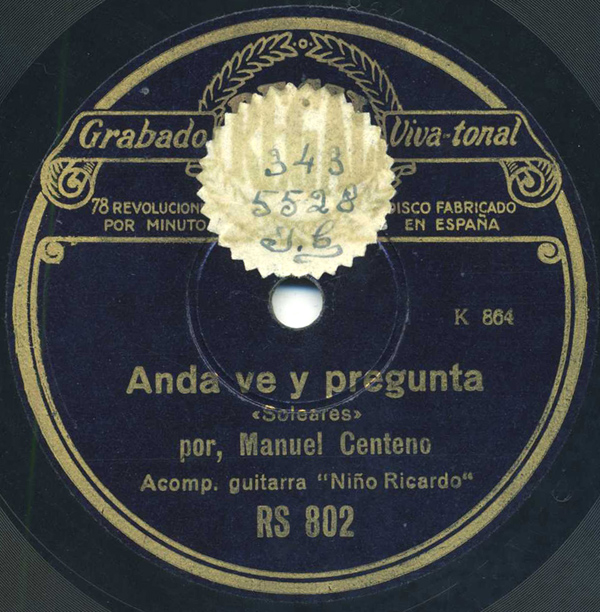
Manuel Centeno – Soleares: Anda, ve y pregunta

centenoI last posted a flamenco piece in September of 2007, not long after I started the blog. It’s probably true that when most people think of music from Spain, they might imagine a flamenco guitarist, singer, or dancer, despite the fact that technically flamenco is really the music of one region of Spain – Andalusia. However, it is true that flamenco has come to represent much more than the music of one region of Spain. Historically, there’s been quite a bit of argument about what is “true” flamenco and imitation flamenco. I’m certainly not prepared or educated enough to enter that debate, not being either an expert or from the region myself. But, I thought it might be time to return to the topic, and post an example of what some would consider genuine cante flamenco by two masters – Manuel Centeno, the cantaor (singer), and Niño Ricardo, the tocaor (guitarist).

There are numerous song types in flamenco music, and those are known as the palos. The oldest and most intense songs are known as cante grande. These songs tend to best express the deepest, emotional sorrow or loneliness that is at the heart of real Andalusian flamenco. They are the Siguiriyas, usually a four-lined poem, and today’s piece, an example of the Soleá, also known as Soleares, which is usually only three or four lines as well. Scholars seem to disagree where the current form of Soleares developed, but Seville is often named as a possibility. The rhythm of the Soleares is always a 12-beat rhythm, with the emphasis on the 3,6, 8, 10, and 12 beats – but flamenco demands a fair amount of improvisation and interplay between the guitarist and singer, so the beat emphasis is really just a guideline. The guitarist usually plays in either the E phrygian or the A phrygian. The singer will inject his lyrics with dramatic melisma and the result, however familiar to fans of international music, can be undoubtedly powerful.

Manuel Centeno was considered to be one of the last great masters of cante grande, particularly by writer D.E. Pohren, whose 1960s books “The Art of Flamenco” and “The Lives and Legends of Flamenco” pull no punches in excoriating those he feels injured the classic art. Pohren gives Centeno’s date of birth as ca. 1900, but a 1966 text in Spanish gives his birthdate as 1885, in Seville (another website gives his birthplace in Murcia). He died in 1960, apparently impoverished. This piece was originally recorded for Columbia ca. August 1928, possibly in Barcelona, and released on their Regal imprint, though Centeno also recorded for HMV in 1929. On HMV’s sessions, Centeno was accompanied by the great Ramón Montoya (uncle of Carlos). On this session he is accompanied by another guitarist of reknown, and also, along with Montoya, one of the few guitarists who accompanied the great La Niña de los Peines throughout her career, the aforementioned Niño Ricardo. Ricardo (1904-1972), born Manuel Serrapi Sánchez in Seville, accompanied all manner of flamenco greats, and even went commercial for a brief period, much to the chagrin of some purists (there were songs like “Flamenco Twist” being performed in the 1950s, by performers who previously practiced more traditional flamenco forms). Regardless, he has always been considered an absolute master. I hope you enjoy the piece, whose translated title means “Go ahead and ask.”

Manuel Centeno – Soleares: Anda, ve y pregunta

Technical Notes
Label: Regal
Issue Number: RS 802
Matrix Number: K 864

There have been a number of reissues of early flamenco throughout the years, many of them with pretty dicey transfers. This track was at one point released on a Spanish CD, Volume 25 of Grandes Clásicos del Cante Flamenco. I’m not sure if that is in print any longer (it doesn’t appear to be), but the sound clips I’ve heard from the CD sound pretty crunchy, so I offer this instead.

Thanks to Dax Diaz and Bill Dean-Myatt.

Excavated Shellac Archives Now Available

Hello all –

As mentioned in a previous post, Excavated Shellac is now part of the Free Music Archive hosted by WFMU. I’m happy to announce that the vast majority of Excavated Shellac tracks are now available for all and sundry. More will be uploaded, gradually, as the blog continues (and there will be a post coming soon…I promise). I’ve also created a mix of fiddle pieces from the archives. Have fun with them, listen, comment, and enjoy.

Excavated Shellac on the Free Music Archive

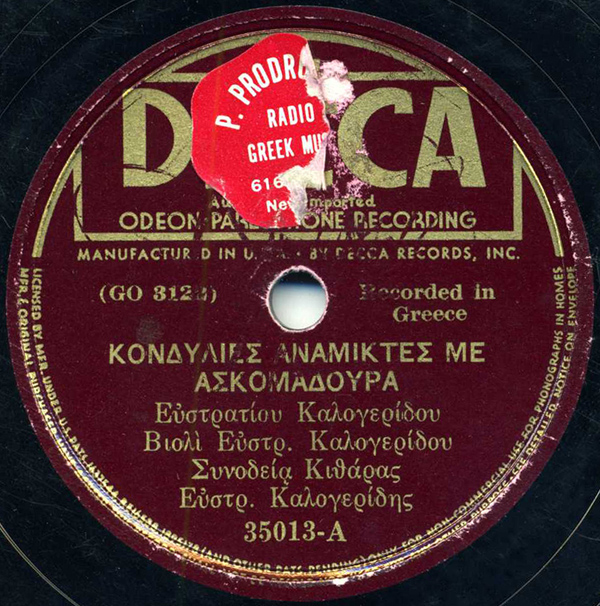
Eustratios Kalogeridis – Kondylies Anamiktes me Askomadoura

kalogeridou1For some time now, I’ve wanted to post something from the island of Crete. The music of Greece is rich and diverse from region to region, island to island – it’s not all bouzouki and hashish dens (as terrific as that can be!). There’s Epirotic music with its Albanian similarities, Roumeli music, Thracian bagpipe traditions, and Pontic kemenje or lyra playing among other types. The deeper you dig, the more gold you will find.

Kritika, or the folk music of Crete, is centered around the playing of either the three-stringed lyra, held upright and thought by some to be a descendent of the Byzantine lyra, or the violin, introduced to the region in the 17th century. Generally, most Cretan folk music is based around musical couplets or simple melodic phrases, called mantinidhes in the western and central areas of Crete, and kondylies in eastern Crete. The songs build in intensity as the violin or lyra player improvises. Dances, such as the pidhiktos or the pentozali, are performed. These musical phrases are part of the collective musical memory in Crete – as such, music in a performance is not always predetermined.

Today’s piece is a hot one – and the title, “Kondylies Anamiktes me Askomadoura,” is simply a descriptive phrase: it literally means “Kondylies mixed with askomandoura.” The kondylies are the aforementioned musical phrases, and the askmomandoura is the Cretan bagpipe. Here’s where it gets interesting – the bagpipe is not played on this piece, it is imitated by the virtuouso fiddle player, Mr. Kalogeridis. I’m sure one can pick out the sections quite easily, but the violin-as-askomandoura occurs from 1:10-1:24, and from about 2:15-2:34. He is accompanied by an uncredited guitarist and pianist – though the pianist may be legendary rebetika musician Spyros Peristeris (1900-1966), who was the recording director for Odeon at the time of this recording (ca. 1938) and often was an accompanist on various instruments.

Kalogeridis is considered a legendary fiddle player in Crete, although there are only about 15 of his recordings that have been documented. He was born in 1883 in Sitía, and studied at the Conservatoire de Paris until 1915, when he returned to Crete – the very first classically trained Cretan musician. However, despite being the chair of the Philharmonic Orchestra of Heraklion and his refined pedigree, Kalogeridis composed true Cretan roots music without European embellishment, basing his improvisations on folkloric lyra playing of eastern Crete. He also wrote down his improvisations – further, his compositions were so influential that they were passed down through oral tradition by other Cretan folk musicians. His first recordings were in 1926, and his last in 1950. He passed away in Piraeus in 1960, apparently having fallen on hard times to due a lengthy illness, and having to sell one of his prized violins for 7,000 drachmas.

This American Decca release was taken from Odeon masters recorded in Greece, and distributed in the US in Greek communities and shops (this one still bears the sticker to a well-known NYC shop). The equally terrific flip side to this record appears on Vol. 2 of the Secret Museum series. And for an incredible down-home askomandoura performance, check out this clip.

Eustratios Kalogeridis – Kondylies Anamiktes me Askomadoura

Technical Notes
Label: Decca
Issue Number: 35013
Matrix Number: GO 3122

Many thanks to Tony Klein, who provided invaluable information for this post!

Dear Readers

I have to level with you, wonderful readers of this blog, and confess to you: I am tired.

Since the site’s inception two years ago, I have transferred, cleaned-up, written about and researched 113 individual 78s from my collection, week after week with only an occasional interruption. There have been 5 guest posts from collector friends. I am not trying to toot my own horn here – this has been something I excitedly look forward to every week! But, like many other bloggers before me, I find myself suffering burnout, the onset of which began well over a year ago. The constraints of my day job, grad school classes at night, and attempting to lead a diverse and active life while juggling the myriad of side projects I am involved with have taken their toll. I can no longer keep up this pace!

So, as you may have guessed, I will have to decrease the amount of posts on Excavated Shellac to 1 or 2 a month. That way, I will still be able to deliver a piece of music as well as writing/research that means something to me, and hopefully to you too. I feel I’ve earned it with the regularity, uniqueness, and quality of what I’ve provided so far, but I do feel guilt. That said, it has never been my intention to upload my entire collection – just a small snapshot, or a gallery. It is, after all, free for the asking, and there’s only so far I can go with this aesthetic – I feel a little like a parent whose child got straight A’s in college and now needs to move out of the house.

There is more to this, however. Quite happily, I have become involved as a curator with WFMU’s Free Music Archive project, which has been in the works for some time. I am working with the folks there to restore my old tracks that have been taken down, as well as all the text and images for each post. An announcement about this will be forthcoming – much sooner rather than later. Over time, I will upload all of Excavated Shellac’s content onto the WFMU servers where the tracks will each have their own page, and where they will remain in perpetuity as an Excavated Shellac product (for lack of a better word) – at which point the Excavated Shellac site will more or less become duplicative. It could be that Excavated Shellac will discontinue, and I will continue to post only with WFMU – I haven’t decided, as there’s time yet.

But, let’s not get maudlin – I’m not going anywhere yet and already have a bunch of posts that are in the works, and while the WFMU project might sound strange to those not familiar to it (more here), I think it represents a real step in bringing a diverse collection of music to people, for free. You might even see a familiar name or two involved (Ian Nagoski, David Seubert).

So, this is a new step – moving onward and upward. I just wanted to be honest with you, as many of you out there have been with the site since the beginning – something I can’t tell you how much I appreciate. And if you are concerned when to check the blog for future posts here, I recommend subscribing to the RSS.

Meanwhile, let’s listen to something fun…

Moh. Sjah & Orkes Kerontjong M. Sagi – Kr. Irama

iramaI thought that, coupled with the previous post of today, I’d post something languid and tranquil, something somewhat relaxed. So, I brought out another classic Indonesian krontjong piece from the mid-20th century, on the local Irama label. “Irama” actually means “rhythm” in English – thus the title of the piece as well as the name of the record label are explained.

I posted a krontjong tune of the same vintage, and on another independent Indonesian label (Dendang), back in May of 2007. This one is similar – it’s the style of krontjong that I quite enjoy, featuring the walking guitar and fiddle player trading runs in between smooth vocals. Krontjong itself is a relatively new type of urban folk music, developing in Indonesian urban areas a little over 100 years ago, with Batavian, Portuguese, Malay, and even African influence. Krontjong had changed dramatically since it was first recorded ca. 1904, and when this record was released (probably the late 1940s or so). The instrumentation was bare bones at first, featuring trios and the like. I’ve heard 1920s krontjong that sounds influenced by Stamboel theater, with a slightly more operatic sound, showing further influences at work. By the 1940s, krontjong was a rage, with whole orchestras and popular singers getting into the act…yet, to me this music is not easily explained. Indonesian-Hawaiian-guitar-and-fiddle-ballads?

As for the singer and band – I’m afraid these are muddy waters. I am mostly sure that “Moh.” stands for Mohammed, and “Kr.” stands for krontjong, but at the risk of being incorrect, I will let the original label stand as the official record.

Moh. Sjah & Orkes Kerontjong M. Sagi – Kr. Irama

Technical Notes
Label: Irama
Issue Number: IRK. 186-145
Matrix Number: imco 233 (on label); JMC 233-1 (on shellac)