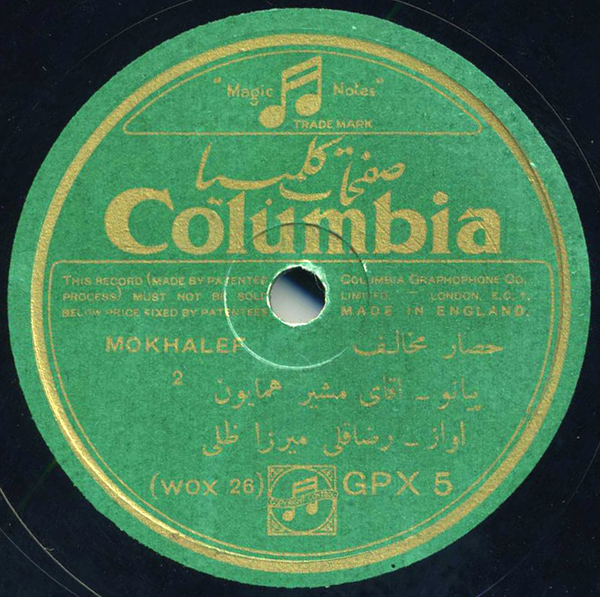
Rezagholi Mirza Zelli and Moshir Homayoon – Hesar Mokhalef

mirza-zelliIran is the first of several upcoming countries and regions that are new to Excavated Shellac, and today’s post, for those who might be unfamiliar, is a fine example of Persian Musiqi-e assil, or Persian classical music. I realize it might come as a shock to some regular followers of this site to actually hear the refined sounds of a modern piano, but the musical and vocal traditions in Persian classical music are positively ancient. Not only that, but the hammered strings of a piano seem an almost logical progression from the traditional hammered dulcimer of Persia, the santur. This recording was made in June of 1933 by engineer Horace Frank Chown, and released in Iran on a 12″ disc – it was the last time a gramophone company would record in Tehran until after World War II.

I can claim no expertise in Persian classical music, but I’ll attempt a humble and basic rundown, particularly as it pertains to today’s track. The body of traditional melodies in Persian music is known as the radīf. The radīf, which some say was developed between the 3rd and 7th centuries CE, is organized into a musical framework called the dastgāh – in fact, quite literally, as dastgāh itself means ‘system’ or ‘framework’ in English. Radīf is memorized entirely by ear, with a student learning the repetoire of his teacher, the ostād. The twelve dastgāh structure organizes the radīf into groups of individual pieces, and those pieces are known as gūshe. The gūshe are modal progressions by which the singer can build his improvisation around, in a similar fashion to the maqam in Arabic music, or the raga in India.  The rhythms are often based on poetry – the rhythm of the human voice. And the human voice, in Persian music, is most often metaphorically linked to the nightingale. This piece is performed in the Chāhār Gāh dastgāh, and as the title implies, it features two gūshe, Hesar and Mokhalef.

Rezagholi Mirza Zelli was born in 1906 and was considered a masterful singer during his career, which ended with his early death in 1945. His teacher was the famous singer and poet Abolqassem Aref Ghazvini (1882-1934). Moshir Homayoon, the pianist, accompanies him.

Rezagholi Mirza Zelli and Moshir Homayoon Shahrdar – Hesar Mokhalef

Technical Notes
Label: Columbia
Issue Number: G.P.X. 5
Matrix Number: WOX-26-2

Thank you to Martik Martirossian for help with translation and to Amir Mansour for information.

Felipe V. Rivera y su Orquesta Típica Boliviana, with Maria F. Sivila and Faustino J. Ventura – Caminito a Yavi

rivera1Here is something I’ve been swooning over lately – the sound of early Bolivian music.

Felipe V. Rivera was born in 1896 in Suipacha, Bolivia, and was a revered performer of Bolivian folkloric music, recording for the Victor and Odeon company in Argentina throughout the 1930s and 1940s, until his death in 1946. He moved from Bolivia to La Quiaca, just over the Bolivian border in the Jujuy province, in 1929, and had his first session with Victor in 1931. He was self-taught, and played guitar, charango (the 10-string, small guitar-like instrument of the Andes, usually made with the back of an armadillo as the shell), and the quena flute. According to the only biography that seems to exist on Rivera, he and his group were apparently met with dismissiveness by the Victor label in ’31, as the label was convinced that music of the Andean Indians wouldn’t sell. Rivera prevailed somehow, and Victor recorded two of his performances, which sold plentifully in August of 1932. Normally this would be followed by subsequent sessions, but Rivera did not record again until the “Guerra del Chaco,” the war between Bolivia and Paraguay, ended in 1935. Rivera went back to Buenos Aires to record in 1936 (when this track was recorded), 1938, and 1942.

Victor began recording in La Paz as early as 1917, but Rivera’s are among the earliest I’ve come across, myself. They are also completely unavailable, as far as I can tell. Too bad – as the sound of the charango can transport a listener. The title of this track “Caminito a Yavi,” no doubt refers to the historic village Camino a Yavi (or, simply, Yavi) in Argentina, about 16 kilometers from La Quiaca. The town, founded in 1667 on a stark plateau, is just a few streets, surrounded by hills and desert plains.

As we begin the third year of Excavated Shellac, very soon we’ll have at least one important announcement, as well as several tracks from countries and regions we haven’t yet been to…

Felipe V. Rivera y su Orquesta Típica Boliviana, with Maria F. Sivila and Faustino J. Ventura – Caminito a Yavi

Technical Notes
Label: Victor (Argentina)
Issue Number: 37988-A
Matrix Number: same or unclear per DAHR

Much information for this post gleaned from Remo Leaño’s fine site on Rivera, located here.

Sami al-Shawwa, Ali Rashidi, Muhammad al-Qasabji – Bachraf Hedjaz Hamayon, Pts. 1 and 2

chawaMy best friend is about to travel to Cairo, surely to experience wondrous sights and sounds. I thought I’d send her off with a piece featuring three of the greatest Egyptian virtuoso musicians ever to record during the 78rpm era. Both sides are featured here, as the piece is in two parts.

Syrian violinist Sami al-Shawwa (1887-1960) established a music school in Cairo by 1906, and began his career on record that same decade, both as a soloist, and as an accompanist for many well-known Egyptian singers (Zaki Mourad, Sayed El-Safti, Um Kulthum – you name them, he played with them). His appearance on a recording was clearly considered a stamp of quality very early on, as he was often credited on records side by side with the singer. On this track he is joined by kanun player Ali Rashidi, of which I know very little (though I know he recorded solo kanun performances around the same time). On oud, however, is the legendary Muhammad al-Qasabji, known forever as Um Kulthum’s oud player (and sometime composer for her, as well as for Asmahan). The three masters perform a bachraf, a song type associated with Turkey, here in the hejaz (or hedjaz) maqam, or scale. Listen to how Sami can’t resist having the last word in the piece, fiddling away after the others have stopped, using up the last 10 seconds available to them.

I am not sure about a date on this recording, but I would guess about 1926 or so, as it’s rather early in Columbia’s “X” series. Enjoy….and bon voyage!

Sami al-Shawwa, Ali Rashidi, Muhammad al-Qasabi – Bachraf Hedjaz Hamayon, Pt.1

Sami al-Shawwa, Ali Rashidi, Muhammad al-Qasabi – Bachraf Hedjaz Hamayon, Pt. 2

Technical Notes
Label: Columbia
Issue Number: 18-X
Matrix Number: E72 (1-A-1)

Apostolic Church Choir – Aba Abraham; Dielykani Moussa – Alfayaya

apostolicI am taking a break from posting next week due to a little traveling, so this week: two tracks on obscure labels from West Africa!

Music from Liberia, in Liberian languages other than their official language of English, is some of the toughest to track down on 78 rpm records. In fact, I’m almost ready to say that nothing was released on commercial labels until the 1950s. There were, however, some important field recordings of ethnographic and popular “café music” made by ethnographer Arthur S. Alberts.

Alberts titled his collection of twelve 78s “Tribal, Folk and Cafe Music of West Africa” and it featured music recorded in French Guinea, “The Gold Coast,” Burkina Faso (rare for that time, as well), French Soudan, and Liberia. The recordings were made in 1949, and were collected in a box set of 12 78rpm records with a 20+ page booklet and a set of black and white photographs taken on the expedition, in a limited edition of 2,000. One could order the set from an address in New York City for a total of $25.88. Those recordings, as well as many unreleased recordings Alberts made on his travels, are now available on CD in three collections (Pearl, Folkways (discontinued), and Yarngo).

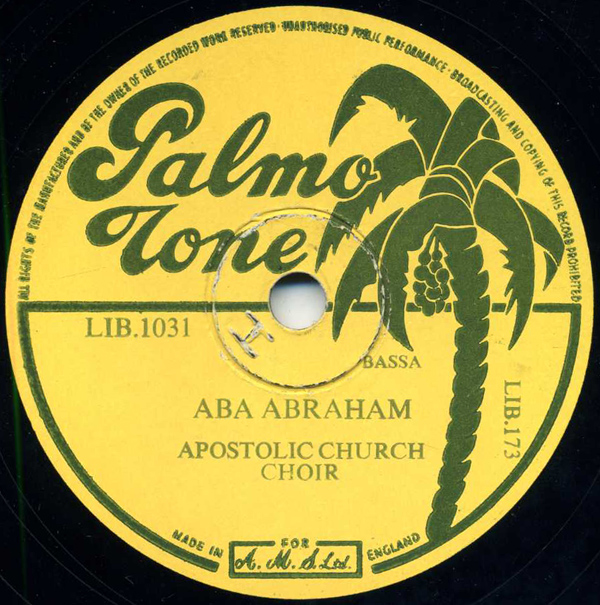
Anyway – getting back on track: in the 1950s or so, a strange little label appeared named Palmo Tone, which only released Liberian music, it seems. The records were pressed in England for something called “A.M.S. Ltd.” And while this piece is by an Apostolic Church Choir (40% of Liberia is Christian) don’t assume this sounds like a westernized group of singers going through a British hymnal – it sounds nothing like it. In fact, everything I’ve heard on the Palmo Tone label is raw, almost ethnographic sounding – a far cry from the café music of the Alberts set. This piece is sung in the Bassa dialect (not to be confused with the Bassa dialect of Nigeria, or the Bassa (Basaa) dialect of Cameroon). Who knows how many records were released on the little Palmo Tone label? At least 60, as far as I can tell.

moussaThe second piece is a subtle, methodical guitar and voice piece in the Jula language (listed as Dioula on the label). Jula is spoken primarily in Burkina Faso, and also in Côte d’Ivoire. Unfortunately, I know virtually nothing about the singer, Dielykani Moussa, or the label (other than that it seems to have been a possibly-short-lived subsidiary of Ducretet-Thomson) and its nice design. I am most curious about where this track was recorded – my personal hunch is that it was recorded in the mid-1950s in Côte d’Ivoire, but I really can’t say for sure. Thanks to reader ‘kabako” we know that the title, Alfayaya, refers to Alfa Yaya of Labé, the Guinean ruler of the Fula people, who was deported to Côte d’Ivoire in 1905.

While some prefer the sound of 78s to remain rarified air, we here at Excavated Shellac know that it’s music for the people…Coming up soon: a 2-hour set for dublab, where I play many rarely heard pieces of music on 78 including lots of material not featured here (as well as several tracks no longer available), talk about Excavated Shellac and collecting old records, blather on about some philosophical issues, and generally sound like a dork. I will post an announcement when it becomes available. Meanwhile, these are for you —

Apostolic Church Choir – Aba Abraham

Dielykani Moussa – Alfayaya

Technical Notes

Label: Palmo Tone
Issue Number: LIB-1031
Matrix Number: LIB-181 (in wax)/ LIB.173 (on label)

Label: Kori
Issue Number: 5014
Matrix Number: DTN.253

Maria Alice – A Minha Aldeia

aliceWe’re fast approaching the two year anniversary of Excavated Shellac – having explored, so far, over 100 78s from about 70 different regions and cultures. I thought I’d take this week to go back to Portugal – in fact, to the same artist I posted a fado by in April of 2007 – the unsung Maria Alice.

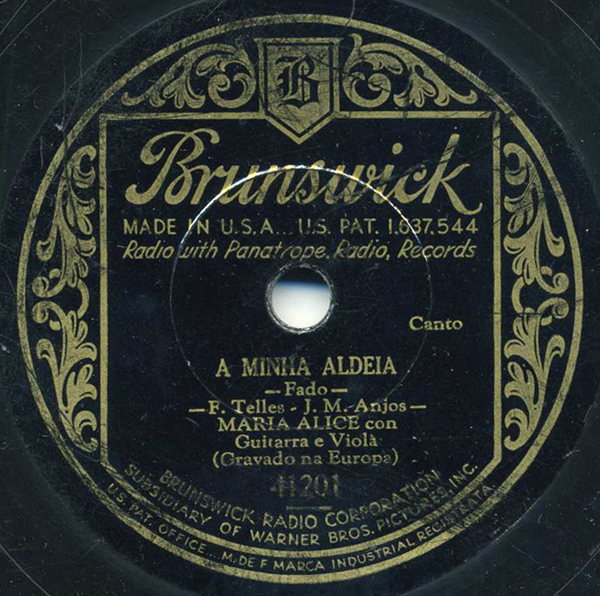
Maria Alice was born in 1904, and was singing the real fado by the late 1920s, recording for the German Polydor label. This piece, with unknown players on the guitarra and violão, was recorded in about 1930 in Lisbon. The title translates to “My Village.” Far more eloquent words about fado’s saudade, “a quintessentially Lusitanian melancholy mixed with nostalgia and yearning,”* have been written elsewhere, and I could not do them justice – suffice it to say it is an essential part of this song, and all great fados. Ms Alice died in 1997.

How this ended up being released by the Brunswick label in the United States is interesting for ephemera-seekers like me. By 1929, the American label Brunswick, a very popular label throughout the early part of the 20th century, was in dire straits due to the Depression and other problems. British Brunswick, their counterpart, had collapsed. To stay alive, in 1930, the American Brunswick label was sold to Warner Brothers, but despite Warners signing up stars left and right, the records did not sell, and in late 1931, Warners sold Brunswick and its contracted artists to the American Record Corporation. It appears, however, that during its brief period of owning Brunswick between 1930 and 1931, Warners continued a relationship which began in 1926 between Brunswick and Deutsche-Grammophon, and reissued classical and some “ethnic” records from German D.G labels in the United States. They don’t turn up much, but I believe the sound quality of the German recordings are quite nice. This is one of them.

Maria Alice – A Minha Aldeia

Technical Notes:
Label: Brunswick (from Polydor master)
Issue Number: 41201
Matrix Number: 2786 1/2 BK

*Peter Manuel, Popular Musics of the Non-Western World.

Hocine Slaoui – Yal Cahla

slaouiSince October’s Lili L’Abassi piece was so popular, I thought I’d post more classic, driving popular music from North Africa – this time, from Morocco.

Hocine Slaoui (more commonly spelled Houcine Slaoui) can be credited with helping to invent Moroccan popular music, acting as a bridge between earlier Moroccan chaabi and more contemporary sounds, despite actively recording only a short time. He was born in 1918 as Houcine Ben Bouchaïb in the city of Salé –  the pronounciation of the city’s name gave him the new last name of “Slaoui.” An oud player with a crack group of accompanying musicians, Slaoui began his recording career for Pathé in the years after World War II, recording upwards of 30-40 songs for the company from ca. 1948-1950 (possibly in Paris). He then mysteriously passed away in 1951. His 78s were huge sellers in the Maghreb, and his name was probably as well known as Mohammed Abdel Wahab or Farid El-Attrache – perhaps because he deliberately gave his songs mass appeal by intermingling all manner of styles. That said, they now turn up infrequently. There is next to nothing written about Slaoui in English, and there appear to be no available CDs, at least in the West, that contain his work.

Along with Slaoui on oud, you’ll hear percussion, qanun, and his chorus – even a little ululating!  This one really moves, like everything else I’ve found by the artist. The title “Yal Cahla,”  is a rather poor English transliteration of something that might be better spelled “Ya l’kHla,” which is a reference to a black-skinned woman. The song, according to reader Tim, is filled with possibly ironic stereotypes of blacks (see the comments below).

Hocine Slaoui – Yal Cahla

Technical Notes
Label: Pathé
Issue Number: PV 202
Matrix Number: CPT 7871-1P (M-127784)

(Thanks to the Alkadhis for help with translation!)

Gergana Tsekova – Kako Todoike, Todoike

tsekovaWhile recording in Bulgaria did begin as early as the first decade of the 20th century, it wasn’t until the 1930s when independent Bulgarian labels began to crop up that recording began in full-swing. To compete with Odeon, Pathé, and HMV, local labels like Orfei, Arfa, Balkan, and London Record were recording at a rapid clip. That said, it wouldn’t surprise me if these records received little distribution beyond cities in Bulgaria – finding folkloric Bulgarian records in anything above hopelessly worn condition is difficult.

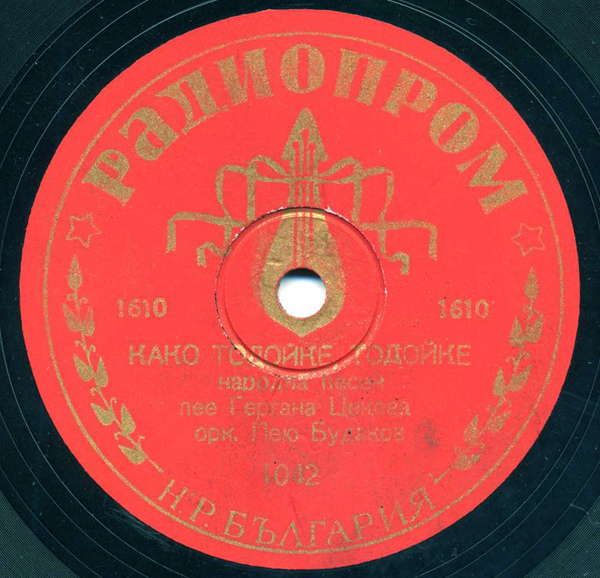
Today’s piece was released on the Radioprom label…but perhaps not at first. The Communist government consolidated (and liquified) the assets of all active Bulgarian independent record labels as part of a nationalization process in the late 1940s, with everything then lumped together under the state-owned label Radioprom. Despite the amount of propaganda released by Radioprom, they did release much folkloric music as well – and re-released material that had previously appeared on other labels. In this case, it appears that Ms Tsekova’s piece originally appeared on the Orfei label, where she recorded a number of tracks in her apparently short-lived career on 78s. And as for Radioprom, it eventually became known as Balkanton in the LP era.

Ms Tsekova sings with the Peyu Budakov brass band (along with a clarinetist, a violinist, a lute player, and an accordion). The exact transliteration of the Cyrillic title, “Kako Todoike, Todoike” may be slightly incorrect. Kako means “older sister” in Bulgarian – and the female name that comes closest in Bulgarian is “Todorke.” I’m reasonably sure this is a song about Todorke, the older sister, though any help is of course appreciated. The equally terrific flip side to this record appears on Song of Crooked Dance, on Yazoo Records. Lauren Brody’s notes for her CD provided some of the information here, as well.

So, here we are with more forgotten sounds, the marks etched in the grooves, as fine as dust…

Gergana Tsekova – Kako Todoike, Todoike

Technical Notes
Label: Radioprom
Issue Number: 1042
Matrix Number: 1610

Felix Sunzu – Vejika

sunzu***Updated, February 26th***

A rare guitar piece from Congo, produced ca. 1950 or so. That’s today’s post, although I must admit it was something of a rescue effort. I’ve had this on my hard drive for many months, and have tried numerous transfers to get it right. I finally decided to let it loose – a hitherto unreleased and potentially unknown piece on an independent African label by a Congolese guitarist (and company), and that’s at least three reasons to get excited, in my opinion. Acoustic guitar music from Africa is worth all of the hype.

So, why was it a “rescue effort”? Well – conditions in Africa for independent labels weren’t exactly the easiest. No one is really to blame – sales in such an emerging market probably weren’t large enough to warrant money to be spent recording multiple takes, or re-pressing problem tracks. That said, I’ve found absolutely amazing records on a number of labels marred by tape speed issues, low-frequency hum, poor microphone placement, and bad pressings – sometimes all at once.  This record comes close. The recording quality is poor, the pressing is mediocre to poor, there seems to be some warbly tape issues (though the speed is constant), the record is warped, and the center hole is slightly off. Although I have other guitar records from Africa in my collection, it was precisely because of these issues that I thought it needed to be worked on and heard by an audience – plus, it’s a beautiful song.

After I first posted this track, late February 15th, I received an illuminating e-mail from Tony Klein in Sweden, who had a hunch that the song was not recorded and pressed at the correct speed. He had taken my mix and raised it two semitones. (Speed issues are common with 78s, and I’ve often adjusted the speed in the past.) After that, we heard from Vincent Kenis of Crammed Discs, who informed us about the speed issues on early Opika records (see the comments) and confirmed that the proper speed was indeed a minor third higher than the released record – THREE semitones. So, we have since adjusted the recording to its proper speed. With his permission, I’ve reproduced Tony’s comments below, as I think they are a great example of this site being a conduit for people interested in historical recordings, as well as an example of the many pitfalls and perils one encounters when transferring 78s.

What I reacted to on your disc was that, even before the voice came in, it felt like the music was running through thick syrup, that no one could play that way even if they wanted to, and then the vowel sounds sounded like slowed down tape. The thing with speed accuracy in music is that there are two particular acoustic absolutes:

1) Transients (i.e. the kick-in sounds, perhaps especially in plucked and struck instruments, and in plosive consonants and of course in extraneous plosive “noises”) and
2) Vowel and timbre formants – which are more or less independent of the pitch of the note sung or played. In the case of instruments, this will depend on the particular acoustic qualities of the musical instrument in question.

Any speed inaccuracy will create (more or less subtle) artefactual effects of the Donald Duck or Darth Vader type. Of course, in the ideal situation one would be familiar with the language, but I’ll take the risk in this case to assert my point.

Thanks to Tony and Vincent, we now have a more accurate version of this rare track. Meanwhile…

Opika was a tremendous label, which I’ve written about in the past. Starting in the late 1940s, the owners of Opika, the Greek brothers Benetar, began recording all manner of artists in east Léopoldville (Kinshasa). They were the first to sign Congolese legends Joseph Kabasele, Jhimmy, and Dr. Nico – and according to Gary Stewart’s Rumba on the River, Opika dominated music sales in the region until they ceased production ca. 1957 or so. They simply had a terrific roster of musicians. (Popular music is not all they recorded, however. In fact, Opika and their competitor label Ngoma recorded a substantial amount of raw, more “ethnographic” recordings as well – and virtually none of those recordings have made it to any present-day compilation, or perhaps have even been acknowledged.) I could find nothing on Felix Sunzu, unfortunately. The label states he was “Wahemba” which appears to be an out-of-date cultural name, and does not appear in the present day Ethnologue. Thanks to a reader (thanks Vincent!) we know that the Wahemba are located in North Katanga, close to Lake Tanganyika. Enjoy the music.

Felix Sunzu – Vejika

Technical Notes
Label: Opika
Issue Number: 423
Matrix Number: 1092

Trio Tipico Paraguayo, Félix Pérez Cardozo – Cigarro Mi

cardosoI’ve yet to visit the country of Paraguay on Excavated Shellac. Certainly a good deal of music was recorded there, particularly during the postwar era, but pre WWII-era recordings from Paraguay are difficult to track down – especially folkloric examples, as Paraguayan bands often had a strikingly European sound at that time. The influential and egalitarian Secret Museum series contains not one Paraguayan track over five discs. Neither does Henry Cowell’s 10-LP set on Folkways, Music of the World’s Peoples.

To be fair, many of Paraguay’s most important folk musicians during the 78rpm era did not actually record in Paraguay – they left their native country and recorded in Buenos Aires, Argentina, a major recording hub at the time for Victor, Odeon, and smaller labels. Two of the most well-known Paraguayan expatriate musicians were guitarist Agustín Barrios, and arpa Paraguaya player Féliz Pérez Cardozo (also spelled “Cardoso”), who performs this week’s track, accompanied by two guitarists.

The diatonic Paraguayan harp, also known as the arpa India despite the fact that it is of European origin, is a lightweight harp with 36 to 40 strings and no pedals. Traditionally, harp music is music of the countryside in Paraguay, and many harpists actually make their own harps, even today. Also, harp music of Paraguay is not standardized – it is taught by observation, and songs often feature the player’s improvisational flourishes and glissandos. But the showiness is deceptive, as Cardozo is a master of making the difficult somehow seem mellow, effortless, even timeless.

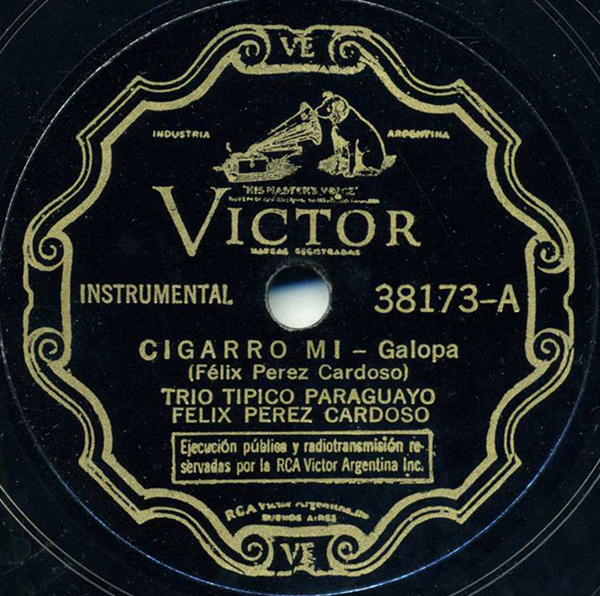
Affectionately nicknamed “Mitá Guazú” (“big boy”), Cardozo is a legend in Paraguay both as a harpist and proponent of Guarani music across South America. He was born in 1908 in a town in the Guairá Department renamed recently as “Félix Pérez Cardozo,” though at the time of his birth it was known as Yhaty. Around 1931, he moved to Buenos Aires to begin his recording career, and this track for Argentine Victor stems from the mid-1930s, give or take a few years. “Cigarro Mi” (“Cigar of Mine”) is a galopa. The galopa is an upbeat folkdance for linked pairs of dancers, generally danced by women only, who are dressed like the raida poti – the honorable country girl. Traditionally, the galoperas perform this dance while balancing a jar of water on their heads. 75 years after this recording, the traditional galopa survives mainly as a tourist attraction, alas. Cardozo died in 1952 – there was a CD of his material released outside of the US and Europe in 2001 titled Paraguayo Puro, though that seems to be difficult to obtain, if not completely out of print (this track does not appear on it).

Trio Tipico Paraguayo, Félix Pérez Cardozo – Cigarro Mi

Technical Notes
Label: Victor (Argentina)
Issue Number: 38173-A
Matrix Number: same

(This copy is a bit noisy, though it is in excellent condition – this is due to a funky pressing and a low recording…but we persevere!)