A big thanks to Susanna Bolle of Rare Frequency and her sweet write-up on the blog in this week’s Boston Phoenix. Welcome to anyone who has found their way to Excavated Shellac from back East.
Author: Jonathan Ward
Gendér Wajang of Kuta – Pemungkah
 Here’s a nice treat for the week: original Balinese gamelan music recorded by the Odeon company on their very first trip to Bali in 1928. In fact, the very first Balinese recording session, ever. These records were historic in many ways – they influenced numerous composers of the time, such as Colin McPhee and Benjamin Britten. In turn, further Balinese recordings influenced minimalists and avant-garde composers such as Harry Partch.
Also, during the 1930s, a few examples from these sessions made their way to a famous 78rpm box set called “Music of the Orient.” This box set – kind of a Secret Museum of Mankind of its day – seemed to have a long shelf life. It was originally produced by Odeon, then reproduced by Parlophone and also by Decca in the United States. Every once in a while, you’ll still see a copy, or at least a few errant examples from the set. Today’s recording, however, was not included in that set, and hasn’t been released since 1928 as far as I can tell.
Gendér Wayang is a type of gamelan music that usually accompanies ritual shadow plays (wayang kulit), both in the day and at night. McPhee called it “perhaps the highest, and certainly the most sensitive form of musical expression existing in Bali.” It is played by a quartet (or sometimes a duo) of musicians playing four separate gendér, the Balinese bronze metallophones with bamboo resonators. The players strike the gendér with their mallets while simultaneously dampening the notes with the heels of their hands. This piece, the Pemungkah, is an overture to a shadow play.
Gendér Wayang of Kuta – Pemungkah
For more of these sessions, check out The Roots of Gamelan CD.
Much information was gathered from Nick Gray’s article “”Sulendra”: An Example of Petegak in the Balinese Gendér Wayang Repertory,” British Journal of Ethnomusicology 1, 1992.
ALSO: Please check out friend of the site and fellow fanatic 78rpm collector Ian Nagoski’s fantastic Black Mirror CD, just released by the fine people at Dust-to-Digital. His choices are excellent and intriguing, and it’s a true labor of love. What else could be better?
Technical Notes
Label: Odeon
Issue Number: A204764
Matrix Number: Jab 555
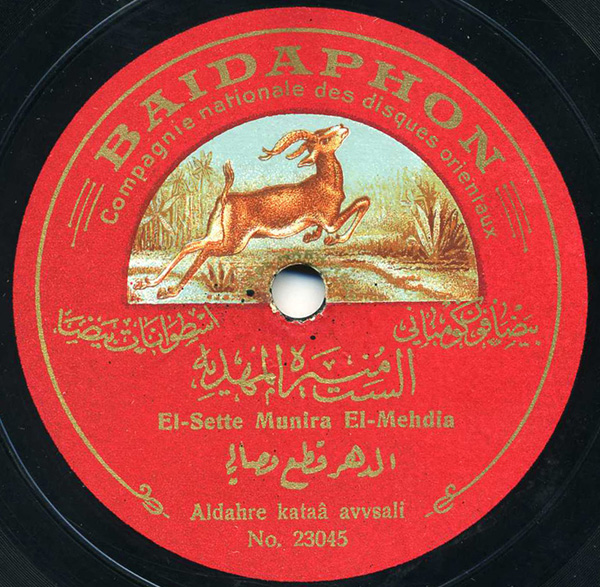
Munira al-Mahdiyya – Aldahre Kataâ Awsali
 For me, classical Arabic music from the first two decades of the 20th century is poetic and beautiful, besides being probably as close a chance we’re going to get to hearing what music may have sounded like in the Middle East in the 19th century. Powerful voices and performances abound, although this is coming from an untrained ear, mind you! I just go by what moves me. There’s a lot out there.
Diehard collectors are all too familar with this, but listening might sometimes be a challenge for some when it comes to early international recordings, the main reason being that the music (up until 1925 for most labels) was recorded before the invention of electric microphone recording. Considerable surface noise was par for the course, no matter how perfect the record. Voices sound like they were recorded far away, through a tin can you might say – the result of singing into a recording horn. A few plays on a period phonograph player with a bad needle could cause instant distortion on an otherwise perfect playing surface. It made the fragile discs all the more ephemeral. Yet the musical (and historical) value of these early recordings far exceeds technology’s shortcomings.
Munira al-Mahdiyya (1884-1965) is among the earliest female recording artists of Egypt. She was a celebrity during her day and appeared in films, much like Umm Kulthum who, shortly after she began recording, eclipsed nearly all artists in Egypt in terms of popularity. I believe this recording was made ca. 1914. On violin and kanun are two accompanists, one of whom (I assume) joins Munira in singing the last third of the song. The title of the piece translates literally to “adversities tore me apart.” I don’t think it’s much of a stretch to take a little more liberty and say that it could also be “hard times tore me apart,” which sounds a lot like countless blues songs.
The Baidaphon label was an early independent label out of Beirut, Lebanon. Started before 1912 by several members of the Bayda family (including singer Farjallah Bayda, also a Baidaphon talent), the label recorded throughout the Middle East and North Africa, sending their masters to Germany to be manufactured. I’ve been lucky to find Baidaphons from Morocco to Central Asia. The label pictured here is their 1920s design. However, I believe the song is from an early session of al-Mahdiyya’s, so in effect this very well may be a 1920s re-release. Baidaphon, like Odeon and a few other companies, seemed to like the 10.5″ record, of which this is an example.
Munira al-Mahdiyya – Aldahre Kataâ Awsali
Thanks to Karim for help with translation!
Technical Notes
Label: Baidaphon
Issue Number: 23045
Matrix Number: 2345
Septeto Machín – El Guateque
 Antonio Machín (1903-1977) was born in Sagua la Grande on the north side of Cuba, and was an important figure in early Cuban recording, particularly in the 1930s, when he released loads of wonderful 78s. He had numerous bands (Cuarteto Machín, Sexteto Machín, and the septet featured here), and eventually moved to Europe.
This was recorded in New York on October 31, 1935, just before Machín had relocated. One of the interesting things about this release is that it’s on HMV’s “GV” series of Latin American, Caribbean, and South American music, which was started in 1933. The “GV” series was exported to, and marketed specifically for, the diverse population of West Africa. The music on the series was a major influence on the development of Afro-Cuban music througout the continent, as the records reached far beyond the West. The rhumba movement in the Congo has been directly linked to the dissemination of the “GV” series, for instance.
But even without its history, it’s fine music nontheless. The title of the track translates to “The Party,” although the lyrics seem quite sorrowful (perhaps someone could save me from some embarrassing translations here). It is a guajira son, which is a guajira sung in the rhythm of a son, a style that was first made famous in the late 1920s.
There are several fine collections of early Cuban music on the market, including several that feature Machin.
Technical Notes
Label: HMV
Issue Number: G.V. 70
Matrix Number: OA98003
Master Laloo – Jevi Karay Je Karni, Tevi Tarat Faday Chhe
 I’m returning to India for a track by Master Laloo, a singer from Gujarat, presumably. Collecting Indian music has always been daunting to me – I love it, but there are so many excellent artists out there, I’m overwhelmed. That said, I enjoy what I have, and what I continue to pick up. Hell, it’s all a giant experiment, for the most part, and that’s what continues to make it fun.
While Laloo doesn’t perform some of the same vocal gymnastics as other masters of Indian classical music, there’s something very appealing to me about the combination of voice, harmonium, and tabla. Basically, what I’m trying to say is that I enjoy listening to this record, which is what it’s all about. It was recorded in Mumbai by Gramophone Company engineer Arthur James Twine, ca. 1928.
I could find nothing on the Master in question. According to a listener from India who wrote in, the translated Gujurati title means “The way you do Karmas, you get fruits for it immediately.”
On a side note, R. and I went to a concert of Central Asian music in Los Angeles the other night. I always feel nervous beforehand that a concert like that will be too faux world-y for me, but it was very good, and one artist stood out: the Kazakh singer and dombra player Ulzhan Baibussynova. Although she performed only three songs, they were riveting. She appears on the recent Smithsonian Folkways release Bardic Divas.
Technical Notes
Label: HMV
Issue Number: N. 2569
Matrix Number: BX. 4884
DIY Excavated Shellac Sampler CD
 A lot of music has been posted on this site, and all of it is still available. If you cull everything from the very start of the blog, April 14, 2007, up through September 12th’s entry, you have about 75 minutes of lost music.
I decided to put together simple, downloadable artwork for the Excavated Shellac Sampler CD, Volume 1, for those interested in doing something with this music other than a) keeping it on your hard drive, or b) putting it on an iPod. Which may 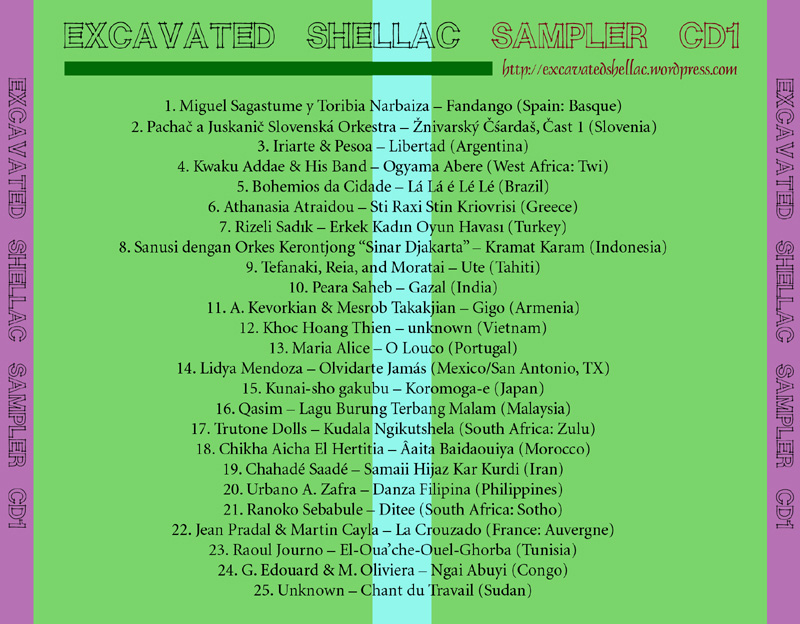 be, in fact, nobody, but what the hell.
So, here are the high-res covers: front and back. These will work for any regular sized CD case. Then, number your tracks – I went ahead and created a track list to follow, which appears on the back cover template, so you can copy that – or make your own if you like to agonize over such stuff, as I obviously do. Print!
Transfer your mp3s to .wav files and burn the CD – I use a program called Switch to transfer, but there’s lots of software that does this. You know all this already, I know. Sigh…
31 de Octubre – Milongueros
 Better late than never. I had to leave town for a short trip, then my file hosting site was acting up last night. But here we are, once again…
Bolivia had its own record label in the mid-20th century called Mendez, pressed in La Paz. Although the examples I’ve come across were pressed poorly – with heavy, bumpy shellac and often in irregular sizes (9 3/4″ as opposed to the standard 10″, for instance) – they were purely a Bolivian product and that counts for a lot. There seems to have been some wonderful regional music captured on Mendez, although I know next to nothing about the extent of their output or how long they existed before being bought up by a larger entity (I do know that they pressed labels in turquoise, gold, and dark blue, as seen here).
The mysterious ensemble known as “31 de Octubre” consisted of a couple of guitar players, at least one probably playing the charango, and a soloist on the quena, or the traditional Andean flute. This track is labeled as a carnaval (the flip side is listed as a danza indigena), also known as a carnavalito, a particular musical style of Bolivia. It is a song from the Eastern part of the country, interestingly, not the Andean side. The title, Milongueros, refers to Milongas (or Milonga), the Argentine style of music, and playing. It’s a nice tune – short and sweet!
(Special thanks to Carol Blenda for help and information!)
Technical Notes
Label: Mendez
Issue Number: 203
Matrix Number: 53-L15
Ma E Mi – “Thai Rhyme with Sound”
 Here’s a track from Burma, also known as Myanmar. [According to a variety of sources, the name Myanmar was given to the country by the military junta in 1989, and many still prefer the name Burma (including the Library of Congress Subject Authority headings).]
Burmese records are difficult to find. I only have a few, and the majority are in pretty dicey shape. This piece was recorded by the Indian branch of Columbia records ca. 1932 or so. It starts off a little rough then improves – but the music is really evocative. It sounds like an interesting conglomeration of Southeast Asian and South Asian musical styles. The instrument being played is the Burmese harp, known as the saung, the national instrument of Burma, and an ancient one, possibly dating to around the 8th century. You can also detect a subtle accompaniment of accordion and percussion.
Thanks to reader Thuya, we know that the singer is singing about how in the summer, after a long monsoon season, flowers are in bloom, and the wavy horizon of mountains is in view. Apparently, the color and smell of each flower is described by the singer.
Ma E Mi – Thai Rhyme with Sound
I don’t believe there’s much of early Burmese music on CD – though there are great tracks both on R. Crumb’s Hot Women CD, and on Volume 3 of the Secret Museum series.
Technical Notes
Label: Columbia
Issue Number: V.E. 2107
Matrix Number: CEI. 7910
James Morrison – The Lark in the Morning/The Wandering Minstrel
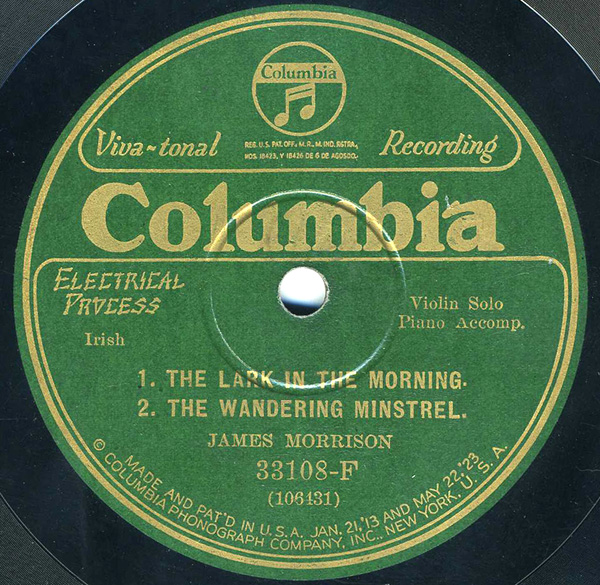 More classic green Columbia fare from the late 1920s!
First, thanks to any and all who happened to catch the set I spun at KXLU last week. Nearly all the tracks I played were newly transferred and cleaned up – with only two exceptions. Over the next several months, I will post many of those tracks. The set contained 78s from Azerbaijan, Turkey, Armenia, Indonesia, Japan, Thailand, South Africa, Congo, Sierra Leone, País Vasco, Ireland, France, Andalusia, and Argentina. This was the Irish track I played…
Irish fiddler James Morrison (1893-1947) was truly a master player. Born near the town of Collooney in County Sligo, Ireland, Morrison immigrated to the U.S. in 1915, first settling in Boston, and then in New York City. His first recordings were as early as 1921, and in the ensuing years he recorded for Vocalion, Okeh, and Gennett.
In March of 1926, he paired with pianist Claire Reardon, and recorded his first electrical recordings for Columbia, which is where this track stems from. Both “The Lark in the Morning” and “The Wandering Minstrel” are classic Irish jigs, and Morrison seems to play them effortlessly.
Columbia’s Irish output during the late 20s and early 30s is formidable. Incredible, in fact. So many wonderful musicians recorded for Columbia during that period – John McKenna, Frank Quinn, The Flanagan Brothers…on and on. Interestingly, I don’t believe this track has ever been compiled. However, there are excellent CD reissues with early Irish recordings that I can heartily recommend, namely Yazoo’s two CDs titled Wheels of the World, and Arhoolie’s Frank Quinn CD. For more on James Morrison, here’s a nice website with information on a Morrison festival in Ireland.
James Morrison – The Lark in the Morning/The Wandering Minstrel
Finally, rest in peace, Mike Stewart. I puchased many fine records from him, and his was the first print auction I ever subscribed to, when I was 23 years old.
Technical Notes
Label: Columbia
Issue Number: 33108-F
Matrix Number: 106431 (2-C-3)
Wednesday, 10/10 – KXLU
I will be a guest on the KXLU (88.9) global music program, Wandering Medicine Show, this Wednesday from 8-9 pm, PST, in Los Angeles. You can stream the station live from their website, or hopefully tune in if you’re in the L.A. area. I will definitely be playing some nice material from across the globe – all from 78s, of course. I might use a couple of tracks from the blog, but the majority if not all of the material will be new.
 Excavated Shellac