Author: Jonathan Ward

Pasquale Sciascia e Co. – Rusina alla Campagna

sciascia.jpgColumbia, in the late 1920s, released approximately 1300 records by Italian-American immigrants, for purchase usually at record stores within, or nearby, their communities across the United States. A wide variety of Italian regions were musically represented, and this one claims to be a song from the Abruzzo region, on the eastern coast of Italy.

As far as I can tell, little is known about Pasquale Sciascia and his musical troupe of violin, guitar, bass, flutes, and singers. Pity, because I really enjoy the singing on this track. Sciascia did record in New York City for the Brunswick label around the same time, and also with two other musicians as the “Trio Sciascia,” both for Columbia and Brunswick. This track was recorded in March of 1929. 

Pasquale Sciascia e Co. – Rusina alla Campagna

Technical Notes
Label: Columbia
Issue Number: 14455-F
Matrix Number: 110450 (2-A-3)

Pilar Calvo y Luis Maravilla – Soleá para Bailar

pilar.jpgRecently, I’ve been transferring some of my best 78s of flamenco and cante jondo music of Spain for a project I’m working on. It’s been really rewarding to delve into it so deeply. I figured I’d share one of my favorites.

Where to begin with flamenco? Despite it being the most well-known folk music of Spain, its origins seem to be constantly debated by experts. Unquestionably it is the music of the Gitanos (gypsies), Europe’s outcasts for centuries, who despite years of persecution, found a home in Andalusia. Over time, as persecuted Jews and Moors joined their communities, their ballads changed. Some maintain that flamenco singing most likely developed as a response to anguish, injustice, and oppression. Despite years of flamenco recording – with the earliest records being considered the closest to “true” flamenco – the music remains essentially a live experience; music and expression meant for an intimate juerga. However, some records by masterful players and singers certainly captured some of the power of a live flamenco experience, in my opinion.

The cantaor and tocaor, the flamenco singer and guitarist, are only part of a larger equation. Equally as important in flamenco performance and the focus of today’s post is the bailaora (or bailaor, as the case may be), her dance, the clapping (palmas), and the castanets.  The presence of castanets in flamenco is a hotly contested topic – for me, the best part of this 78 is the footwork.

The vast majority of early flamenco 78s are simply guitar and voice. This was probably due to primitive recording technology – both the singer and guitarist had to stand right in front of a massive recording horn (or microphone). Flamenco 78s that just feature baile flamenco are particularly special, like this one, recorded in Barcelona in mid-1948 by Ms. Calvo and Mr. Maravilla. Despite the late date, the performances here are stellar – the interplay between Maravilla’s compás and Calvo’s feet is wonderful, and it builds to a thunderous, powerful crescendo. Just as powerful as any singer might achieve, I think (though I freely admit that I’m no expert, and some might consider this far from authentic). Perhaps this is because Calvo and Maravilla (born 1914) were husband and wife.

Pilar Calvo y Luis Maravilla – Soleá para Bailar

There are loads of books, magazines, and online resources on flamenco. There are numerous collections of vintage flamenco on CD as well, though I cannot vouch for their transfers. However, one name you can trust is Arhoolie, and they have a nice CD available here.

Technical Notes
Label: HMV (La Voz de su Amo)
Issue Number: GY 762
Matrix Number: OKA 1279

(Thanks to Bill Dean-Myatt for discographical information.)

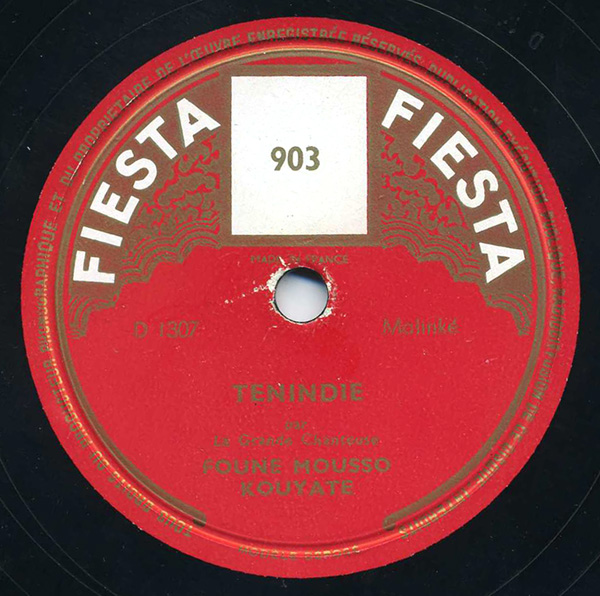
Foune Mousso Kouyate – Tenindie

I’ve got several more 78s from Europe already in the queue for future posts, so I thought I’d take a break and return to Africa. I hope this might interest listeners who discovered this blog via the fine Benn loxo and Matsuli Music sites.

The French, because of their large colonial presence in Africa, were also at the forefront of recording African folk music. Their reach may not have had the span of the Gramophone company in England (or the variety), nor did it – as far as I know – have the brilliance of a local ethnomusicologist behind it such as Gallotone with Hugh Tracey. But it was formidable. While it’s true that the Phillips label produced hundreds if not thousands of recordings up and down West Africa, there were numerous smaller French (and Belgian) labels recording classic examples of local music throughout the continent. Africa Vox, for one, specialized in raw, field recordings. Le Chant du Monde recorded African popular songs. Ngoma, Loningisa, and Opika recorded in the Congo. And then there was Fiesta, the label of today’s track. Fiesta appears to have been independently owned (and bears a suspicious label resemblance to the Congolese Opika label), and pressed in France. But it may not have been independent. I have no idea!

Regardless, Fiesta was a presence in both French West Africa and the Congo, where they also recorded. Ms. Kouyate, “Le Grande Chanteuse” as she is credited on the label, is unknown to us. She is accompanied by two bala (or balafon) players, and chimes. They were Malinké, which would most likely place the recording in Guinea, Mali, or Gambia.

Foune Mousso Kouyate – Tenindie

Technical Notes
Label: Fiesta
Issue Number: 903
Matrix Number: D-1307-1

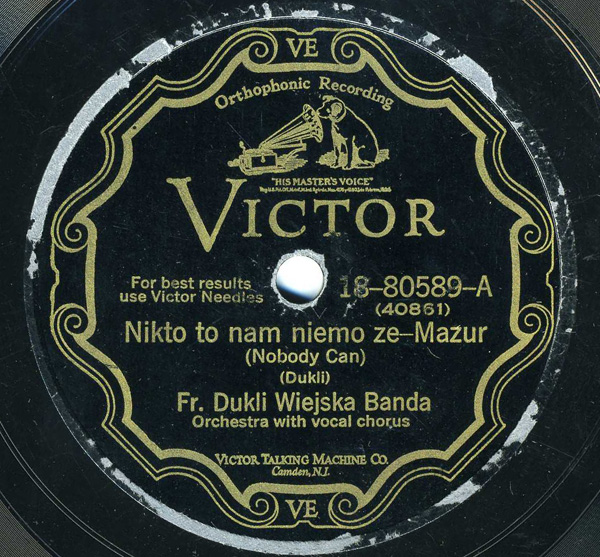
Franciszek Dukla Wiejska Banda – Nikto to nam niemo ze

frdukla.jpgMost of the best examples of Polish folkloric music of the early 20th century were recorded by Victor and Columbia Records in Chicago and New York City – not in Poland proper. By the mid-1920s, both companies were actively recording folk music by recent immigrants from across the globe, for sale in their adopted stateside communities. Sales of these records were miniscule compared to, say, a hit by Paul Whiteman and His Orchestra, which could sell up to a million copies. A good seller for a Polish record by Victor was probably one or two thousand, I’m guessing. But, that didn’t stop these companies from striving to develop emerging markets during this period, and recording costs were comparatively low. It’s staggering the variety, volume, and musical quality they captured.

This week, I really wanted to showcase a fine example of Polish wiejska, or “village music.” At first, I remastered a classic by the Makowska Orkiestra Działowego titled “Zbójcy W Karcmie” or, “Outlaws in the Road House.” But, I quickly realized that it had already been compiled on the excellent Arhoolie release Polish Village Music. Then, I decided to use Władyslaw Polak’s “Dzieci W Krateczki” or, “Children In Squares.” After which, I discovered that Polak’s tune was used on the compilation Stranded In the USA. I want to keep this blog strictly for 78s that have NOT been compiled anywhere since the shellac was released.

Then I remembered my records by the great violin player Franciszek Dukla and his group, who, with his band, was the very first to record Polish village music on 78 (and was frequently credited as “Fr. Dukli” as you can see by this release). This track, a mazurka, whose English title is “Nobody Can,” was recorded in Chicago on November 13, 1927.

Village music is exactly what it might sound like from its name – oldtime, Polish country music from the village. A typical village music band consists of a lead fiddle, two harmony fiddles, a bowed bass or cello, and a clarinet. In the great reference text Ethnic Recordings In America, Richard Spottswood interviews a Polish record store owner named Alvin Sajewski, who sold records in his family’s Chicago store throughout the 20s and long after. He also helped to locate, discover, and promote Polish musicians during that time. They discussed Dukla’s records:

Q: Frank Dukla’s music sounds older than other music that was on records at that point.

A: Well, yes, it was. After all, they were all old musicians, and they all played by ear. None of ’em played from music. Maybe some of them did, but they didn’t have arrangements or anything…Dukla had a kind of bass that really came out beautifully on [early electric phonographs].

Enjoy!

Franciszek Dukla Wiejska Banda – Nikto to nam niemo ze

Technical Notes
Label: Victor
Issue Number: 18-80589
Matrix Number: 40861

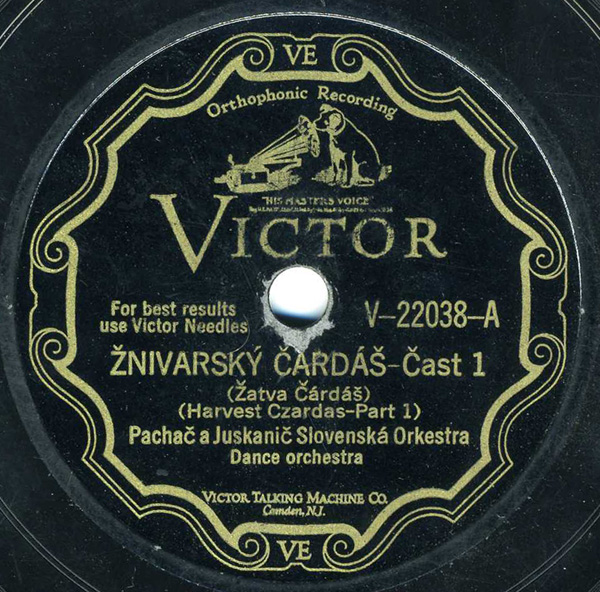
Pachač a Juskanič Slovenská Orkestra – Žnivarský Čardáš, Čast 1

pachac.jpgOkay, it’s back to the regular schedule for a while!

In the late 1920s, the Victor company decided to begin producing recordings of music geared specifically to Slovakian immigrants in the United States. It was a short-lived effort, yet it yielded some fascinating music, most of which was performed by a cache of immigrants (quite probably coal miners) from western Pennsylvania. I’ve heard other Slovenian/Slovakian 78s, but nothing matches the wild, almost primitive energy of these Victor recordings, which don’t turn up too often.

The Pachač a Juskanič Slovenská Orkestra recorded this, Part One of their “harvest” čardáš, on December 6, 1929, in New York – the same date they recorded the bulk of their entire output (the group would later record a few more releases in that dark year for the American recording industry, 1932). The čardáš is a closed-circle folk dance in 2/4 time which originated in Hungary, but has close gypsy connections according to Richard Spottswood, in the notes to his excellent CD Slovak Csardas: Dance Tunes from the Pennsylvania Coal Mines. In his opinion, the Slovakian music on Victor from this period may be a peek into what music from the area may have sounded like in the nineteenth century.

There are several tracks by the Pachač a Juskanič Slovenská Orkestra on Mr. Spottswood’s CD, but this track remains unreleased. Listen close for the whistling!

Pachač a Juskanič Slovenská Orkestra – Žnivarský Čardáš, Čast 1

Technical Notes
Label: Victor
Issue Number: V-22038
Matrix Number: n/a

Urbano A. Zafra – Danza Filipina

urbano1.jpgAn early post this week – I will be busy through the 10th.

This track, a steel guitar solo by Mr. Zafra accompanied by Mauro Baradi on a standard acoustic guitar, puts me in the strange position of not exactly knowing how to react when listening to it. It sounds awkward enough to be the first time the musicians have played the number…or, that could be my own cultural ignorance and the piece is meant to slowly lumber along. Probably the latter, as the flip side is a more standard, uptempo folk melody. Either way, I’ve always liked this, and have never found anything quite like it. Being from the Philippines, you can definitely hear the influence of 300 years of Spanish colonial rule.

This was released on Columbia’s “X” (for “export”) series, and recorded in November of 1929, in New York City.

Urbano A. Zafra – Danza Filipina

Technical Notes
Label: Columbia
Issue Number: 3910-X
Matrix Number: 111286

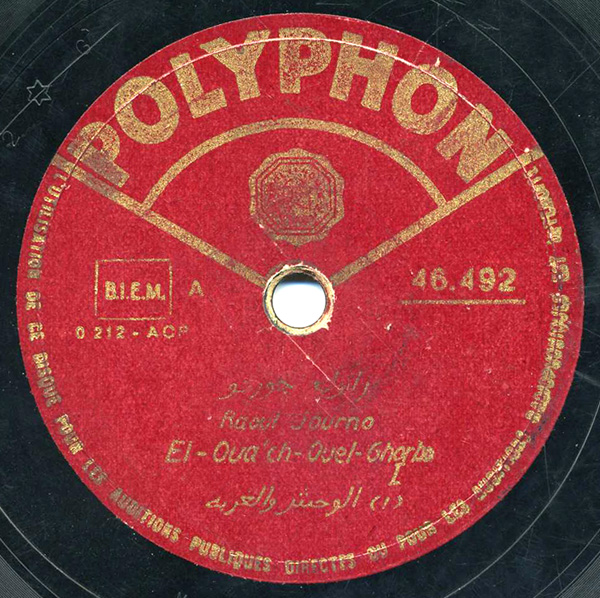
Raoul Journo – El-Oua’che-Ouel-Ghorba

raoul.jpgWhen I first received this record, I thought, “Gee, could a record possibly be in worse condition?” I had purchased it for a cheap price knowing that it was heavily battered, which is pretty uncommon for me. I don’t often want to go down that road of buying records that are destroyed simply because they are rare. Not really my style. It has less to do with feeling high and mighty, and more about conserving space! However, this was Raoul Journo, perhaps the greatest male Tunisian singer ever, so I made an exception.

It paid off in a way. Yes, this record is heavily worn, but it doesn’t sound nearly as bad as it looks, with its wasteland of grey grooves, thousands of scratches, its myriad of “digs.” Like everything else I offer on this blog, it has never been made available in any format as far as I know (although I’m betting he re-recorded it later in his long career). And, again – did I mention that this is Raoul Journo we’re talking about? In short: my apologies for the sound, but I thought it was worth it in this case. These are not common.

Journo (1911-2001) was a Jewish Tunisian singer, and I believe this stems from one of his earliest sessions, in 1935 for the Polydor company. He’s accompanied by percussion, violin, and oud – plus, there’s a nice qanún solo in the introduction.

Also – I included BOTH sides of the record this time (Parts 1 and 2).

For more of his work, try the Secret Museum’s fantastic North African compilation. This outfit offers some later releases, as does this one. And here’s another site of interest.

Raoul Journo – El-Oua’che-Ouel-Ghorba

Technical Notes
Label: Polyphon
Issue Number: 46.402
Matrix: 0212-ACP/0213-ACP

Rizeli Sadık – Erkek Kadın Oyun Havası

sadik.jpgOk. Here’s a doozy. Really, this is one of my absolute favorite, favorite 78s of all time.

You want hyperbole? You’ve got it. I’m casting aside all restraint on this one, and probably my critical faculties. This is one of the most entertaining instrumental soloists I’ve ever heard. Sadık must have been from the region around the Black Sea, because his kemençe technique, well, rocks. He’s like the Jimi Hendrix of the instrument, which is a 3-stringed fiddle, held upright. It sounds like he’s taunting the competition when he plays.

I’m not positive when this recording was made, perhaps between the late 30s and mid-40s, on the Turkish HMV imprint, Sahibinin Sesi. I have been lucky to find a second Sadık 78 on Turkish Columbia. And as long as we’re in the nerdy, provenance-related paragraph, I should mention another, extra-special reason I enjoy this 78 so much: the surface of this record looks like garbage, yet it sounds beautiful! Hats off to the Turkish pressing. I really hope you enjoy this. For more, here’s a great video of a present-day kemençe master.

Rizeli Sadık – Erkek Kadın Oyun Havası

Technical Notes
Label: Sahibinin Sesi (Turkish HMV)
Issue Number: AX. 2023
Matrix Number: OTB 593

Kunai-sho gakubu – Koromogo-e

japan.jpgWhile I do have some examples of Japanese instrumental folk music 78s, I thought this might be unique to post: an example of gagaku, or the traditional court music of Japan, recorded in the late 1920s or so.

First off, I have to send heaps of thanks to Steve and Sari at Airform Archives and inbetweennoise.com, as well as Rika Hiro, for going far beyond the call of duty for translations and meanings. Without their help and information, I’d be more or less clueless. So, this entry was co-produced!

Gagaku is truly an ancient form of music, dating as far back as 700 CE, when it was employed by the Imperial court. There are numerous styles and variants of gaguku, and the one being played here is an example of saibara. I don’t think I could explain the song type better than my friends, who wrote:

Sai-bara is a kind of gagaku song that is grew out of the folk songs of horsemen….basically the folk song of someone who owns a horse and sort of used the horse like a taxi cab (holding the reins while the rich person rode on the horse, because the rider is above the horse person in class)…[saibara] was eventually, during the 700’s, influenced by gagaku or entered the canon of gagaku and became more of a proper song.

The players listed, Kunai-sho gakubu, are the Music Department of the Ministry of Imperial Household. And the song title, Koromogo-e, roughly translates to “exchange of clothes,” in the sense that changing of clothes means the changing of seasons. And in the sense that in ancient Japan, this phrasing was a another way of suggesting the union of a man and woman.

Kunai-sho gakubu – Koromoga-e

Technical Notes
Label: Victor
Issue Number: 13024
Matrix Number: 273

Lidya Mendoza – Olvidarte Jamás

lidya-mw.jpgThere’s precious little that can compare with the unmistakable voice and guitarra doble of Lidya Mendoza, also known as “La Alondra de la Frontera,” or “The Lark of the Border.”

Lidya (commonly known as “Lydia”) was born in 1916 and began singing with her family in the Plaza del Zacate of San Antonio at a young age. In 1928, the Mendoza Family recorded 10 sides for the Okeh label. However, in the early 1930s, she signed a 10 year contract with the Victor subsidiary Bluebird, and recorded hundreds of tejano classics.

This canción, uncompiled as far as I know, was recorded on August 12th, 1935, in San Antonio’s Texas Hotel. The title translates to “I Will Not Forget You.” Her 78s can be found, but most often in one condition: trashed! They were well loved, and finding a decent copy of any early Mendoza is a good thing.

She is a legend, and there’s little else but hyperbole I can add to her biography. For more, go here. Or here. And if you’re interested in music, please go to the Arhoolie label and check out their fine Mendoza releases.

Lidya Mendoza – Olvidarte Jamás

As a recent reader noted, Lydia Mendoza passed away on December 20, 2007. The New York Times obit can be read here.

Technical Notes
Label: Montgomery Ward
Issue Number: M-4866
Matrix Number: B-2379A