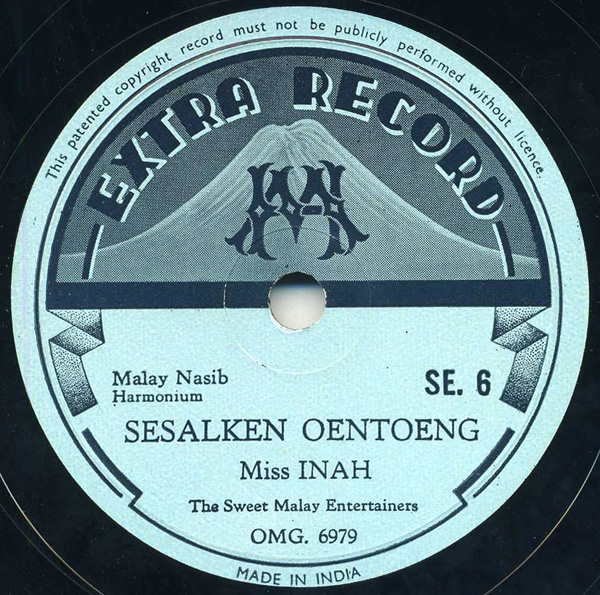
Miss Inah & The Sweet Malay Entertainers – Sesalken Oentoeng

Allow me to present to you to a type of music that has a special place in my heart: the Nasib, or “Song of Fate” from Indonesia and Malaysia…part of what once was the Dutch East Indies.

‘Nasib’ in Malay means ‘fate.’ The Nasib song is an aching, slow lament; a deeply melancholic popular song type which is built around the singer’s misfortune in life. On the surface, this description would make the Nasib similar to the fado, rebetika, or blues, but that would be a mischaraterization. The origins of the Nasib derive, in fact, from Indonesian/Malaysian stambul theater music. Stambul theater (also referred to as bangsawan) developed in the late 19th century and was an urban affair, where theatrical groups would perform musical dramas, many with stories which had origins in India or the Middle East. Stambul songs were most popular from 1920-1935.

The Nasib is sung by a singer who is in fact playing – or at the very least channeling – a character or situation from these classical stories, rather than singing her own blues. Interestingly, much of the stambul music that I’ve heard from that era is quite cultured – operatic, even. However, the Nasibs, although derived from stambul, are a different thing altogether. The operatic aspect has gone out the window, and what we have here is swooning sadness – the Nasib adopted to a bar band setting!

Today’s Nasib features Miss Inah singing “Sesalken Oentoeng” (a Dutch transliteration of the Malay “Sesalkan Untung”), which more or less means “I Regret My Luck.” She is accompanied by her smooth yet lurching Malay Entertainers on harmonium (another Indian connection), saxophone, bass, and percussion.

And what about this tantalizingly obscure and beautifully designed label “Extra” – of which this appears to be the sixth release? From the wonderful choice of typefaces, the baby blue color, the looming image of a mountain (Mount Kerinci, the highest peak in Sumatra, most likely), and the overlapping letters H, M, and V, in a skeleton font – the whole label reeks of mystery!

It turns out that the Extra label was based in Palembang, Indonesia, in the south of Sumatra, and was in operation during the early 1940s, before the Japanese occupation. Right off the bat, this clues us in to the fact that the record, despite the band’s name being the Malay Entertainers, is most likely from Indonesia as opposed to Malaysia (the ethnic Malay group is found in both countries). How many records did Extra make? Collectors have traced only nine releases. There may be more, though I’m betting the number is low. It’s also unclear the relationship between Extra and HMV. The matrix numbers on this record (the numbers separate from the catalog numbers on the record, indicating masters and often takes) are clearly HMV matrix numbers. But, we do not know if these songs were also released by HMV, or if Extra was the sole entity releasing these tracks.

Extra records were pressed in India. Which brings us to another issue: why in the hell does this record, which is in absolutely mint condition, sound so rough?

There are a couple of reasons, familiar to collectors but perhaps not to anyone else. One, the record could have been pressed using a worn stamper. The early recording process yielded negative masters. From a negative master, a positive, metal-coated “mother” was created (these sound pristine). The metal mother was used to make a stamper – a negative version of the mother – and then your store-bought records were made from the stampers. When one stamper wore out, another stamper was made from the metal mother. Sometimes, however, companies let their stampers become wrecked before they replaced them. The result was, as you could imagine, a really crappy sounding record.

Another reason could be that there’s too much garbage in the shellac mix. Again, the bane of collectors, but bears ranting about even if you’re not ensconced in that kind of minutiae. So, those metal mothers I was talking about sounding pristine in the previous paragraph? Well, something else happens between the recording process and the resulting 78rpm record. Since 78rpm records were made to be played on acoustic, wind-up gramophone players, record companies were quite aware that the sharp steel needles used to play 78s wore down the records very quickly. So, they made better needles, right? Er, no. Instead, they added junk into their shellac mix – carborundum, cement, sand – which was supposed to wear down the gramophone needle as it moved through the grooves! This is the main reason why surface noise exists on clean 78s. When I look at this Extra record, I can actually SEE the junk in the shellac on the record’s surface. But, sometimes you gotta take what you can get!

Miss Inah & the Sweet Malay Entertainers – Sesalken Oentoeng

Technical Notes
Label: Extra Record
Issue Number: SE-6
Matrix Number: 0MG-6969-1

I am indebted to Philip Yampolsky for much of the information in this post. Mr. Yampolsky is a renowned expert in the music of the region, and the person behind the staggering 20-volume Music of Indonesia series for Smithsonian Folkways.

Luna y Delgado – Sal A Tus Puertas

Over the next couple of weeks, I thought I’d revisit some music from regions I hadn’t been back to since the early days of the blog. With the spirit of Lydia Mendoza in mind, and after a recent viewing of Chulas Fronteras instigated by my friend Chimatli, I thought I’d spin some more early Tejano music from the Texas-Mexico border.

Alejandro Luna and Regino Delgado recorded several sides for Victor’s Depression-era, budget-conscious subsidiary label Bluebird in the mid-1930s, including this one, “Sal A Tus Puertas” (meaning “Come To Your Doors” – thanks, Dax). This particular track was recorded at the Texas Hotel in San Antonio on January 25th, 1935, and the duo accompany themselves on guitar and bajo sexto.

The Bluebird “ethnic” series began in about 1934 and lasted until 1939, totalling about 1400 records. The recording industry had been crushed by the Depression, but Victor, in large part due to their Bluebird subsidiary (which also released country, blues, jazz and pop), were able to ride out the difficult times. For example, in the late-teens, it was not uncommon for a 78rpm record to cost $1.00, or even $1.25. Very pricey, considering. Well, by the early 30s, with sales in the tank and record companies folding left and right, Bluebird records went on sale for 35 cents.

Finding Mexican or cajun records on the Bluebird ethnic series is possible, but it is quite difficult to find them in decent condition. Today’s track has some wear, but we embrace surface noise here at Excavated Shellac, though we try to soften it up just a little bit! Plus, it’s an enjoyable piece of music that has not yet been compiled or written about…

Luna y Delgado – Sal A Tus Puertas

Technical Notes
Label: Bluebird
Issue Number: B-2317
Matrix number: n/a

Zainab Palvanova – Ofarin

Welcome to Excavated Shellac.

I feel like I have to say that every once in a while, both for anyone new who may have found themselves here, and for myself, to keep my motivation going. Excavated Shellac has been online for 18 months now, and I have shared a total of 81 different records. I still think it remains a unique spot – on the web, at least. I could conceivably do this for a long time, though I have no idea how long I will continue – just as I have no idea how long I will continue the collecting, the scheming, the acquiring, the hunting for these pieces of music that make me happy. I’ve been away for the past few weeks, so I wanted to say thank you to those who continue to stop by and listen, and for allowing me to indulge.

With that, we’re off to Uzbekistan, after World War II. Before 1917 and the Russian Revolution, quite a bit of recording was made in the Caucasus region and Central Asia, as European record companies were interested (somewhat amazingly) in exploring new markets in places like Tashkent and Tbilisi. Few original copies of those very early recordings have turned up (for a sample, I would recommend the Topic CD Before the Revolution). And, according to much of what I’ve been reading, very little recording was made in Central Asian regions between 1917 and the Second World War. However, in the early 1950s, the Russian label CCCP recorded “ethnic” folk music on 78 from the Caucasus to Central Asia and beyond. Some was imported into the United States even, with English translations on the label, presumably for immigrant communities or sold in Russian record stores. Still, even those are quite difficult to find today.

Zainab Palvanova’s piece, sung in Uzbek, is translated as “Glory” and she is accompanied by a “folk instruments orchestra” led by Y. Radzhabov. The folk instruments I can detect are at least one long-necked lute (probably a tar or dutar), the nay flute, at least one fiddle, and the unmistakable sound of the doira frame drum. It’s from ca. 1955.

Zainab Palvanova – Ofarin

For music from the CCCP label during this period, the Secret Museum’s Central Asia CD is heartily recommended.

Technical Notes
Label: CCCP
Issue Number: 24932 (a)
Matrix Number: 24932/4-1

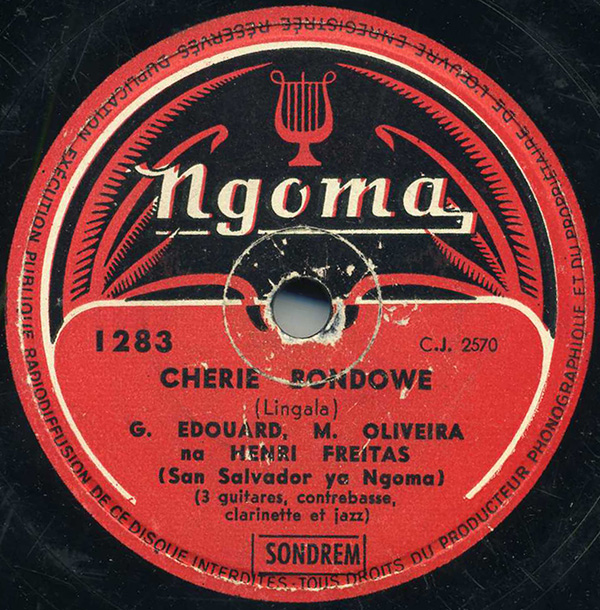
Edouard, Oliveira, Freitas, and San Salvador – Chérie Bondowe

Back to the Congo and the incredible Ngoma label. In fact, this week we are returning to the same important Congolese artists who appeared in my June 7, 2007 post. However, this time they are accompanied by their band San Salvador, named by Manuel D’Oliveira after his birth place in Angola. This track, an outstanding example of Congolese pop from the early 1950s, features three guitars, a beautifully captured upright bass, some subtle percussion, and not a clarinet as the label states, but a phenomenal solo on the Solovox keyboard. This is a good one.

Ngoma, as mentioned in my previous post, was one of the first independent labels to start producing records out of Léopoldville (now Kinshasa), and was run by two Greek brothers: Nikos and Alexandros Jéronimidis. They recorded their first records in the late 1940s on acetates, which were then shipped to Belgium for duplication, and shipped back to Léopoldville for sale. However, Belgium proved too expensive for duplication because of import taxes, so the brothers eventually bought a tape machine for use in Congo, and a record pressing factory outside of Paris. By the late-50s, they had recorded some 2000 records, and had moved into the production of 45s. As far as I can tell, they were sold in Congo and Cameroon, with perhaps some distribution in West Africa and elsewhere (?). The original Ngoma master tapes were destroyed in a fire in 1963, and apparently the only complete collection of file copies of Ngoma releases was destroyed during internal strife in 1989.

Before you African music aficionados jump up, I will admit that I’m doing something a little different here. This track originally appeared on the now out-of-print CD, Ngoma, The Early Years, 1948-1960. Although a terrific CD in its own right (with great notes by Dr. Wolfgang Bender and others), many of the tracks on that CD, including this one, were culled from less-than-perfect sources (i.e.: often muffled tape copies of original vinyl EPs, as opposed to original 78rpm copies). This song is also IN print on a Buda Musique CD titled Musique Populaire Africaine. While my copy of this record is not stone perfect, I believe this mix is a marked improvement on both the existing CD versions (give ’em a try, you’ll see) so if you are familiar with either of them, I think you will be happy.

Edouard, Oliveira, Freitas, and San Salvador – Cherie Bondowe

Technical Notes
Label: Ngoma
Issue Number: 1283
Matrix Number: J 2569

Professor Dwaram Venkataswami Naidu – Thanam-Kalyani

Back to India so soon? Yes, I’ve focused on the music of India several times over the past 17 months on Excavated Shellac, but haven’t until now posted an example of a Indian soloist in the South Indian, Carnatic classical tradition.

The partially blind violinist Dwaram Venkataswami Naidu was born in 1893 in Bangalore, and rose to fame as a professor of music at the Maharajah’s College in Vizianagaram, the first college in India established to promote music. In 1936, he had become the principal of the school and by 1938 was giving solo, improvisatory concerts. He died in 1964.

Naidu’s technique is renowned. Much has been written about him and how he fits into the history of Carnatic music, but certain words crop up often when discussing his technique: “simple,” “deceptively simple” and even “minimal.” He was known to be a listener of Western and Hindustani music, and would imbue his solos with occasional flourishes from outside influences – without disturbing his own music’s tradition. This was one of the very first Indian records I’ve ever owned, found in a heap at the bottom of an apartment complex I lived in around 1993, in New York City. While I am by no means an expert, this record made me appreciate Carnatic soloing, and Indian classical music in general.

This piece is a “thanam” (or taanam), an improvisatory section of the Kalyani raga. I believe it was recorded sometime in the 1940s or so. There is a subtle, uncredited accompanist on the veena.

Professor Dwaram Venkataswami Naidu – Thanam-Kalyani

News: by the end of the month, I will be adding catalog and matrix numbers (the numbers/letters that are stamped or etched into the “dead wax”) for each record, at the end of each post (including old posts). While this is of zero interest to most people and can be ignored, these numbers can be very helpful to pinpoint dates and recording locations by historians and collectors, and can help flesh out some of the info on Excavated Shellac.

And next week, we will return to Africa with a beautiful piece of music. It will be a limited download, so get ready…all will be revealed…

Technical Notes
Label: HMV
Issue Number: N.8970
Matrix Number: OMC. 11839-1

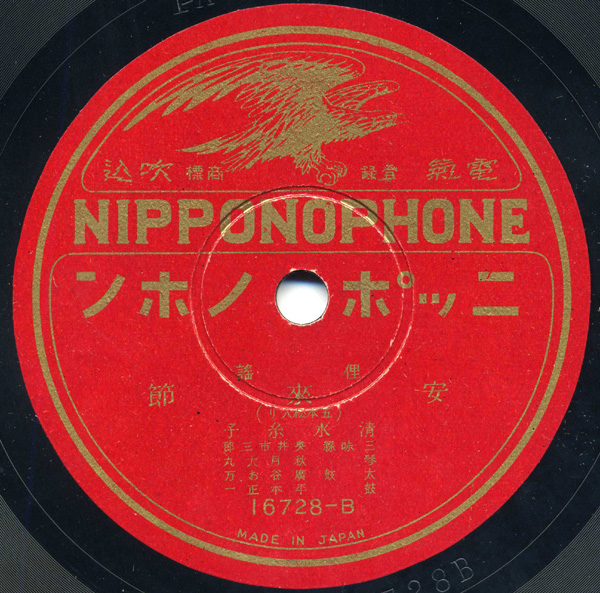
Shimizu Itoko – Yasugi Bushi

Today, we’ll go back to Japan, around the early 1920s. Still very much in the acoustic recording era before electric microphones, this is a classic example of min’yō, the generic name for Japanese folk music, passed down locally through oral tradition. Min’yō, however, is a late 19th century term used as an umbrella for a variety of folk music: traditional work songs, dance songs, and the like. Interestingly, it is a direct transliteration of the German volkslied.

Usually most min’yō song titles start with a place name, as does this one: Yasugi, a town in the Shimane prefecture on Honshū island. Yasugi Bushi simply means “song from Yasugi” in English. It became popular in the early 20th century, especially when accompanied by a dance of the same name, which imitated the movement of scooping down to catch loach fish. It is sometimes known as the “loach catching song.”

The beautifully expressive Shimizu Itoko is the singer of the piece, and she is accompanied by Okui Ichisaburou on shamisen, Akizuki Daimaru on the koto, Hirotani Omann on the taiko drum, and Hiramoto Shoichi on the tsuzumi drum. You’ll also hear some of the traditional pitched exclamations throughout the song, known as kakegoe.

Shimizu Ikoto – Yasugi Bushi

Many thanks to Makoto and Lena Watanabe for translation assistance.

Technical Notes
Label: Nipponophone
Issue Number: 16728
Matrix Number: same, with 1-A-1

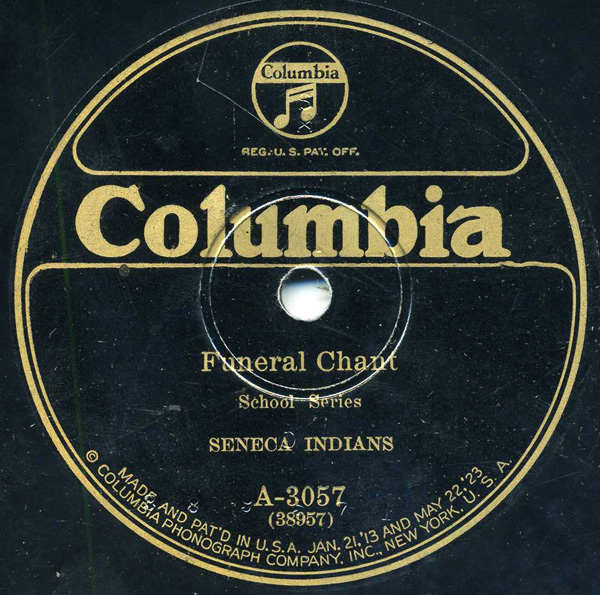
Seneca Indians – Funeral Chant & Children’s Chorus

These two tracks of authentic music by Seneca American Indians were recorded 95 years ago, on July 23rd, 1913. Columbia must have kept it in the catalog for some time, as my copy is a pressing from the mid-1920s for their “Children’s Series,” which must have been a 1920s marketing tool for Columbia to regenerate interest in some of their older titles under a new umbrella. “Funeral Chant” is sung unaccompanied, while the “Children’s Chorus” is accompanied by tom-tom. The Seneca recorded another track that day, though it was never released. All we know is the title, scribbled down by an engineer in a Columbia ledger: “Farewell to Minne-ha-ha.”

Documentation indicates that this track was recorded in New York. Was it recorded in New York City proper? It looks like it. I scoured New York City papers from that time period and there was no definitive mention of Seneca Indians in town for an event in the summer of ’13. However, in May of 1913, there was an announcement in the New York Times of a production of “Hiawatha” performed from June 9 to July 5th of that year by the “Indian Players from the Government reservation on Lake Erie” on a theatre on an estate in the Bronx, with the whole event being sponsored by the Women’s Municipal League. The “government reservation” referred to in the article is almost certainly Cattaraugus, a Seneca reservation on the lake established in 1784 – and most probably these are the same Seneca Indians who made this recording.

Seneca Indians – Funeral Chant
Seneca Indians – Children’s Chorus

I will be away for the next three weekends, detoxing from the city and hopefully spending most of my time in a contemplative state. However, Excavated Shellac will continue on schedule! So, keep checking back. We aim to please.

Technical Notes
Label: Columbia
Issue Number: A-3057
Matrix Number: 38957 (1-D-2), 38958 (1C-2)

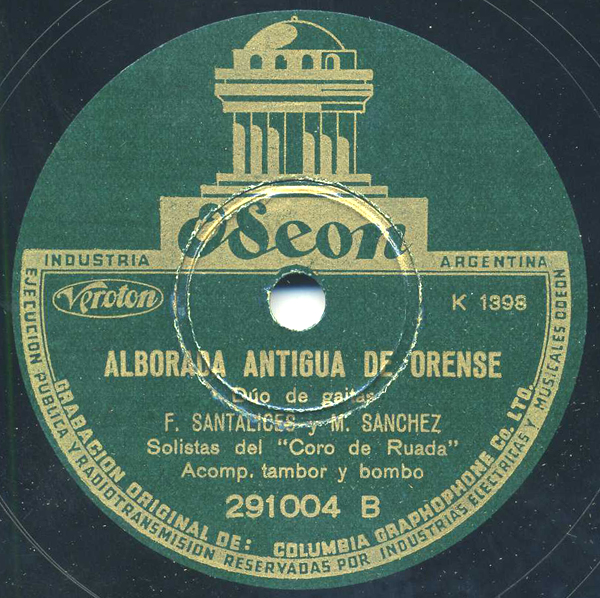
Faustino Santalices & Modesto Sanchéz – Muñeira de Rubiás

I’m fascinated by the early regional music of Spain. The variety of songs and musical styles found in one country, even a country with many autonomous communities, is quite amazing. I’ve previously posted music from País Vasco (Basque Country), Asturias, and of course, the most well known folk music of Spain, flamenco from Andalucía. And while the music from all of these regions can be captivating, that’s only the tip of the iceberg when it comes to Spain. There’s cobla music from Catalonia, the jota from Aragon, fiddle music from Mallorca, dulzaina music from Valencia, unbelievable unaccompanied shouts from the mountainous region of Cantabria, not to mention the distinct music of Navarro, Extremadura, the Canary Islands…on and on. We’re lucky it was captured on 78s, though finding much beyond hot selling flamenco records of the 40s can be a dogged struggle. It’s music that, unless we lived in these regions in the first three decades of the 20th century, you and I were not meant to hear.

Today: the wonderful sounds of the gaita galega, the bagpipe of Galicia in northwest Spain. Faustino Santalices (1877-1960) was a legendary master of both the zanfona (the hurdy gurdy in Spain) as well as the gaita, though his recorded output was quite limited. Here he is joined by Modesto Sanchéz in a gaita duet stemming from 1929. They are accompanied by the tambor (snare drum) and bombo (bass drum). It seems from the description that Santalices and Sanchéz were both performing in Galicia’s Coral de Ruada at the time (also known as the Coro de Ruada). Coral de Ruada’s historical recordings have been released on a relatively hard-to-find issue by the Ouvirmos label here – they are well worth checking out, though I can’t vouch for the CD quality. They still exist today, too!

A different take of this song, from the same 1929 sessions (originally released on the Regal label), was released on a Santalices CD several years ago on the Boa label, titled Gravacions Historicas De Zanfona 1927-1949. Boa claimed it was the definitive collection of Santalices’ work, though thanks to Félix Castro and Tony Klein, who contributed comments and compared my version and Boa’s (see the comments section), we know this track is either a new discovery, or one that was simply unknown at the time of the CD’s production, and therefore left out. What made matters more confusing, was that the record label was in fact a botch, and the song titles were mislabeled on either side. Either way, I hope it is new to you.

Faustino Santalices & Modesto Sanchéz – Muñeira de Rubiás

Technical Notes

Label: Odeon

Issue Number: 291004

Matrix Number: WK 1398 (A8685A)

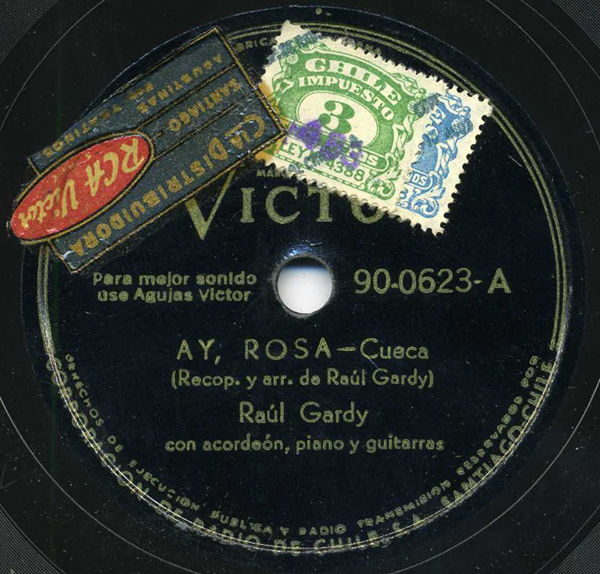
Raúl Gardy – Ay, Rosa

You wouldn’t get very far exploring traditional Chilean music without running into the cueca. An important symbol of national identity, the cueca’s origins are cloudy (African and Spanish influences are often cited), but the dance seems to have first appeared in the early 19th century, right around Chile’s independence. After having flourished for 200 years or so, in 1979, in the midst of Pinochet’s power over the country, it officially became the national dance. (It is also, interestingly, Bolivia’s national dance.) Despite his attempts however, Pinochet did not succeed in keeping cueca solely as a patriotic symbol. It remains something far more than that, and continues to thrive in Chilean immigrant communities across the world, as well as at home.

Usually in 6/8 time, in a major key and featuring guitars, the cueca (short for zamacueca) is a courtship dance for couples, where the man symbolically plays the rooster and the woman, the hen – both of whom dance with white handkerchiefs. Cuecas were frequently recorded in the 78rpm era though they don’t grow on trees – Odeon and South America’s arm of the RCA Victor label probably recorded in the region the most. Raul Gardy’s cueca is joyful, and he is accompanied by guitars, piano, accordion, and spoons.

Raúl Gary – Ay, Rosa

For more Gardy, you could check out the CD releases Nostalgias de Chile, or Chile Tipico Vol. 3 and Vol. 4. I can’t vouch for the sound quality, but they’re out there.

There is also Jan Sverre Knudson’s article “Dancing Cueca “With Your Coat On.”

I also recommend this interesting 15-minute documentary on a gentleman trying to recapture cueca’s working-class and traditional roots. Lots of history and dancing therein.

Technical Notes
Label: RCA Victor (Chile)
Issue Number: 90-0623
Matrix Number: n/a

Set Badria Anwar – Rah Wilfy

In the late 1920s, musicians from across Iraq were being recorded by a variety of companies: Baidaphon of Beirut, Polyphon of Germany, and HMV of England being the Big Three. As usual in those nascent markets, all were competing against each other for shelf space in the shops that sold gramophone records.

I chose an early piece from Iraq this week because of the appearance of a terrific Honest Jons release culled from original copies at the EMI Hayes Archive titled Give Me Love: Songs of the Brokenhearted – Baghdad, 1925-1929. Two lovely songs by Badria Anwar are included on Give Me Love, but today’s post is another of her long lost recordings, from ca. 1928-1929 or so. “Rah Wilfy” translates roughly to “My Lover Is Gone.” She is accompanied by oud, kanun, violin, and percussion. (Thanks to the Pictures Clerk for translation!)

Set Badria Anwar – Rah Wilfy

While I generally refrain from deep ruminations on this website, I thought I’d just write about Give Me Love as well as some thoughts on current reissues of historic recordings. Nobody asked me, of course, but these issues actually mean a lot to me. (In hindsight, I see I may have gotten long-winded, but what the hell…)

First, I think Give Me Love is an important collection. There has not been, until now, any serious survey of Iraqi historical recordings released – certainly not one with such a wide variety of styles. Musically, it is superb in my opinion – the taksims are amazing, the songs beautiful, from Kurdish melodies to Iraqi Jewish songs. I’ve little to say in that arena, as I was simply very impressed with the selection. Because of Honest Jons’ access to the Hayes Archive they were able to use untouched file copies of these exceptionally rare recordings, or perhaps even the metal masters, for their transfers. (For those who are wondering, 78rpm masters have shockingly less surface noise than the final product, the mass-produced gramophone record copy of the master, which often contained loads of garbage, or filler, along with the shellac – Paramount Records used sand and cement in their mix, for instance, making virtually all of their records sound like crap.)

That does not happen often. Very few companies exist which still have accessible masters or clean file copies of their original 78s, much less are willing to work with a small label for a release. EMI and Hayes are the major exception. And, the transfers are alive: I’ve listened to Give Me Love a few times now and although I (and my ears) waver a bit on this thought – and I may change my mind still again – I have come to believe that we are finally getting to a point where, taking into account a number of factors, the majority of surface noise can be removed from a 78rpm recording to the actual BENEFIT of the recording itself. There are far too many CDs of historic international folk music (not to mention historic anything) which have been hampered by overzealous noise reduction in their transfers. Of course, on the flip side, some of these recordings are so rare (I’ve seen around 4 Iraqi records in the past 5 years, say), you have to take what you can get sometimes. In other words, I’d probably buy this if it was dubbed from an old Certron cassette tape. (And as if it even needs to be said, I clearly am in no way a professional engineer – I just do the best I can with what I present on Excavated Shellac. Better the stuff is out there than not, is my opinion. Just wanted to get that out of the way.)

On Give Me Love, it sounds like the musicians are next to you. Well, next to you in mono. As I mentioned, achieving this sonic quality depends on a host of important factors: condition of the original record, turntable, tonearm, a wide variety of specialized diamond cut needles of various sizes, analog noise reduction equipment, digital noise reduction equipment, equalization equipment and methods, and the most important factor, a finely tuned ear. It is expensive, time consuming, and surely a monetary loss in the short term. But, I think Honest Jons got it right. And that’s good for both music fans, and scholars of this music.

Another thing Honest Jons got right is the design. Because I still prefer the tactile sensation of an LP (a DJ at heart), I purchased their double-LP issue of Give Me Love. Graphically it is beautifully done – and the design is current. While this may seem secondary to many, I believe the presentation of historical music is absolutely vital to its survival. These releases cannot and should not appeal only to the converted, the record collectors, the ethnomusicologists. They have to break through to new audiences, new listeners, people willing to take a chance. Releases like this, if they are to continue, absolutely must at the very least attempt to appeal to younger generations by methods of marketing, distribution, sale, and especially presentation. If not, the consequence is that the releases, the listeners, and by proxy the music, will become even more elitist, more rarified, more segregated – precisely what shouldn’t happen. This doesn’t mean dumbing down these releases, it just means an overhaul. The design of Give Me Love is, well, pretty damn attractive. It makes one feel that this is an important record, filled with mysterious lost music that is different than what one has experienced.

With all that said, I’m not above some critique. While comparatively minor, I had a few related problems with Give Me Love – in particular, problems with the notes which accompany the LP.

Despite its savvy design, Give Me Love presents itself, rightly I think, as a historical document, and includes a short essay on the backstory behind these recording sessions, with information on some of the artists and quotes from correspondence between HMV employees in Iraq and the home office. Why is it then that there is no detailed recording information (dates, specifically) for any of the tracks? This information could be extremely helpful to those wishing to study further, it would be very brief in terms of space to annotate, and would almost certainly be accessible in the Hayes Archive, as HMV kept scrupulously detailed recording ledgers. Since Honest Jons had full access and permission from EMI, why not list the original record catalog numbers, too? I realize that including this information may go against the whole “reaching out to new audiences” idea I just mentioned (in other words, it might be useless to most consumers), but I think not including it and still attempting to be a historical document is disingenuous. This is new territory they’re working with, and why not go for broke – those adventurous enough to purchase the record may appreciate that detail somehow. Plus, it firmly places these works in a specific place, at a specific time.

The rest of my complaints are niggling and petty and I fear I’ve gone on too far as it is. If you’ve read this far, I appreciate your interest…the most important part of this post is of course way up above: the music.

Technical Notes
Label: HMV
Coupling Number: AX 568
Face Number: 7-213737
Matrix Number: BX4397